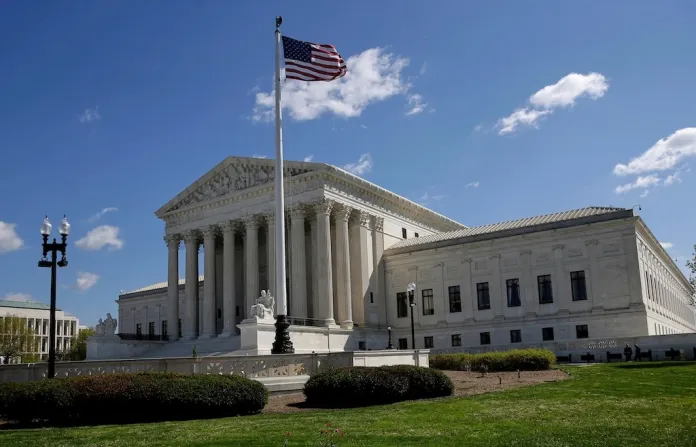
Supreme Court tosses racial redistricting rulings in Mississippi and North Dakota
the U.S. Supreme Court rejected federal court decisions in two cases involving racial redistricting claims under Section 2 of the Voting Rights Act-one in Mississippi and one in North Dakota. In separate orders, the justices sent both cases back to the lower courts to decide what should happen next in light of their recent landmark ruling in *Louisiana v. Callais*.
In Mississippi, a federal court had struck down several state legislative districts becuase it found the maps unlawfully diluted Black voters’ ability to elect preferred representatives. In North Dakota, another federal court found the state’s map unlawfully diluted Native American voters’ ability to elect their preferred representatives.
The Court’s *Callais* decision raised the evidentiary bar for section 2 racial gerrymandering claims, emphasizing proof of intentional racial gerrymandering rather than incidental impacts-while allowing partisan gerrymandering. Justice Ketanji Brown Jackson dissented in both Mississippi and North Dakota, arguing the Court should not vacate because the unanswered issue was whether private parties can bring these Section 2 lawsuits-a question she said *Callais* did not address.
These actions are part of a broader wave of supreme Court orders as *Callais*,which have prompted states to redraw maps during mid-decade redistricting with greater latitude regarding racial outcomes.
The Supreme Court tossed out federal court rulings in Mississippi and North Dakota on Monday over racial redistricting claims under Section 2 of the Voting Rights Act, weeks after the high court issued a landmark decision changing the standard for such legal challenges.
The justices issued the pair of summary dispositions in an orders list, ordering the respective federal district courts where the cases originated to decide on the next steps for both cases with the high court’s recent ruling in Louisiana v. Callais. Justice Ketanji Brown Jackson dissented from the unsigned majority in both cases.
Recommended Stories
In the Mississippi case, the U.S. District Court for the Southern District of Mississippi struck down two state Senate districts and one state House district as violations of Section 2 of the Voting Rights Act, finding that they unlawfully diluted black people’s ability to elect their representatives of choice. In the North Dakota case, the U.S. District Court for the District of North Dakota found that the state’s legislative district map unlawfully diluted Native Americans’ ability to elect their representatives of choice, in violation of Section 2 of the Voting Rights Act.
The Supreme Court’s ruling in Callais last month significantly raised the bar for bringing Voting Rights Act lawsuits over alleged racial gerrymandering, requiring clear proof of intentional racial gerrymandering, rather than the incidental splitting of racial groups into different districts, while pursuing partisan gerrymandering, which is lawful.
In both cases, the justices were asked to decide whether private parties could bring lawsuits alleging violations of the Voting Rights Act, something the district courts allowed in both cases. Jackson argued in her dissent that that particular issue still needed to be addressed by the high court.
“This case presents only the question of Section 2’s private enforceability, which our decision in Louisiana v. Callais did not address,” Jackson wrote in both of her brief dissents. “Thus I see no basis for vacating the lower court’s judgment.”
SUPREME COURT DENIES DEMOCRATS’ BID TO REVIVE VIRGINIA GERRYMANDER
The Supreme Court’s decision to toss out rulings in the Mississippi and North Dakota cases is the latest order set off by the justices’ 6-3 decision in Callais last month. Earlier this month, the high court quickly tossed a VRA ruling against Alabama’s congressional map that had mandated the state have two black-majority districts.
The high court’s ruling in Callais, along with subsequent orders such as in Alabama, have touched off a new round of mid-decade redistricting, as states have significantly more freedom to redraw their congressional and state legislative maps without prioritizing racial outcomes.
" Conservative News Daily does not always share or support the views and opinions expressed here; they are just those of the writer."
*As an Amazon Associate I earn from qualifying purchases