One year later, ripple effects of Roe reversal still felt.
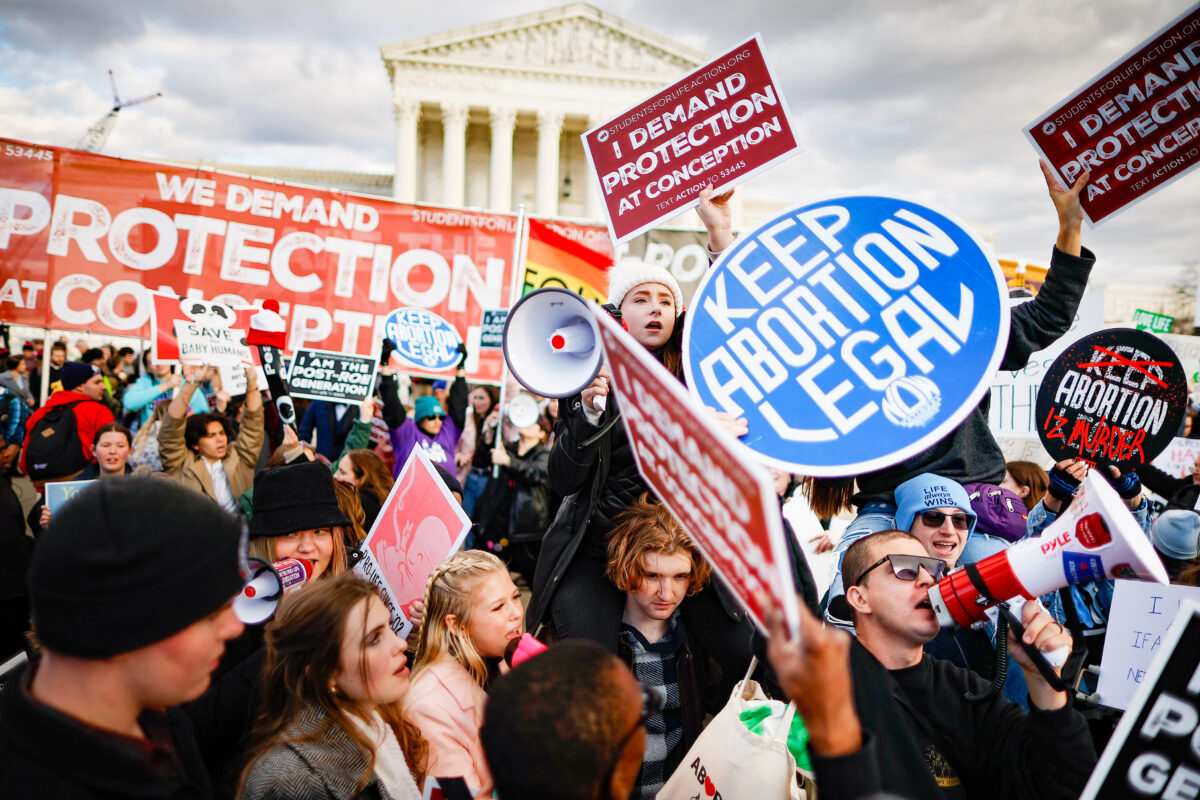
Throngs of demonstrators carrying signs and bullhorns gathered outside the U.S. Supreme Court building on a Friday morning. A tangible tension mingled with the chants in the air.
The date was June 24, 2022, and they were moments away from witnessing history—they all but knew it.
Just weeks before, a leaked draft opinion of the high court’s Dobbs v. Jackson Women’s Health Organization ruling had rocked the nation. A half-century of judicial precedent was about to be struck down, and with it, the legal right to abortion.
As the final opinion came down, the crowd erupted into shouts of joy and anger, their highest hopes and worst fears confirmed: Roe v. Wade was no more, and the states would now decide the fate of abortion in America.
Now, one year later, that fate is still very much in question.
Shifting Landscape
In the wake of the court’s decision, the move to enact new abortion legislation around the country was swift. As left-leaning states feverishly rushed to codify protections for women seeking abortions, more conservative states moved to tighten restrictions on the procedure at varying stages of pregnancy.
Meanwhile, in some states, abortion laws that pre-dated Roe were instantly triggered by the ruling’s reversal. In Wisconsin, an 1849 ban on all abortions in the state—save those involving risk to the mother’s life—took effect. That law has since been challenged in court.
In Arizona, the state’s Court of Appeals ruled that a similar ban dating back to 1864 can coexist with a 2022 law that allows abortions through 15 weeks of pregnancy. The more recent law, the court held, should simply be viewed as an exception to the earlier ban. That ruling has been appealed to the Arizona Supreme Court.
Additional lawsuits in other states have left the legal parameters of abortion in limbo.
For instance, in Florida, a six-week abortion limit Gov. Ron DeSantis signed in April cannot take effect until the state’s Supreme Court rules on an embattled 15-week restriction lawmakers passed last year.
Similarly, South Carolina’s six-week limit has been temporarily blocked pending a review from the state’s Supreme Court.
The Fallout
In the wake of the court’s decision, the move to enact new abortion legislation around the country was swift. As left-leaning states feverishly rushed to codify protections for women seeking abortions, more conservative states moved to tighten restrictions on the procedure at varying stages of pregnancy.
Meanwhile, in some states, abortion laws that pre-dated Roe were instantly triggered by the ruling’s reversal. In Wisconsin, an 1849 ban on all abortions in the state—save those involving risk to the mother’s life—took effect. That law has since been challenged in court.
In Arizona, the state’s Court of Appeals ruled that a similar ban dating back to 1864 can coexist with a 2022 law that allows abortions through 15 weeks of pregnancy. The more recent law, the court held, should simply be viewed as an exception to the earlier ban. That ruling has been appealed to the Arizona Supreme Court.
Additional lawsuits in other states have left the legal parameters of abortion in limbo.
For instance, in Florida, a six-week abortion limit Gov. Ron DeSantis signed in April cannot take effect until the state’s Supreme Court rules on an embattled 15-week restriction lawmakers passed last year.
Similarly, South Carolina’s six-week limit has been temporarily blocked pending a review from the state’s Supreme Court.
The Fallout
With so much uncertainty surrounding the legality of abortion in several states, Senate Democrats described the current landscape as a “dystopian reality” for women.
“One year ago, Americans lost a constitutional right for the first time in history and Republicans ripped it away,” said Sen. Patty Murray (D-Wash.) at a June 21 press conference at the Capitol. “Since that Dobbs decision, 14 states have passed a total ban on abortion, another six states have severely limited abortion services, and nine other states have had their abortion bans blocked in court.”
Murray added that the consequences of the court’s decision had been “devastating” for those who considered abortion to be a woman’s “fundamental right.”
“Women are heartbroken,” she said. “They’re terrified. But they are also mad, and they are determined, and they are speaking out, and so are Senate Democrats.”
Later that day, Murray led an effort to push through four bills aimed at expanding protections for women seeking abortions and reproductive health services via unanimous consent—a move that was ultimately blocked by Republicans.
But abortion advocates are not the only people expressing concern over the ramifications of Dobbs.
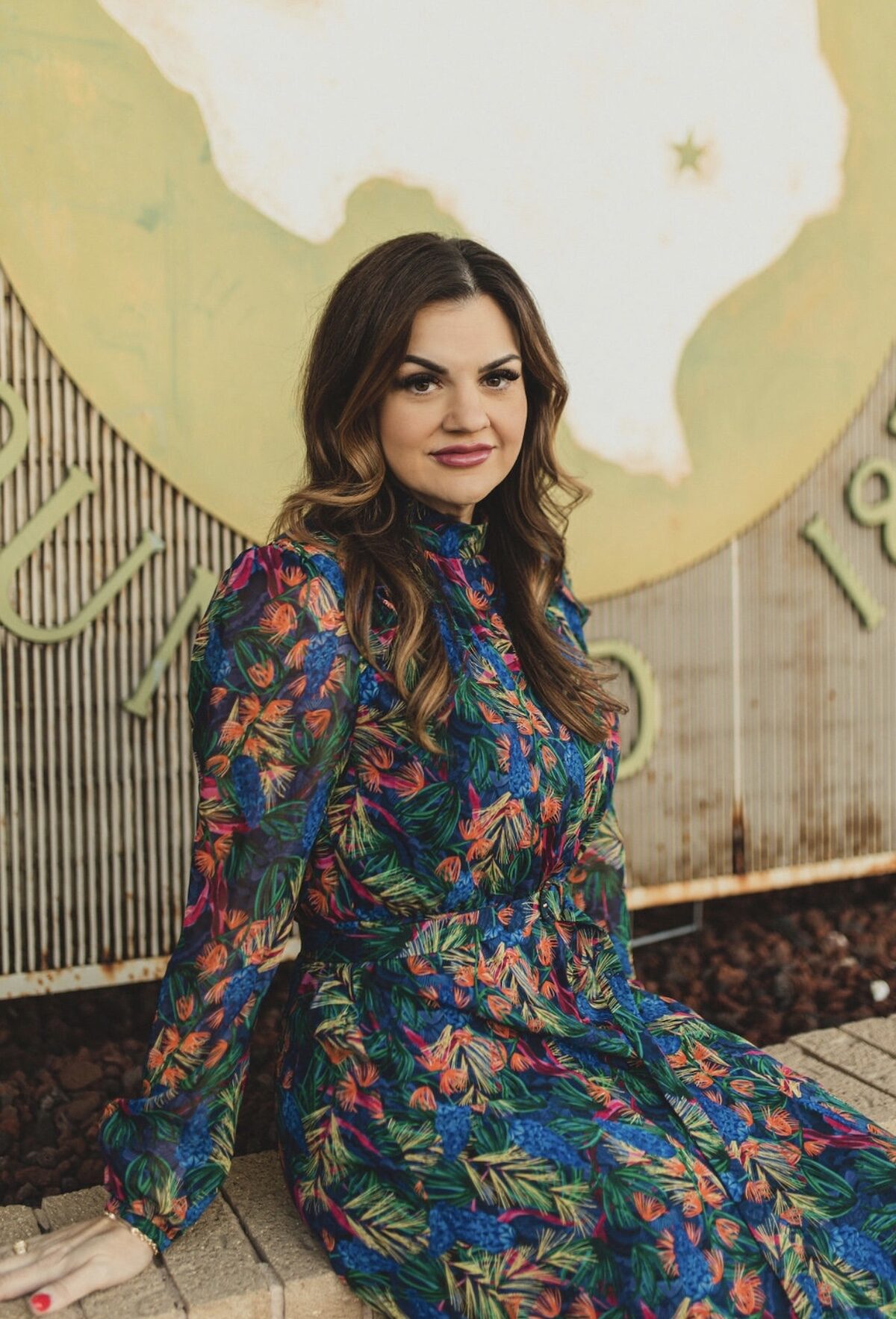
For those who oppose abortion, the overturn of Roe has largely been considered a win. But according to pro-life advocate Abby Johnson, the ruling has had its drawbacks for the pro-life movement as well.
“After Roe was overturned, there was a fear that people who weren’t as involved in the pro-life movement were going to kind of throw up their hands and say, ‘Great. OK, now we don’t have to worry about abortion anymore.’ And unfortunately, it seems like that has been the case,” Johnson told The Epoch Times.
She noted that, in recent months, there has been a marked decline in volunteerism and donations to pro-life organizations, yet the fight for life has, if anything, only gotten harder.
“In a way, we’ve made the landscape a little more difficult for ourselves because, now, instead of just one battle, we have 51 battles, if you include D.C.,” she said.
And those battles aren’t only legislative.
According to a list (pdf) compiled by the conservative Family Research Council, 106 attacks on churches and pro-life organizations occurred between the May 2022 leak of the Dobbs decision and May 19, 2023. An additional 24 incidents of vandalism and harassment targeting pro-life individuals have also been reported.
Johnson, once a Planned Parenthood clinic director, now helps clinic workers to leave the abortion industry as the CEO and founder of the nonprofit And Then There Were None. And even though her staff works remotely, she noted that the organization has been forced to take extra precautions following recent threats to her safety.
“Since all this has happened, I have more security when I go out than I did before,” she disclosed. Her organization has also taken measures to protect the identities of staff members.
Even so, after years of speaking out against abortion, Johnson said she had found such risks to be “par for the course.”
“Violence begets violence. And they are for violence against the most vulnerable people among us.”
By the Numbers
A decrease in the number of abortions performed in the United States over the last year may also be a result of the Dobbs ruling.
A recent analysis (pdf) of abortion data conducted by the pro-abortion Society of Family Planning found that more than 25,000 fewer abortions were performed in the country from July 2022 to March 2023 than were expected.
That organization held that the reduction meant “grave consequences” for women unable to obtain abortions, “including increased economic insecurity, poorer physical health, and continued exposure to violence from the man involved in the pregnancy.”
But E.V. Osment, Susan B. Anthony Pro-Life America’s vice president of communications, shared a different perspective.
“What we have known all along is the majority of women want to keep their children,” Osment said. “They’re just hoping and looking for a way to do that.”
Many women, she noted, feel pressured by their partners and
" Conservative News Daily does not always share or support the views and opinions expressed here; they are just those of the writer."
*As an Amazon Associate I earn from qualifying purchases