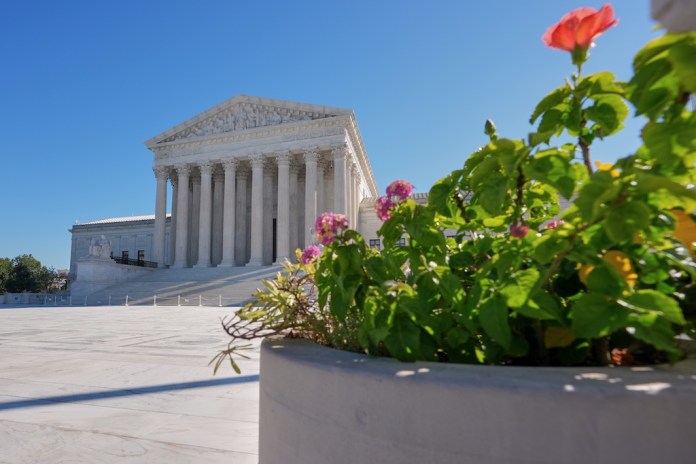
Why the Supreme Court is Immune from Attack by Democrats
The text argues that the United States’ founding shoudl be seen not just as a festivity, but as a carefully designed effort to prevent tyranny. It explains that the original experiment under the Articles of Confederation failed because it left the government with power that was too weak, while also reflecting the founders’ deep fear of concentrated authority.
It then describes why the Constitution took its final shape: choosing a republic over monarchy, oligarchy, or direct democracy, and solving the ancient risk of republics turning into dictatorships by building in separation of powers among the executive, legislature, and judiciary. The author also emphasizes the Bill of Rights and “comity” (restraint and legal respect in court matters) as key protections against government overreach.
The article further claims that American federalism-states largely viewing themselves as distinct entities-helped lock in decentralized power, making the constitutional system unusually robust. it portrays later political conflicts as attempts by Democrats (in the author’s view) to undermine or bypass the Constitution-such as by targeting courts, proposing court changes, or seeking to nullify state constitutional provisions-while insisting these efforts are blocked by legal limits and the independence of the courts.
it presents the Constitution as uniquely engineered to defend liberty and constrain political actors, especially during disputes over court authority and constitutional boundaries.
The 250th anniversary of America should be more than just fireworks and barbeques. It should be a time for reflection. And learning. And buckling up.
When they decided to form a country, the Founding Fathers’ foremost preoccupation was that it was not, and would not become, despotic.
At first, they created the Articles of Confederation and Perpetual Union, but that experiment fizzled. In their intense dislike of abuse of power, they had created a government with no power.
James Madison described it as “in fact nothing more than a treaty of amity of commerce and of alliance, between so many independent and sovereign states.” In fact, the states would at times impose an import tax on goods from other states, while others had enough friction with neighbors that armed conflict was considered.
The Dutch Republic, the Amphictyonic League, and the Swiss confederacy also had similar arrangements, with mixed outcomes.
So, they tried again. But what to create? In studying historical precedents, there were four types of government: monarchy, oligarchy, democracy, and republic.
The first three were anathema. A democracy was impractical considering the size of the nation. That left a republic. But republics had historically evolved into dictatorships. So how to prevent that outcome?
The answer was a separation of powers: the executive, the legislature, and the judiciary. On top of that, the legislature was further split up into the Senate and the House of Representatives — logically, the legislature setup should not work, but it does — each protective of its turf.
The result is the present Constitution, which is essentially a manual on how to run a country.
They were further aided by the fact that each colony, and later each state, considered itself a country in itself.
Some individuals were of the opinion that there was no point in continuing the Union now that the war for independence was over. Like many others, James Madison considered Virginia his country; he also considered America his country.
For more than a century, citizens would continue to have this schizoid outlook, simultaneously considering themselves to be both. There was absolutely no possibility of eliminating state sovereignty, though it was certainly curtailed.
Recently, on social media, several Brits have remarked that each state is practically a country, with different concerns, laws, traditions, dialects, cuisine, and geography.
Many American states are bigger than European countries. After all, America spans half a continent.
Partly because of comity, and partly because of planning, the decentralization of political power became set in stone.
This was one of the things that has made the American Constitution truly unique. The other was the Bill of Rights, which is a protection against government overreach.
The Supreme Court has rigidly upheld the Bill of Rights and the principle of comity in legal matters not pertaining to the Constitution — such as how many persons can be on a jury.
The Constitution was engineered to protect the public from people like Democrats.
Incidentally, many Europeans were certain that the United States would follow precedent and either become a dictatorship, dissolve, or plunge into civil war. In 1861, they were proven right.
This multimodal center of power was a stumbling block for the leftists after their 2020 coup d’etat. Although most states were cowed into submission, Texas, Arizona, and Florida eventually fought back when hordes of illegal aliens were brought into the country by the Biden Politburo.
The numerous attempts at censorship in state universities were also thwarted by a handful of scholars and students who still had backbones. Numerous conservatives were judicially attacked, as were individuals who defended themselves from crimes. Appeals away from leftist judges saved the victims.
Donald Trump was particularly targeted with a barrage of bogus lawfare, such as being prosecuted for borrowing money from a bank and paying it back with interest. They failed because he has a huge war chest and a titanium backbone.
Democrats’ hatred of the Supreme Court and the Constitution is well documented. Although they have placed leftist judges in courtrooms and even some state Supreme Courts, their primary target remains the U.S. Supreme Court. On numerous occasions, they’ve floated the idea of packing the Supreme Court with leftist judges who will nullify the Bill of Rights and sanction lawfare.
Recently, the Democrat Virginia legislature tried to nullify the state constitution regarding representation. Virginia’s Supreme Court nixed it, whereupon Democrats appealed to the U.S. Supreme Court, where they failed again.
As usual, they responded with hysterics, with one Democrat urging that the Virginia constitution be trashed. Others threatened Virginia’s Supreme Court with “reform,” proposing legislation to retire its judges. That idea was soon abandoned.
But the U.S. Supreme Court is immune from attack. On numerous occasions, Democrats have practically salivated over legislating additional seats to a presumed defenseless court.
But that would be Congressional overreach. The President cannot tell the members how to run Congress; Congress cannot tell the President how to run the White House; neither can they tell the Supreme Court how to run the Supreme Court.
Just like Congress can decide on its own rules, and the executive can decide on how it can act, short of a constitutional amendment, the Supreme Court can rule packing to be congressional overreach and, therefore, unconstitutional and, therefore, illegal.
The views expressed in this opinion article are those of their author and are not necessarily either d or endorsed by the owners of this website. If you are interested in contributing an Op-Ed to The Western Journal, you can learn about our submission guidelines and process here.
Advertise with The Western Journal and reach millions of highly engaged readers, while supporting our work. Advertise Today.
" Conservative News Daily does not always share or support the views and opinions expressed here; they are just those of the writer."
*As an Amazon Associate I earn from qualifying purchases