Vance: U.S. Aims To Fend Off ‘Nuclear Arms Race’ In Iran Talks
Vice President J.D. Vance said recent U.S.-iran talks focus on one core objective: preventing Iran from ever acquiring a nuclear weapon. He argued that if Iran obtained one, manny other countries in the Gulf and beyond woudl seek nuclear capabilities too, triggering the kind of “domino” proliferation and nuclear arms race U.S. nonproliferation policy has helped avert for decades.
Vance also acknowledged the negotiations remain tough and confusing, noting the U.S. cannot be sure whether Iran’s behavior reflects poor dialog or bad faith. He said the Trump administration has tried to be explicit about its “red lines” and what it will and won’t accept-especially that Iran must both abandon its nuclear weapons program and commit to preventing any future rebuilding of that capability.
At the same time, Vance could not confirm a deal is likely soon, emphasizing that proposals only matter onc they are finalized and signed. If talks fail, he said the U.S. would shift to “option B,” meaning restarting the military campaign to pressure Iran back to negotiations, even though he indicated this is not what either side wants.
Vice President J.D. Vance said Tuesday that talks with Iran hinge on the United States’ central aim of stopping Iran from ever obtaining a nuclear weapon and thus preventing an anticipated “domino” effect of nuclear proliferation across the region. The vice president said achieving the goal was necessary to ward off a “nuclear arms race.”
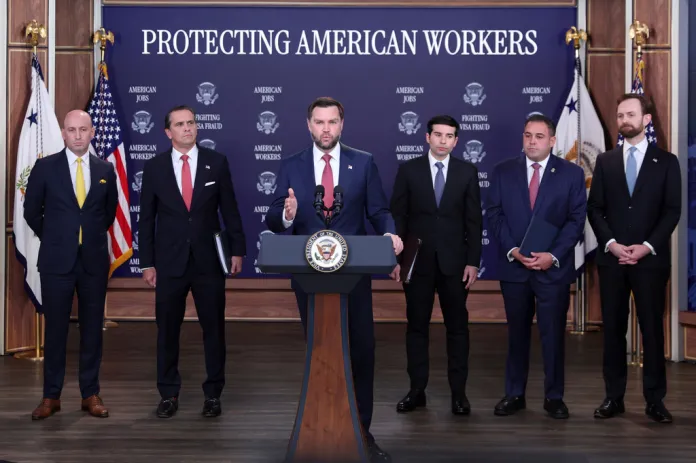
Barring Iranian access to nuclear weapons has always been among the stated goals of the Trump administration in prosecuting the war with Iran, but Vance’s comments at a White House press briefing shed some light on internal thinking through the negotiations, in a war that has otherwise often lacked clarity on objectives in terms of U.S. interests.
“It’s not just that Iran cannot have a nuclear weapon; it’s what would happen if the Iranians did get a nuclear weapon: We know that a lot of nations all across the Gulf would then want their own nuclear weapon, and then a lot of nations all across the world. And what has been a very effective bright spot of American foreign policy, really for the last 20 or so years, would disappear overnight,” Vance said, likely referencing U.S. policy advancing nuclear nonproliferation.
“If you have every country in the world scrambling to try to get a nuclear weapon, it would make us all much less safe, and Iran would really be the first domino, and what would set off a nuclear arms race all over the world. That’s very, very bad for the safety of our country.”
Negotiations with Iran have been rocky from the start, with the openness of the Strait of Hormuz in flux, deadlines being extended, setbacks, and on Monday, planned military strikes being called off by Trump amid negotiation developments.
Vance said that President Donald Trump has asked his team to “negotiate in good faith” with the Iranians, but that it is difficult to read the intentions of the Iranians, stating he was unsure of whether it is “sometimes bad communication [or] if that’s bad faith.”
“It’s sometimes hard to figure out exactly what it is that the Iranians want to accomplish out of the negotiation,” he said, acknowledging the rollercoaster of progress versus setbacks. The primary sticking point for the U.S. has always been Iran giving up its nuclear weapons program, and Vance said that in light of apparent confusion from Iran’s negotiators, all the U.S. can do is be clear about its position.
“What we’ve done is tried to be as clear as possible: What are our red lines? What are the things that we’re willing to be accommodating on, and what are the things that we absolutely must have?” he said. “As the President has said ad nauseam — and I think I’ve said it a lot too — Iran cannot have a nuclear weapon. We want to see not just the commitment to not have a nuclear weapon, but the commitment to work with us on a process to ensure that not just now, not just when Donald Trump is president, but years down the road, that the Iranians are not rebuilding that nuclear capability.”
But the negotiations still appear to be in limbo, as Vance could not confirm that a deal would be struck sooner rather than later. He said he did not necessarily trust that any proposal would be a final iteration until it is real and signed, stating, “I will not say with confidence that we’re going to reach a deal until we’re actually signing a negotiated settlement here.”
If the U.S. and Iran cannot agree to a deal, then “option B” comes into play, where the U.S. will “restart the military campaign” in order to push the Iranians more toward the negotiating table. Vance said that a reboot of military action is “not what the president wants, and I don’t think it’s what the Iranians want either.”
Breccan F. Thies is the White House correspondent for The Federalist. He is a co-recipient of the 2025 Dao Prize for Excellence in Investigative Journalism. As an investigative journalist, he previously covered education and culture issues for the Washington Examiner and Breitbart News. He holds a degree from the University of Virginia and is a 2022 Claremont Institute Publius Fellow. You can follow him on X: @BreccanFThies.
" Conservative News Daily does not always share or support the views and opinions expressed here; they are just those of the writer."
*As an Amazon Associate I earn from qualifying purchases