White House: Congress Must Institute Harsher Penalties For Fraud
Vice President J.D. Vance is actively leading efforts to combat trillions of dollars in taxpayer fraud, emphasizing the need for Congress to impose stricter penalties, enhance data sharing between federal and state agencies, and increase funding. Since establishing his anti-fraud task force, $230 billion has been identified in fraudulent activities, with $56 billion stopped before distribution. Challenges include limited transparency in welfare programs, particularly concerning the recipients of benefits like SNAP, which sometimes include illegal aliens or criminals without federal oversight. Experts highlight that improved data sharing, possibly aided by artificial intelligence, is crucial for detecting fraud more effectively. current penalties for welfare fraud are inadequate, frequently enough resulting in minimal or no prosecution, undermining deterrence and social trust. Proposed reforms include verifying providers before payments, implementing criminal background checks, requiring real-time immigration verification, better monitoring of welfare recipient data, and upgrading benefit cards for security. Lawmakers are also urged to scrutinize and expose fraudulent practices by state and local officials that enable abuse of the system, aiming to preserve program integrity and social trust.
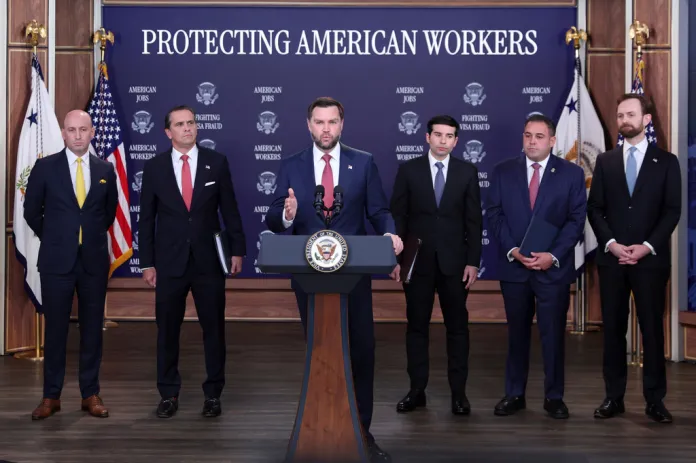
THE WHITE HOUSE — Vice President J.D. Vance has been leading the charge against billions in taxpayer fraud. But to mobilize the entire federal government in combating the theft, Vance said Wednesday, Congress needs to create harsher punishments for fraudsters and force states to share data for welfare recipients.
Vance hosted a roundtable with members of Congress at the White House midweek, attempting to hammer out plans for legislation to strengthen the executive branch’s ability to investigate fraud and expand prosecutors’ options to penalize Americans and illegals committing fraud.
Since the start of Vance’s anti-fraud task force, the group has uncovered $230 billion in fraud, with Vance noting the force was “conservatively estimating” the total, and stopped $56 billion in payments that were on their way to fraudsters.
Along the way, however, the task force has found some roadblocks to being able to uncover and stop even more fraud. Vance said there are three primary areas that need congressional approval to advance the mission: data sharing, stiffer legal punishments, and funding.
Among those goals, the “first and most important thing” is data sharing.
“One of the weirdest and most difficult parts of this is the black box that exists around certain state programs,” he said. Vance went on to add, “I think the American people would be shocked to learn — because I was certainly shocked when I learned it a few months ago — that when we send tax dollars to the states to administer the SNAP program, we have no visibility into who is ultimately getting those benefits. In other words, if the state of California gives those food stamp benefits to an illegal alien, to a violent criminal, the federal government has no visibility, and sometimes the states themselves have no visibility. So we need to work with Congress, and we need some legislation that would actually force some data sharing between the state governments and the federal governments.”
Andrew Ferguson, Federal Trade Commission chairman and vice chair of the anti-fraud task force, said that “data sharing should be a requirement” for taking part in federal programs, and noted that fraud is relatively easy to achieve in America because of the lack of data. “Data is the enemy of fraud,” he said, adding that artificial intelligence (AI) will play a huge role in tracking and flagging fraud cases.
The current punishments for committing welfare fraud are extremely lax, and sometimes nonexistent. Both Vance and White House Deputy Chief of Staff Stephen Miller said that most of the time, committing $1 million worth of fraud will go unprosecuted. They asked Congress to look into severe penalties, including for low-level fraud, both to properly punish fraudsters and to deter others.
“Every single person who considers raiding one of our agencies and taking money out of our pockets needs to think long and hard about what might happen to them if they are caught,” Ferguson said.
But Ferguson said it is even more important than just the money and the deterrence — it is about “restoring social trust in America.”
“All of the programs that the fraud effort has focused on were set up for a high trust society,” he said. He pointed out that “when Congress was creating these programs, some of them almost 100 years ago, we didn’t expect that these programs were going to be attacked by fraudsters to the tunes of billions and billions of dollars a year. We expected, because that’s the America that we were, that everyone would play by the rules, that the money turned over to help our friends, our families, neighbors would be made available only to the people who really needed it, and that is just not true anymore.”
On the money front, Vance said an enormous amount would not be needed, but streamlining anti-fraud initiatives across all executive agencies will likely take some form of specific appropriation. Vance also pointed out that congressional action will help bolster anti-fraud initiatives against potential counterefforts of future Democrat administrations.
Vince Haley, director of the Domestic Policy Council, came to Congress with 10 specific ideas to reform welfare and laws going after fraud:
- All government agencies must verify that every Medicaid provider or SNAP retail store is actually legitimate and eligible for payment before any payment is issued, rather than paying first and checking later.
- Require criminal background checks and fingerprinting for health care providers in categories with high rates of Medicaid fraud, and re-verify provider credentials at least every three years.
- Require states to verify every welfare applicant through the federal government’s free database system that verifies immigration status in real time before issuing any taxpayer-funded benefits.
- Require states to compare welfare rules every month against death records, wage records, and incarceration records.
- Double the number of welfare fraud investigators so that more fraud and corruption cases can be aggressively investigated and prosecuted.
- Upgrade welfare benefit cards used for food and cash assistance to have secure chip technology with a photo and expiration date.
- Prohibit high-risk retailers such as some liquor stores and smoke shops from accepting taxpayer-funded food stamp benefits.
- End the use of government-issued pre-populated forms to do automatic reenrollments into Medicaid.
- Eliminate so-called self-attestation, which allows applicants to simply report their own income and household information on welfare applications without providing documentation, and instead requiring proof of income and eligibility before benefits are approved.
- Require state taxpayer-funded Medicaid programs that issue payments to health insurance companies on behalf of people who had already died to stop immediately once the death is recorded and require those insurance companies to return any money collected after the enrolle’s death.
But Haley also said members of Congress must stigmatize the enabling of fraud, urging them to “call out as corruption the behavior of state and local leaders who refuse to enforce common sense fraud controls or purposely embrace loopholes that avoid individual eligibility validation, allow self-certification of eligibility, [and] expand eligibility far beyond what Congress intended,” thus “trap[ping] millions” into a “life of dependency.”
Breccan F. Thies is the White House correspondent for The Federalist. He is a co-recipient of the 2025 Dao Prize for Excellence in Investigative Journalism. As an investigative journalist, he previously covered education and culture issues for the Washington Examiner and Breitbart News. He holds a degree from the University of Virginia and is a 2022 Claremont Institute Publius Fellow. You can follow him on X: @BreccanFThies.
" Conservative News Daily does not always share or support the views and opinions expressed here; they are just those of the writer."
*As an Amazon Associate I earn from qualifying purchases