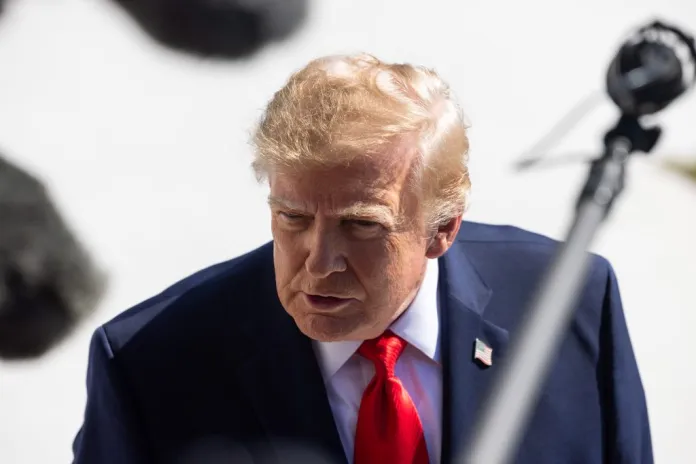
Trump Is Running Out Of Time To End Asylum Abuse For Good
The recent mass migration event at Ceuta, Spain’s enclave on the Moroccan coast, was driven by migrants seeking political asylum to gain permanent entrance into wealthy countries, highlighting the effectiveness of border policies that restrict asylum processing. Spain’s Supreme Court recently invalidated a policy similar to those used by the Trump administration, which expelled migrants without allowing asylum claims, and mandated that asylum applications be adjudicated before expulsion. This serves as a warning that U.S.efforts to curb migration through similar measures are legally fragile and reversible.
Under the trump administration, policies like the 2025 proclamation “Guaranteeing the States Protection Against Invasion” suspended asylum rights and expelled migrants en masse, effectively ending previous migration surges. Though, these policies can be reversed or challenged legally. A key proposed solution involves the U.S. withdrawing from the 1967 UN Refugee protocol, which obligates countries to process asylum claims based on persecution grounds rooted in race, religion, nationality, social group membership, or political opinion. This treaty, originally aimed at Cold War-era persecutions, has been exploited to grant asylum illegally, leading to a need for withdrawal and legislative reforms.
Legislative amendments are also crucial. These would restrict eligibility for asylum to those who have not traveled through safe third countries, require asylum claims to be made at ports of entry, specify that persecution must involve government actors, and cap annual asylum numbers based on pending cases. These measures aim to prevent abuse of the asylum system and avoid crises like Ceuta’s.
the U.S. must pursue legal and legislative strategies-such as treaty withdrawal and law reforms-to strengthen asylum integrity and prevent border crises similar to Ceuta’s, which pose broader security and immigration challenges.
The most powerful people-magnet on Earth was at the root of last week’s epic mass migration event that swamped Ceuta, Spain’s city enclave on the Moroccan coast: the perceived opportunity among poor laborers to lodge political-persecution asylum claims they know would allow their probable release into rich destination countries, pretty much forever.
Video footage shows hundreds of migrants crossing into Spain’s North African enclave of Ceuta on Thursday, with many entering on foot or by sea. pic.twitter.com/wJV1pKZjy5
— CBS News (@CBSNews) July 30, 2026
What just happened in Spain must serve as a seminal warning to the Trump administration that its admirable work to quiet the U.S. southern border — the same formula Ceuta used to deny migrants the globally coveted asylum claim process — is very far from complete.
Spain’s Supreme Court triggered the human torrent when it struck down a policy uncannily like Trump’s border policy. It promptly expels arriving migrants and denies all a chance to start the lengthy asylum claim process that leads to interior releases. The Spanish court required that Spain adjudicate asylum claims before expulsion.
Trump’s border expulsion and asylum-denial policies, which reduced crossings to historically low levels, are just as legally fragile and politically reversible. The administration can and must use Spain’s misfortune as a catalyst to permanently improve asylum integrity that will forever prevent an American Ceuta. But time to do so is short and dwindling.
The One-Two Punch
On Jan.20, 2025, Trump issued the presidential proclamation “Guaranteeing the States Protection Against Invasion.” It triggered U.S. Immigration and Nationality Act section 212(f) to suspend the right of illegal crossers to apply for asylum. That plus orders for Border Patrol and U.S. military personnel to catch and expel every arriving migrant abruptly ended the 2021-2024 mass migration crisis.
It’s all reversible by a court or a new president without the following two-punch combination. First, withdraw the United States from the United Nations treaty, the 1967 “Protocol relating to the Status of Refugees,” which extended to the United States a 1951 global obligation on which to model its current abused asylum law. Second, power-drive several legislative amendments to restore the intent of asylum protection before the next Congress takes office in January 2027.
Leave the UN Treaty
In 1967, President Lyndon B. Johnson signed the “Protocol Relating to the Status of Refugees,” which committed the United States to asylum-processing obligations of the 1951 “United Nations Convention Relating to the Status of Refugees.” President Harry S. Truman had refused to sign the 1951 treaty, but Johnson did via the 1967 Protocol, and the U.S. Senate ratified it.
Article 31 of the Convention obliged the United States to adopt as a human “right” the ability of migrants who can reach U.S. soil to claim asylum on five mainly government persecution grounds: race, religion, nationality, membership of a particular social group, or political opinion. Eventually, Congress passed the current version of America’s asylum law as the 1980 Refugee Act, which contains the asylum process provisions that millions have abused ever since to get released into the United States.
The treaty and law are obsolete, founded to offer sanctuary first to those fleeing Cold War-era communist government persecutions. The elements of who is a persecutor and what is membership in a particular social group have expanded and been abused for decades, watering down eligibility standards to grant asylum to more people.
With dramatic reductions in the costs of transportation and communication, the world’s ineligible poor discovered they could use asylum to win permanent stays inside the United States (as well as European signatories to the Convention). This became the immigration speedway for ineligible millions since the 1990s.
Permanently ending this cycle of abuse must start with withdrawing from the treaty. Withdrawal will set the stage for congressional legislative fixes to overcome the inevitable diplomatic pressures and litigation delays.
The treaty makes this pretty easy. Article 9 of the Protocol allows signatories to simply let the UN Secretary-General know of an intention to withdraw, which “shall take effect one year from the date on which it is received…”
Can a president withdraw from a treaty ratified by the U.S. Senate? There’s ample precedent. In 1979, President Carter withdrew from the Senate-ratified Mutual Defense Treaty between the United States and Taiwan. The move drew litigation, but the Supreme Court later ruled Carter was in bounds. In 2018, President Trump withdrew from the Intermediate-Range Nuclear Forces Treaty and from the Senate-ratified 1992 Open Skies Treaty in 2020.
Withdrawal, however, is the easier part.
Fix the Law
Pushing legislation to amend the 1980 Refugee Act through this deadlocked Congress is more difficult, but the administration must pursue the following codifications of its asylum integrity policies by the end of this year:
- State that any foreign national who has already secured protection in a third safe nation is ineligible to apply for U.S. asylum.
- State that any foreign national who has traveled through a safe third nation and did not request asylum is ineligible to apply for U.S. asylum.
- State that anyone who seeks asylum protection at our border must do so at a port of entry. They are ineligible to apply for asylum if they crossed illegally between ports of entry.
- Require that persecution be done by a government actor, not family members, gang members, etc.
- Remove the undefined and exploited catch-all persecution ground of “Membership of a Particular Social Group.” Stick to the objective grounds of race, religion, nationality, and political opinion.
- Cap the annual number of asylum applications, in combination with the annual number of refugee settlements and based on the number of pending asylum cases before the Department of Homeland Security.
- Remove the ability of a migrant in removal proceedings to apply for asylum and related withholding of removal and Convention Against Torture relief from removal.
Migrants have at least two opportunities to seek protection from persecution: before entering the United States (refugee protection) and after arrival (affirmative asylum) with U.S. Citizenship and Immigration Services. Convention Against Torture claims used to be considered by ICE and should return to that agency during consideration of a migrant’s removal country.
To achieve these legislative changes, President Trump will have to persistently push Congress, but doing so will save America from a Ceuta-like crisis that will be far bigger.
Todd Bensman is a Texas-based senior national security fellow for the Center for Immigration Studies, a Washington D.C.-based research institute, and a writing fellow for the Middle East Forum. His latest book is “Overrun: How Joe Biden Unleashed the Greatest Border Crisis in U.S. History” (Bombardier Books). For nearly a decade, Bensman led counterterrorism-related intelligence efforts for the Texas Department of Public Safety’s Intelligence and Counterterrorism Division. Follow him on Twitter @BensmanTodd.
" Conservative News Daily does not always share or support the views and opinions expressed here; they are just those of the writer."
*As an Amazon Associate I earn from qualifying purchases