The Federalist’s Guide To The 2026 Supreme Court Term
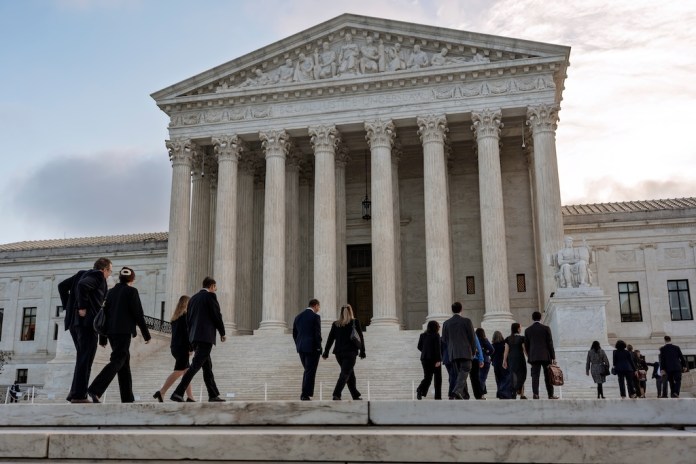
The upcoming 2026-2027 Supreme Court term features several high-profile cases covering a range of significant policy issues:
1. Suncor Energy Inc. v. County Commissioners of Boulder County involves climate change litigation where Colorado authorities sued fossil fuel companies over their contributions to climate-related damages. The Supreme Court will decide whether federal law preempts state-law climate claims.
2. Viramontes v. Cook County and Grant v. Higgins address Second Amendment challenges to bans on assault weapons. The Court will consider whether such bans violate constitutional rights, with oral arguments scheduled for fall 2026.
3. St. Mary Catholic Parish v. Roy concerns religious objections to Colorado’s preschool nondiscrimination law that conflicts with religious beliefs. The court will examine whether such laws infringe on religious rights and their interpretation under First Amendment doctrine.
4. International Partners for Ethical Care, Inc. v. Ferguson involves laws delaying parental notification for minors seeking gender-affirming treatment. The case questions parental rights and the constitutionality of related statutes, with the Court scheduled to hear arguments.
5. Wassily v. Blanche focuses on noncitizens with prior asylum status and their eligibility to adjust to lawful permanent resident status after their asylum is terminated. The Supreme Court will resolve circuit split on this issue.
6.Genalo v. Black involves a Dominican immigrant convicted of assault and detained pending deportation. The Court will review whether prolonged detention without a bond hearing violates due process rights.
7. Grand v. City of University Heights centers on the constitutional rights of a Jewish man seeking to host religious gatherings at his home and the city’s zoning restrictions. The Court will consider religious accommodation under First Amendment and land-use laws.
8. Republican National Committee v. Mi Familia Vota challenges Arizona laws requiring proof of citizenship for voting.The Court will decide if these election laws are consistent with federal statutes and previous decrees.
9. Montoya Palacios v. Liggins involves an immigrant challenging his detention and removal proceedings, seeking to clarify if his detention was unlawful and whether he can obtain attorney’s fees under the EAJA. The court will address issues of habeas corpus jurisdiction and due process.
10. kian v. Florida considers whether trying a serious criminal charge with a six-person jury, rather of twelve, violates defendants’ Sixth Amendment rights under the Constitution. The Court will examine jury size requirements for serious felonies.
These cases highlight ongoing debates over constitutional rights, federal and state law preemption, religious freedom, immigration, gun control, and election integrity. Oral arguments are scheduled for dates in late 2026, with final decisions expected thereafter.
Another summer has come and gone, which means that the U.S. Supreme Court is gearing up for yet another blockbuster term.
Like those before it, this year’s docket is piling up with cases touching on some of the biggest policy issues in American society. From religious liberty to parental rights, here is a breakdown of the biggest legal battles set to be argued before the high court during its 2026-2027 term.
Suncor Energy Inc. v. County Commissioners of Boulder County
This case dates back to early 2018, when the city of Boulder and Boulder County Commissioners sued three Suncor Energy businesses and the Exxon Mobil Corporation.
According to Justia, the Colorado officials alleged that these entities’ “fossil fuel activities contributed to climate change, causing harm to Boulder’s property and residents.” They furthermore “sought damages for public and private nuisance, trespass, unjust enrichment, and civil conspiracy, claiming that the [companies] knowingly contributed to climate change while misleading the public about its impacts.”
The oil companies’ repeated efforts to have the case moved from state to federal court were rejected by a federal district court and the 10th Circuit Court of Appeals. The Boulder County District Court also dismissed the companies’ request to dismiss the case, “rejecting their arguments that Boulder’s claims were preempted by federal law, including the Clean Air Act (CAA) and federal common law.”
The Colorado Supreme Court sided with the city and commissioners in May 2025. The Centennial State’s highest court ruled that Boulder’s claims were not preempted by federal law and permitted the lawsuit to move forward.
The energy giants petitioned the U.S. Supreme Court to take up the case in August 2025. They asked the justices to address the question of whether “federal law precludes state-law claims seeking relief for injuries allegedly caused by the effects of interstate and international greenhouse-gas emissions on the global climate.”
SCOTUS agreed to take up the matter in February 2026. In addition to considering the question presented by petitioners, the court will also determine whether it “has statutory and Article III jurisdiction to hear th[e] case.”
[READ:[READ:SCOTUS Takes Up Oil Companies’ Challenge To Colorado City’s Climate Lawfare]
Oral arguments are scheduled for Oct. 5, 2026.
Viramontes v. Cook County and Grant v. Higgins
Viramontes v. Cook County
This case’s origins can be traced back to 2021, when resident Cutberto Viramontes filed a lawsuit challenging Cook County, Illinois’ ban on the possession and transfer of AR-15s and similar semiautomatic firearms (so-called “assault weapons”). He argued that the prohibition violated his Second and 14th Amendment rights.
The U.S. District Court for the Northern District of Illinois sided with Cook County in spring 2024, with the 7th Circuit Court of Appeals following suit in June 2025. In doing so, the lower courts pointed to a 2023 7th Circuit ruling on a series of state and municipal laws banning “assault weapons” and large-capacity magazines that they said warranted dismissal of Viramontes’ challenge.
Viramontes filed a petition with SCOTUS in August 2025, in which he asked the justices to consider the question of whether the Second and 14th Amendments “guarantee the right to possess AR-15 platform and similar semiautomatic rifles.”
Grant v. Higgins
Dating back to June 2023, this case deals with a similar challenge to Connecticut’s “assault weapons” ban. Much like in Viramontes, the Grant plaintiffs alleged that the state’s restrictions on AR-15s and similar semiautomatic rifles unlawfully infringed on their Second Amendment rights. They also sought a preliminary injunction blocking the law’s enforcement.
The district court rejected this request in August 2023. As described by Justia, the lower court argued that plaintiffs did not show a likelihood of success on the merits of their Second Amendment claim and that they “failed to demonstrate that the regulated weapons and magazines were commonly used for self-defense.” The court further ruled that “the state’s restrictions were consistent with the nation’s historical tradition of regulating unusually dangerous weapons.”
Plaintiffs appealed the decision to the 2nd Circuit Court of Appeals, which affirmed the district court’s ruling in August 2025. In petitioning the Supreme Court several months later, they asked the justices to address whether the Second and 14th Amendments “guarantee the right to possess semiautomatic rifles that are in common use for lawful purposes, including the most popular rifle in the country, the AR-15.”
After months of consideration, the high court agreed to take up Viramontes and Grant consolidated in late June 2026 and answer the question presented in the former.
A date for oral arguments has not been announced.
[READ:[READ:Legal Specialists Preview Upcoming SCOTUS Cases On ‘Assault Weapons’ Bans]
St. Mary Catholic Parish v. Roy
This case’s origins can be traced back to 2020, when Colorado voters approved a ballot measure authorizing the establishment of a state-funded “universal” preschool program. The Colorado General Assembly subsequently codified the program into law, with participating preschools — both public and private — set to receive funding beginning in the 2023-2024 school year.
As part of the program, however, participating schools are required to sign a nondiscrimination agreement, which “mandates that preschools offer equal enrollment opportunities regardless of characteristics such as race, religious affiliation, sexual orientation, gender identity, income, or disability,” according to Justia. This prompted plaintiffs — two parents, two Catholic parishes, their preschools, and the Archdiocese of Denver — to challenge the mandate’s legality under the First Amendment. They argued that the requirement unlawfully infringes on their sincerely held religious beliefs — specifically those centered around sexual orientation and so-called “gender identity.”
The U.S. District Court for the District of Colorado largely ruled against the challengers in June 2024. Per Justia, the lower court rejected their First Amendment claims, denied their request that an injunction be issued blocking the requirement’s enforcement, and dismissed the archdiocese for lack of standing. The court did, however, bar Colorado from “enforcing the nondiscrimination requirement as to religious affiliation for as long as a congregation preference existed, a ruling not challenged on appeal.”
The plaintiffs suffered another loss upon appeal to the 10th Circuit Court of Appeals. In agreeing with the district court, the 10th Circuit ruled in September 2025 that the state’s requirement is a generally applicable law that “does not target religious status or use.” The appellate court further “rejected the plaintiffs’ expressive association claim” and “concluded that the requirement is rationally related to the legitimate government interest of ensuring equal access to preschool,” according to Justia.
With nowhere left to turn, St. Mary Catholic Parish and its co-plaintiffs petitioned the Supreme Court to consider their case in November 2025. In doing so, they asked the court to address three questions: “Whether proving a lack of general applicability under Employment Division v. Smith requires showing unfettered discretion or categorical exemptions for identical secular conduct;” “Whether Carson v. Makin displaces the rule of Employment Division v. Smith only when the government explicitly excludes religious people and institutions;” and “Whether Employment Division v. Smith should be overruled.”
As Federalist Editor-in-Chief Mollie Hemingway described in her bestselling book, Alito, the high court’s Smith ruling permitted Oregon “to deny unemployment benefits to a Native American worker who was fired for using peyote, a controlled substance, even though his use was for religious purposes.” Hemingway noted how the decision “represented a change in how the Court evaluated laws that incidentally impinge on someone’s exercise of his religion,” with the court effectively “holding that the First Amendment does not require religious exemptions from a ‘neutral general law of applicability.’”
The justices announced in April 2026 that they would take up the St. Mary case. They did not agree to address the third question of whether Smith should be overruled, however.
Oral arguments are scheduled for Nov. 3, 2026.
[READ:[READ:SCOTUS To Decide Whether Colorado’s ‘Universal’ Preschool Program Can Exclude Catholic Families]
International Partners for Ethical Care, Inc. v. Ferguson
This legal dispute traces back to 2023, when Washington state amended its laws governing parental notification for runaway children. As described by The Federalist Society, these changes “delay[ed] notification and reunification of a runaway child with his or her parents if that child claims to be receiving or requests” so-called “gender-affirming treatment” — aka “care” that promotes transgenderism.
According to Oyez, a group of parents whose children suffer from gender dysphoria filed a lawsuit challenging the laws not long after their enactment. They argued that the statutes “violated their constitutional rights to direct their children’s upbringing, refuse medical treatment on their children’s behalf, raise their children consistent with their religious faith, and speak freely on matters of gender.”
The district court dismissed the challenge in May 2024 over an alleged lack of standing to bring the suit. A panel for the 9th Circuit Court of Appeals subsequently upheld this verdict in July 2025 and later denied plaintiffs’ request to rehear the case en banc (a hearing by the full court) in December 2025.
The plaintiffs petitioned SCOTUS to take up their case the following month. They asked the justices to address, “Whether parents have standing to challenge a law or policy that deliberately displaces their decision-making role as to ‘gender transitions’ of their children, and in so doing creates present and likely future impediments to their ability to parent their children as they deem best for them.”
The Supreme Court agreed to hear the case for its next term in late June 2026.
A date for oral arguments has not been announced.
Wassily v. Blanche
This case deals with a pair of noncitizens who were granted asylum in America after arriving in the 1990s but later committed crimes. According to Justia, “one was convicted of stalking and child endangerment, the other of multiple driving while intoxicated offenses.” The federal government sought to revoke their asylum status on the grounds that their actions amounted to “particularly serious crimes,” and moved to deport them as a result.
While immigration judges initially affirmed these decisions, the noncitizens moved to change their status to lawful permanent resident (LPR). Following a drawn-out legal battle, the Board of Immigration Appeals ultimately upheld the government’s opposition to such changes.
The noncitizens then brought their cases to the 2nd Circuit Court of Appeals, which ruled in August 2025 that federal law “requires a noncitizen to have current asylum status to be eligible for adjustment to lawful permanent resident status,” as described by Justia. The court further “concluded that a past grant of asylum is insufficient if that status has since been terminated.”
The challengers petitioned SCOTUS to take up the case in January 2026. They asked the justices to address this question: “Whether noncitizens who were ‘granted asylum,’ but whose asylum was later terminated, are eligible for adjustment to LPR status under [the Immigration and Nationality Act’s] Section 1159(b) (as the Fifth Circuit held), or are categorically ineligible (as the Second and Fourth Circuits held)?”
The Supreme Court agreed to take up the case in late June 2026.
A date for oral arguments has not been announced.
Genalo v. Black
This case centers around Keisy G.M., a Dominican national who became a green card holder in 2011. After a physical altercation in New York the following year, G.M. ultimately plead guilty in 2015 to “second-degree assault and was sentenced to two years in prison and three years of supervised release,” according to Oyez.
U.S. immigration officials arrested G.M. in October 2020 and initiated proceedings to remove him from the country based on his 2015 conviction. Per SCOTUSblog, he was in custody for 21 months as the government aimed to deport him, and “was eventually released under an order issued by another court, but his challenge to his detention continued.”
The 2nd Circuit Court of Appeals sided with G.M. in 2024. The panel ruled that his detention “had become unreasonably prolonged” and that the “constitutional guarantee of due process precludes a noncitizen’s unreasonably prolonged detention under section 1226(c) [of the Immigration and Nationality Act] without a bond hearing.”
The Trump administration petitioned the Supreme Court to take up the case in January 2026. It asked the justices to address the question of whether “there is a point at which an alien’s detention under” the contested INA provision, “pending a decision on whether he is to be removed, becomes ‘unreasonably prolonged,’ such that due process requires a bond hearing.” It also asked the justices to answer “whether, if so, due process in such a bond hearing requires placing the burden on the government to justify the alien’s continued detention by clear and convincing evidence.”
While announcing in June 2026 that it will consider these questions, SCOTUS also said that it will address a question raised by G.M.’s legal team in their opposition to review. That is, whether G.M.’s case is moot since he was released in 2022.
Oral arguments are scheduled for Oct. 13, 2026.
[READ:[READ:Supreme Court To Hear Major Case On Trump Admin’s Detention Of Illegal Aliens]
Grand v. City of University Heights
This case began in early 2021, when Daniel Grand, an Orthodox Jew from University Heights, Ohio, sent an email to friends in the community inviting them to his residence for a minyan, a quorum of at least ten adult males, as required by his faith. As The Federalist previously reported, “That email was leaked to others in the town, who reported Grand to the city and asked them to ‘put a stop to this,’ according to Alliance Defending Freedom. The next day, Grand received a cease-and-desist letter from the city’s law director ordering him to shut down his illegal ‘place of religious assembly.’”
The city informed Grand that he would need to obtain a commercial special-use permit (SUP) in order to host a religious assembly. As described by Oyez, “Grand applied for an SUP, but the City unexpectedly converted the hearing to a ‘quasi-judicial’ format — apparently for the first time in city history — which locked the evidentiary record at the outset and blocked Grand from submitting additional materials.”
In light of such difficulties, Grand withdrew his application. The city’s mayor subsequently “issued a public pronouncement warning that any activities ‘consistent with’ those of a house of worship still required an SUP, that the City had previously sued and obtained a permanent injunction against another home-based Jewish prayer group, and that neighbors should report any suspicious activity at Grand’s address for enforcement.”
Grand then sued the city, alleging violations of his First Amendment and due process rights and the Religious Land Use and Institutionalized Persons Act.
The U.S. District Court for the Northern District of Ohio sided with the city in its September 2024 ruling. The lower court dismissed Grand’s claims for lack of ripeness, concluding that “there was no final decision by the relevant local authorities regarding the application of the zoning ordinance to his property,” according to Justia. It also dismissed other claims on the merits.
The 6th Circuit Court of Appeals later upheld that decision in November 2025.
This prompted Grand to petition the Supreme Court in February 2026. In doing so, he asked the justices to address, “Whether the First Amendment’s established chilling-effect doctrine — under which a credible government threat that deters the exercise of fundamental rights constitutes a complete and independently actionable constitutional injury — is displaced by[[Williamson Cty. Planning v. Hamilton Bank’s]land-use finality requirement when a plaintiff alleges that government threats both before and after a Planning Commission meeting chilled religious exercise, worship, and assembly.”
The high court granted Grand’s request to hear his case in June 2026.
A date for oral arguments has not been announced.
[READ:[READ:Ohio Man Had To Petition SCOTUS To Host In-Home Prayer Group]
Republican National Committee v. Mi Familia Vota
In 2022, Arizona enacted laws mandating that individuals provide documentary proof of citizenship (DPOC) when registering to vote via state registration forms. These statutes also required such proof for residents “submitting mail-in ballots and voting in presidential contests,” as The Federalist previously reported.
(In Arizona, individuals who do not provide DPOC when registering to vote are permitted to do so as “federal-only voters” and only cast ballots in federal elections).
[RELATED:[RELATED:Elon Musk Rightly Says Arizona Doesn’t Verify Federal Voter Citizenship — But The Feds Don’t Let Them]
This prompted Democrats and left-wing organizations to challenge the laws in federal court. They alleged that the statutes violated the NVRA, an existing consent decree, the 14th Amendment’s equal protection clause, and the Civil Rights Act. It was this point that the RNC intervened to defend the laws.
The U.S. District Court for the District of Arizona sided with the leftist challengers in spring 2024. According to Oyez, it “enjoin[ed] Arizona’s proof-of-citizenship requirement for state-form applicants (relying on the … consent decree) and [held] that the NVRA’s 90-day quiet period barred Arizona from systematically canceling noncitizen registrations within 90 days of a federal election.”
The GOP appellants filed a motion with the 9th Circuit Court of Appeals to partially stay (“pause”) the district court’s injunction ahead of the 2024 election on three issues: requiring DPOC on the state registration form, for voting by mail, and for voting in presidential contests. While a 9th Circuit motions panel partly granted the request (requiring DPOC for state registration forms), a merits panel for the appellate court quickly overturned that decision.
The Republicans then filed an emergency application with SCOTUS, in which they asked the justices to revoke the lower court injunction pertaining to the three aforementioned DPOC policies. Similar to the 9th Circuit motions panel, the high court partially granted that request (5-4) in August 2024 as to the requirement for showing DPOC when registering via state registration forms.
In a February 2025 ruling on the merits of the laws, the 9th Circuit affirmed the district court’s decision against Republicans. The appellate court subsequently declined to rehear the case en banc (a hearing by the full court) later that year.
The RNC formally petitioned the Supreme Court in February 2026. It asked the justices to answer two questions: First, does the NVRA “or a federal consent decree prohibit Arizona from requiring voter-registration applicants to produce ‘satisfactory evidence’ of U.S. citizenship when registering with a state registration form?” Second, does the NVRA prevent Arizona “from implementing a program within 90 days of a federal election to cancel the registrations of voters who are not U.S. citizens?”
The high court revealed in June 2026 that it would take up the case for its upcoming term.
A date for oral arguments has not been announced.
Montoya Palacios v. Liggins
This case centers around Kevin Isaac Montoya Palacios, a Salvadoran national who was apprehended and placed in removal proceedings in 2016 for illegally entering the United States. An immigration judge deemed Montoya Palacios removable as charged in 2023, but “simultaneously granted him protection barring his removal to El Salvador under the Convention Against Torture,” according to Oyez. He was subsequently released from custody and placed under federal supervision.
The Department of Homeland Security revoked Montoya Palacios’ order of supervision and took him into custody in December 2025. The government intended to deport him to Mexico — a “third country.”
This prompted Montoya Palacios to file a petition for a writ of habeas corpus days later challenging the legality of his detention. In doing so, he sought his immediate release and an award of attorney’s fees under the Equal Access to Justice Act (EAJA). As described by Bloomberg Law, the EAJA “allows certain civil litigants to seek attorney fees from the government if they win their cases.”
While the U.S. District Court for the District of Maryland granted Montoya Palacios’ request for release in January 2026 after finding his “continued detention” to be unlawful, it rejected his request for attorney’s fees under existing circuit court precedent. The 4th Circuit Court of Appeals later affirmed that decision in March.
Montoya Palacios petitioned SCOTUS in April 2026 and asked the justices to address the question of whether, under the EAJA, “‘any civil action’ encompasses an action seeking a writ of habeas corpus to challenge civil immigration detention.” The high court agreed in June 2026 to hear the case.
A date for oral arguments has not been announced.
Kian v. Florida
This case centers around Florida-based chiropractor Hamed Kian, who was charged by the state with five counts related to practicing with a suspended license. Practicing medicine on a suspended license is considered a serious felony offense under state law.
In Florida, all criminal cases are tried by a six-person jury, with the exception of capital cases (12-person jury). As such, Kian was tried and convicted by a six-person jury on all five counts, with the trial court sentencing him to a year and one day in prison, followed by several years of probation.
Kian argued that the state’s “trying him before a six-person jury” as opposed to a 12-person jury in a serious criminal case violated his Sixth Amendment rights. He subsequently appealed to the 4th District Court of Appeal of Florida, which affirmed his conviction and sentencing without a written opinion in October 2025.
Kian petitioned the Supreme Court directly to take up the case in January 2026. According to Oyez, “the Florida Supreme Court lacks jurisdiction to review district court decisions issued without a written opinion.”
The high court agreed to take the case in June 2026 and will decide the question of whether Kian was “deprived of his right, under the Sixth and 14th Amendments, to a trial by a 12-person jury when the defendant is charged with a serious felony.”
A date for oral arguments has not been announced.
Shawn Fleetwood is a staff writer for The Federalist and a graduate of the University of Mary Washington. He is a co-recipient of the 2025 Dao Prize for Excellence in Investigative Journalism. His work has been featured in numerous outlets, including RealClearPolitics and RealClearHealth. Follow him on Twitter @ShawnFleetwood
" Conservative News Daily does not always share or support the views and opinions expressed here; they are just those of the writer."
*As an Amazon Associate I earn from qualifying purchases