SCOTUS Agrees To Weigh Leftist Group’s Gambit To Acquire DOGE Records
In September, as Sen. Susan Collins, R-Maine, campaigned for reelection, the non-profit investigative journalism organization ProPublica published a story connecting her to a bribery scandal.
Details in a moment, but the first rule when you read ProPublica stories is to pay very close attention to their word choices, which tell you more about what the story isn’t saying than they do about what the story is saying. In this case, the FBI was “circling” Collins in a headline because ProPublica couldn’t say the FBI was investigating Collins. That’s because it wasn’t. If they could have said, for example, “The FBI Anti-Corruption Squad Was Investigating Susan Collins – Until Trump Stopped Them,” they would have. Notice when they don’t really say the thing that they mean to imply.
In September, as Sen. Susan Collins, R-Maine, campaigned for reelection, the non-profit investigative journalism organization ProPublica published a story connecting her to a bribery scandal.
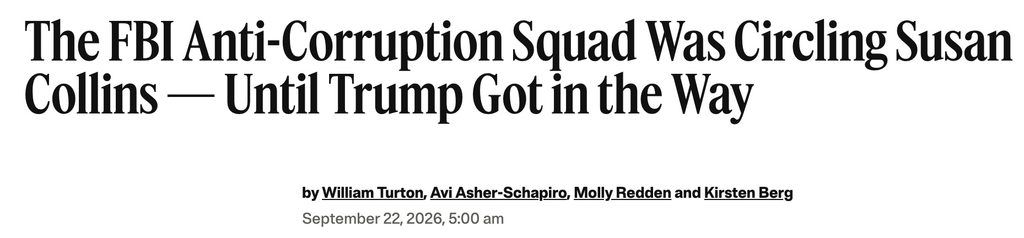
Image CreditScreenshot
Details in a moment, but the first rule when you read ProPublica stories is to pay very close attention to their word choices, which tell you more about what the story isn’t saying than they do about what the story is saying. In this case, the FBI was “circling” Collins in a headline because ProPublica couldn’t say the FBI was investigating Collins. That’s because it wasn’t. If they could have said, for example, “The FBI Anti-Corruption Squad Was Investigating Susan Collins – Until Trump Stopped Them,” they would have. Notice when they don’t really say the thing that they mean to imply.
The FBI wasn’t investigating Collins, so ProPublica published a headline saying they were circling her. Innuendo, not reporting.
The second rule is a more specific variation of the first one, and it’s the decoder ring for every ProPublica story you’ll ever read: Watch for sentences that say some version of “after” when they should say “because.” This story says that investigators were circling Collins, but they stopped circling her after Trump became president. They do not say that investigators stopped circling Collins because Trump became president, because they can’t prove that Trump interfered in the factually ambiguous circling thing.
There was no investigation of Collins, but then Trump appeared, and then after Trump appeared there was also no investigation of Collins, so Trump is very bad.
Vague claims, bold headlines. They hint, they suggest, they sneak innuendo with slippery language, but there are two clear allegations you absolutely will not find in this story about anti-corruption investigators circling Collins until Trump got in their way:
1.) A claim that Susan Collins was being investigated.
2.) A claim that Trump stopped the investigation.
ProPublica dined out on this story for weeks, regularly promoting the thing with headlines that shamelessly inflated what it actually claims. In October, they turned it into a video.
“We uncovered bribery allegations against Susan Collins.” They didn’t. Read the explainer that they published with the video, and look for the sentence in which they say explicitly that investigators believed they had evidence that Collins took bribes: a government contractor handed her a bag of cash. You won’t find it.
Then, later in October, they produced a podcast about the story that they’d already turned into a video.
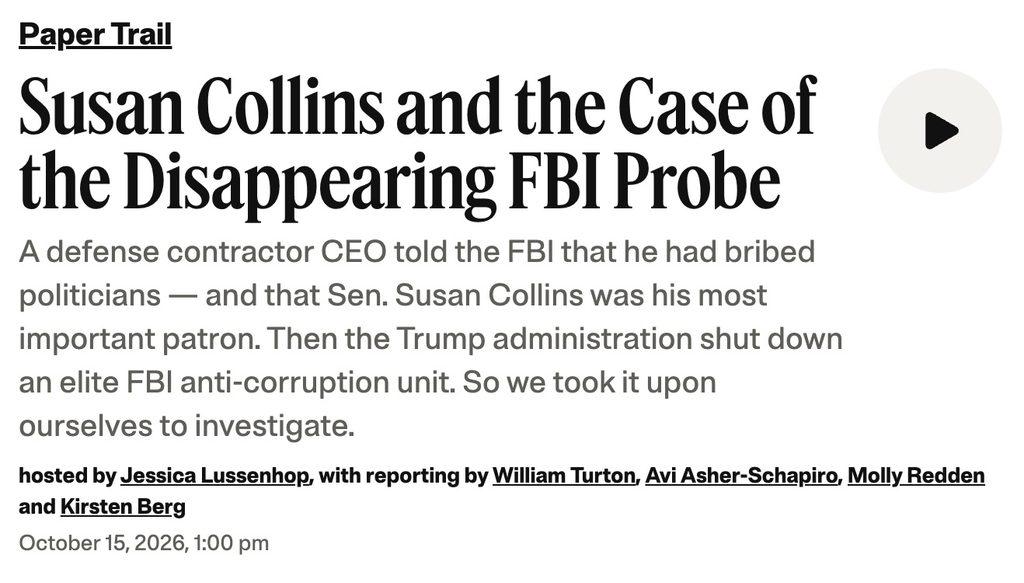
Image CreditScreenshot
One remarkably thin story produced a steady stream of headlines in the two months before the election, putting scare words next to the name of the Republican candidate for a Senate seat: SUSAN COLLINS CORRUPTION, SUSAN COLLINS BRIBERY. SUSAN COLLINS FBI PROBE. It’s subtle, right?
So let’s go back to the story that started the whole thing. There’s some real stuff there: It makes Collins look terrible, and they have evidence of some fairly typical Beltway pay-to-play sleaze of a type that one senator from Maine definitely didn’t invent. A defense contractor sent money to a pro-Collins super PAC through a shell company, and the head of the super PAC told them Collins would guarantee them defense contracts. Then they wanted more government contracts, so the head of the super PAC told them to give him more money: “If they cut a big check, the CEO told Reed, Navatek wanted Collins to guarantee tens of millions of dollars in additional federal funding.”
There are two plausible claims in the story that are supported by evidence. First, there’s evidence that Navatek was just a subsidy farm, and didn’t really expect to produce real products in exchange for their government checks. And second, ProPublica does produce evidence that Collins backed the company in discussions with the military and did it knowing they had contributed to a super PAC that supported her.
So ProPublica had a real story, but the story they published goes far beyond the facts that they can prove. First, look closely at what they say the FBI was actually discussing with an informant:
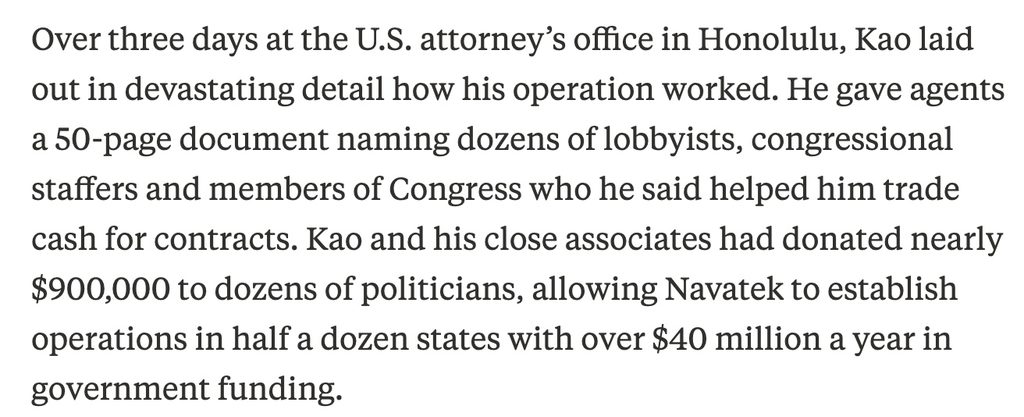
Image CreditScreenshot
The discussion between the FBI and the informant was about “dozens of politicians,” including members of Congress. Members, plural. The story is about Susan Collins, alone, and without explanation. Why did ProPublica drop the dozens of other people named by the informant? To put that question a little differently, why did ProPublica focus only on a single Republican senator in the immediate run-up to an election in which she was a candidate?
This paragraph shows up soon after:
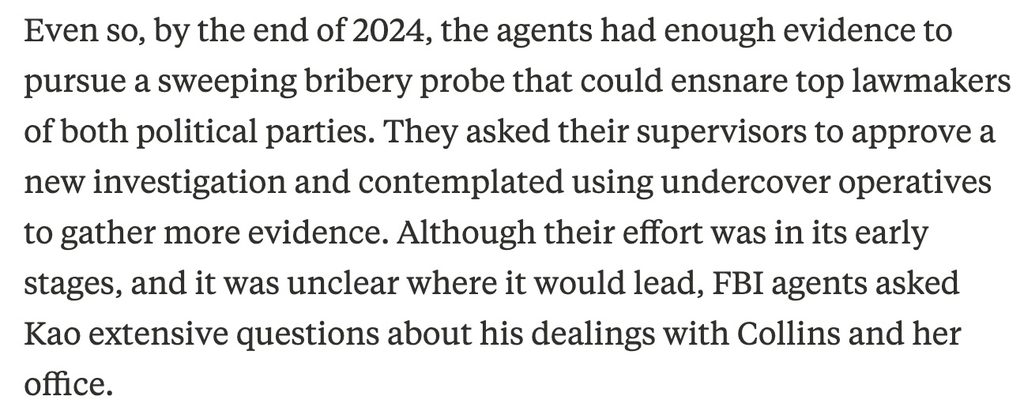
Image CreditScreenshot
So, first, the headline is about a SUSAN COLLINS BRIBERY SCANDAL, but the story is about “top lawmakers of both political parties.” And then the big claim that follows is that the FBI … almost opened an investigation, “and it was unclear where it would lead.”
“Then Trump returned to the White House,” they say, and corruption probes stopped. They don’t make even the slightest effort to actually make the “because” claim about Collins. After this, therefore because of it. They imply an action by proximity and chronology, not with evidence.
They can’t help themselves. Even when they have a real story about a company that got government contracts by writing checks to politicians, they almost magically turn it into a wildly inflated election-timed political hit piece that distorts the evidence and chooses the named target for the big headlines in highly suspect ways:
1.) SUSAN COLLINS BRIBERY SCANDAL
2.) For example, the FBI was talking to someone who made campaign contributions to dozens of politicians.
That’s ProPublica. It’s what they do. And once you know what to look for, it’s easy to see.
" Conservative News Daily does not always share or support the views and opinions expressed here; they are just those of the writer."
*As an Amazon Associate I earn from qualifying purchases