DHS Asks DOJ To Investigate Voter Roll Group For Sharing Personal Data
Department of Homeland Security Secretary Markwayne Mullin has requested an examination into the Electronic Registration Details Center (ERIC) over concerns that it may have illegally obtained and shared personal data with private entities. The data, including Social Security and driver’s license numbers, was acquired through state motor vehicle records and shared with private organizations. Homeland security officials believe at least nine states, representing over 48 million registered voters, engaged in data transfer agreements, though the actual number could be higher.
ERIC is portrayed as a group that contracts with states to maintain voter rolls but is criticized for acting more as a front for Democrat-aligned organizations, notably the Center for Election Innovation and Research (CEIR), which received significant funding from the Chan Zuckerberg Initiative. Mullin alleges that ERIC exposes sensitive private data to unknown contractors, possibly violating the Driver’s Privacy Protection Act (DPPA), and that it pushes for data sharing involving individuals who are not registered to vote, including non-citizens and deceased individuals.
Specific incidents highlight misuse of data, such as mailed voter registration materials to unvetted addresses, which raises concerns about the potential for illegal alien and deceased voter registration. Mullin emphasizes that ERIC’s contractual policies prohibit sharing data indicating non-citizens, yet reports indicate migrant non-citizens are still being invited to register, and thousands of deceased individuals remain on voter rolls.the investigation aims to address these privacy violations and the potential for illegal voting practices facilitated by ERIC.
Department of Homeland Security (DHS) Secretary Markwayne Mullin asked Attorney General Todd Blanche to open an investigation into the Electronic Registration Information Center (ERIC) over whether it illegally obtained and shared personal data with private organizations.
The personal information, which includes Social Security and driver’s license numbers, was obtained through state motor vehicle data, and then shared with private organizations.
“While a DOJ investigation could determine the final number of files involved, Homeland Security officials believe at least 9 states engaged in the grant agreement authorizing the transfer of the data and those 9 states have over 48 million registered voters,” an administration official said. “Homeland believes the number transferred could be much higher since the number of individuals in each state’s Motor Vehicle database would exceed the registered voter number because it included motorists who had not registered to vote.”
ERIC is an organization that contracts with states purportedly to help clean and maintain their voter rolls, but as The Federalist has reported, acts more like a front group for Democrat-aligned organizations.
“Marketed as a voter list maintenance organization, ERIC exposes millions of citizens’ sensitive private data to unknown contractors, subcontractors, and agents of ERIC — potentially in violation of the DPPA,” Mullin wrote. “In practice, it appears ERIC lobbies states to sign a contract that requires the disclosure of the private data of individuals who were not registered to vote and therefore certainly could not be in need of voter list maintenance.”
Mullin’s letter makes clear ERIC’s ties to the left-wing Center for Election Innovation and Research (CEIR), which received $70 million from the Chan Zuckerberg nonprofit for the 2020 election. The money “was used to provide grants to state election officials who agreed to turn over sensitive private data to CEIR,” the letter states.
The data is then used to identify eligible but unregistered (EBU) voters, and the EBUs are subjected to a targeted campaign to get them to register. As Mullin stated in the letter, “This category of data regarding potential voters is incredibly valuable to political parties and campaigns.”
DHS flagged possible violations of the Driver’s Privacy Protection Act, which regulates disclosure and use of personal information from motor vehicle data.
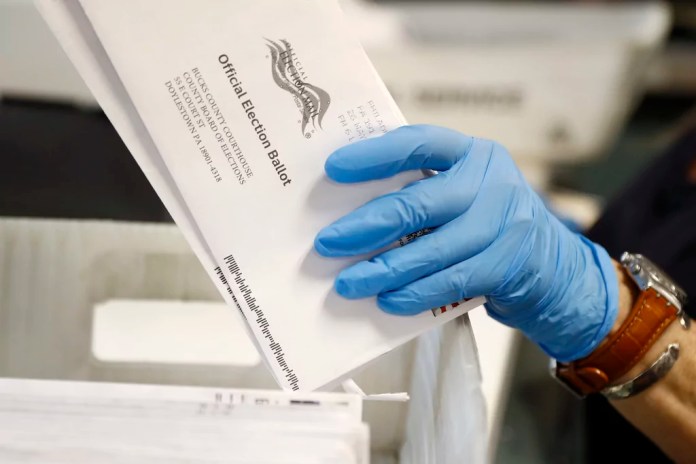
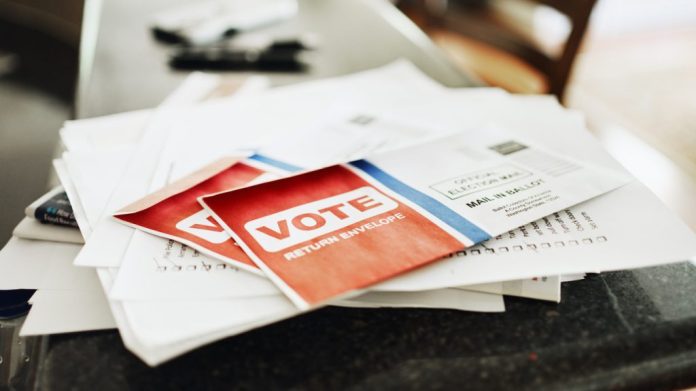
Mullin pointed to a February 2026 incident where a Washington state resident found “hundreds of ballots next to a dumpster at a commercial mailbox rental business” and also found 550 EBU postcards at the same address, sent from the Washington Secretary of State, encouraging voter registration.
“In my view, this mass mailing of voter registration material to unvetted addresses is another indicator of the reckless use of DPPA-protected motor vehicle data that could potentially result in alien voter registration and alien voting,” he wrote.
For an organization that claims to help states clean voter rolls, which could include identifying non-citizens captured on the rolls or deceased people who should be removed, ERIC actively fights against doing that.
According to Mullin, the group’s model contract to enter an agreement with states says that “under no circumstances shall the Member transmit an individual’s record where the record contains documentation or other information indicating that the individual is a non-citizen of the United States.”
“This problem has direct implications for our efforts to prevent alien voting,” Mullin stated, pointing to Colorado in 2022, whose ERIC EBU list had 30,000 non-citizens on it, all of whom were invited to register to vote. “We have serious concerns about the potential for alien registration across other states,” Mullin said.
As for deceased individuals, a similar problem occurs. While Georgia has contracted with ERIC since 2019, a 2026 review of voter roll data using the Systematic Alien Verification for Entitlements (SAVE) system showed over 42,000 deceased individuals registered to vote, according to an analysis by U.S. Citizenship and Immigration Services (USCIS).
Breccan F. Thies is the White House correspondent for The Federalist. He is a co-recipient of the 2025 Dao Prize for Excellence in Investigative Journalism. As an investigative journalist, he previously covered education and culture issues for the Washington Examiner and Breitbart News. He holds a degree from the University of Virginia and is a 2022 Claremont Institute Publius Fellow. You can follow him on X: @BreccanFThies.
" Conservative News Daily does not always share or support the views and opinions expressed here; they are just those of the writer."
*As an Amazon Associate I earn from qualifying purchases