
Trump Announces “Major Motion” in Response to Mar-a-Lago Raid
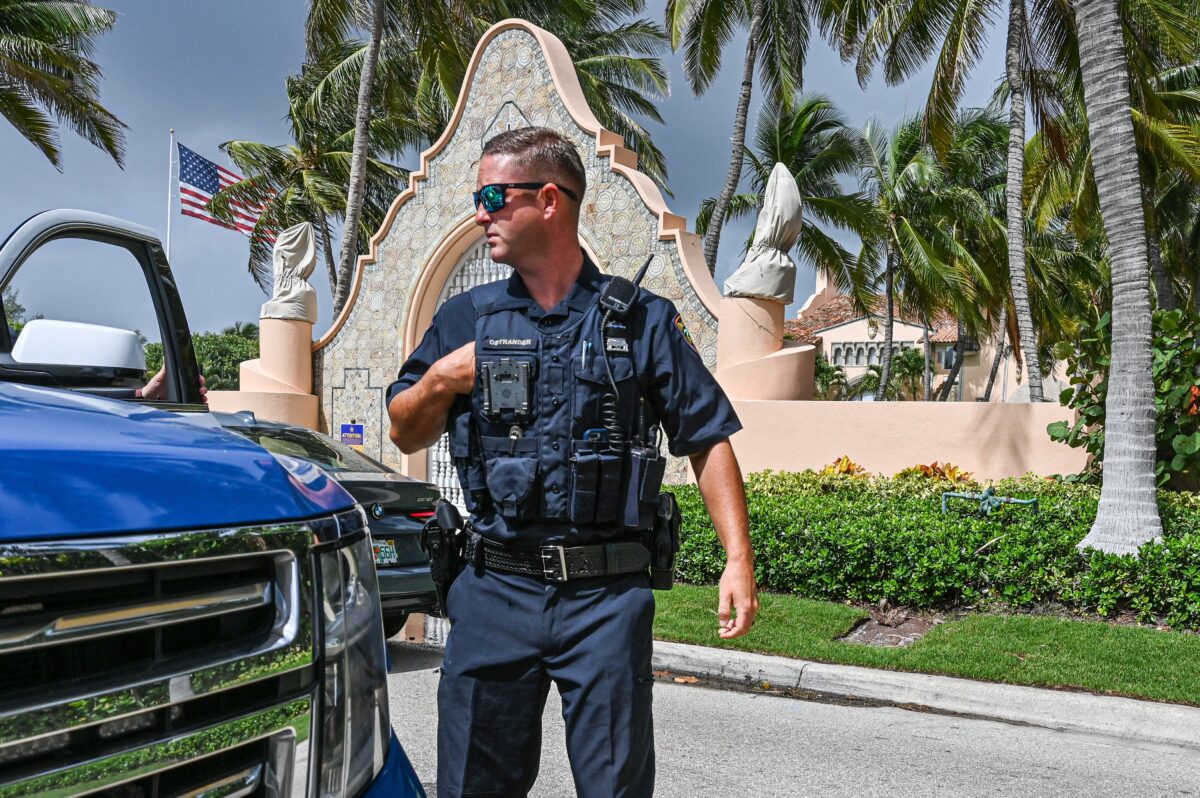
Former President Donald Trump announced Friday that a “major motion” will soon come following the FBI’s raid on his Mar-a-Lago resort.
“A major motion pertaining to the Fourth Amendment will soon be filed concerning the illegal Break-In of my home, Mar-a-Lago, right before the ever important Mid-Term Elections,” Trump wrote on Truth Social, less than two weeks after the FBI raided his resort in Mar-a-Lago in search of supposedly classified documents.
“My rights, together with the rights of all Americans, have been violated at a level rarely seen before in our Country,” Trump continued. “Remember, they even spied on my campaign. The greatest Witch Hunt in USA history has been going on for six years, with no consequences to the scammers. It should not be allowed to continue!”
Trump’s announcement, if it were to materialize, represents the former president’s first major legal move after the feds raided his Florida home. It is unclear as of writing who Trump plans to sue, but the Department of Justice (DOJ), specifically Attorney General Merrick Garland—who said he “personally approved” the warrant—would likely be among the defendants.
Game Plan
One of Trump’s lawyers, James Trusty, said on the Mark Levin show late Friday that the lawsuit will come “very soon.”
“It should be something that gets publicly filed, so the whole United States will get to read this thing,” Trusty, a former federal prosecutor, said of the lawsuit on the show. “And I think that’s very important to the president. He’s been very transparent through this whole process.”
“It’s coming very soon,” Trusty said, adding that the team will possibly file it Monday.
Trusty said that the team plans to request judicial intervention via a special master, an appointee by the court who will oversee an aspect of the lawsuit. A special master, on rare occasions, is needed in cases where a “privilege issue” is present, Trusty said, such as when a search warrant is executed at an attorney’s office. He added that this case warrants the assignment of a special master because it involves issues of attorney-client privilege and executive privilege.
“We have to get somebody in the middle because we are not going to leave it to DOJ to tell us that they are doing their filter search, and they are the guardians of what’s privileged or not,” Trusty said, adding that the special master can order to halt the DOJ’s document reading.
“We are going to have court involved, judicial intervention, at the district court level to get somebody in the mix here that can help us vindicate the Fourth Amendment rights of the president.”
Key Information
According to Trusty, a key piece of information in Trump’s lawsuit would be the search warrant executed by the FBI agents in the raid, which was unsealed by Obama-appointed magistrate Judge Bruce Reinhart following requests from both Trump’s lawyer and the DOJ. The warrant shows what items the agents were authorized to seize, where the agents were authorized to search for the operation, and the laws that the federal agents were pursuing in executing the warrant.
While the warrant did not pinpoint what probable cause the FBI established to conduct the raid, the warrant authorized the seizure of “all physical documents and records constituting evidence, contraband, fruits of crime, or other items illegally possessed” that the agents perceived to have violated the U.S. Code. The various items that federal agents seized from Trump’s Florida resort included 26 boxes of unidentified material, “Various classified/TS/SCI documents,” binders of photos, a gift, and other classified material.
Meanwhile, another key piece of information in Trump’s lawsuit would be the warrant affidavit, which currently remains under seal. The affidavit would show the probable cause that the agents established before Reinhart, which would give more insight into why the DOJ felt the need to raid a former president’s home, notwithstanding the ensuing political ramifications.
Trump’s team has asked the court to release the search warrant affidavit with “no redactions,” while the DOJ has filed in an attempt to keep the affidavit under complete seal. The judge ordered the government to produce a redacted version of the warrant on Aug. 18.
Warrant Too Broad
Though the Trump team’s exact argument is unclear at this point, Trusty’s comments on the Mark Levin Show gave a general sense of the key principle the argument would hinge on: namely, how the warrant executed by the FBI in its search-and-seizure operation at Mar-a-Lago was allegedly too broad that it would fail a requirement of the Fourth Amendment that warrants need to meet a certain level of specificity.
The Fourth Amendment states that “the right of the people to be secure in their persons, houses, papers, and effects, against unreasonable searches and seizures, shall not be violated, and no Warrants shall issue, but upon probable cause, supported by Oath or affirmation, and particularly describing the place to be searched, and the persons or things to be seized.”
“The Fourth Amendment requires particularity. It requires narrowness to the intrusion on the person’s home,” Trusty said, adding that the warrant has a language in it that authorizes the federal agents to take “whole boxes” and “any boxes near” perceived classified documents.
“That’s really the functional equivalent of a general search. There’s just no limit to that kind of scope in the warrant,” Trusty said.
Jeffrey Clark, former U.S. assistant attorney general for the Civil Division under Trump, shared a similar rationale with Trusty, when Clark wrote on Twitter shortly after the judge unsealed the warrant on Aug. 12 that its breadth is “breathtaking.”
Specifically, he pointed to a statement on “Attachment B” of the warrant: “[a]ny government and/or Presidential Records created between January 20, 2017, and January 20, 2021” shall be subjected to seizure if the agent deems it relevant as “evidence, contraband, or fruits of crime.”
This statement, Clark wrote, makes the warrant exactly the type of general warrant that the “Framers abhorred and sought to ban in the Fourth Amendment,” pointing to two historical cases cited frequently by the U.S. courts—Wilkes v. Wood and Entick v. Carrington—that he says “inspired” the ban, under the Fourth Amendment, on warrants that are too general.
In addition, Clark wrote the warrant is “undermined by its timing” and, for this reason, has an underlying political motive.
“Since [federal] officers had been to Mar-a-Lago to inspect the documents there, they already knew there were [presidential] documents there, and have for [months],” Clark wrote. “The political nature of [the] raid [is] clear because they waited to search for what they knew was ALREADY THERE until just before the Midterms.”
‘Americans Deserve to Know’
Jenna Ellis, constitutional attorney and former senior counsel to the former president, says Trump is “absolutely right to assert his constitutionally protected rights” in pursuing the lawsuit.
“President Trump is absolutely right to assert his constitutionally protected rights and ask the Court to immediately stop document review, appoint a special master, and demand the Department of ‘Justice’ show cause for their unreasonable, irregular, and politically motivated raid,” Ellis said in a statement to The Epoch Times in response to Trump’s announcement.
“Americans deserve to know how their own law enforcement is operating and by what rules,” she said. “If Attorney General Garland truly wants to even attempt to restore legitimacy in the FBI’s credibility, he has to answer for this.
“No one is above the law, but absolutely no one is below the law in America either, even if your last name is Trump,” Ellis said. “Everyone named Trump and associated with Trump has been targeted and harassed by law enforcement and the Democrats for six years. This has to stop.”

Follow
Gary Bai is a reporter for Epoch Times Canada, covering China and U.S. news.
" Conservative News Daily does not always share or support the views and opinions expressed here; they are just those of the writer."
*As an Amazon Associate I earn from qualifying purchases


