The Spanish Socialist Workers’ Party Triggered the Invasion of Ceuta
The provided content includes a brief introduction about Ceuta, a Spanish autonomous city located on a peninsula in the Mediterranean, bordering Morocco. Although part of Spain, Ceuta is geographically in Africa adn is subject to EU law. Recently, it has experienced a surge of migrants, mainly Moroccan and sub-Saharan men, attempting to cross illegally into Europe via the Tarajal breakwater. Images depict chaotic scenes of people climbing fences and breaching security, raising debates about nations’ rights to defend their borders. Past incidents,including a mass crossing in 2021,highlight ongoing tensions regarding border security and sovereignty.
The Spanish government, led by Socialist Pedro Sánchez, refuses to classify the situation as a crisis, blaming human trafficking networks exploiting judicial rulings that prevent “hot returns” at sea. A recent court decision clarified that border rejection policies cannot be applied at sea,encouraging more crossings. Additionally,the government’s decision to regularize status for around 500,000 undocumented migrants has inadvertently increased the number of applications-initially estimated at half a million,now over a million-perhaps incentivizing illegal entry.
Opposition parties criticize these policies,arguing thay encourage illegal immigration and strain public services. Right-wing leader Santiago Abascal calls it an invasion, blaming the government for allowing what he describes as an organized influx of men of military age. the situation remains a contentious issue involving border security, immigration policies, and political debates in Spain.
Ceuta is a stretch of land at the tip of a small peninsula in the Mediterranean that holds the status of a Spanish autonomous city. It is located in Africa, yet the moment you set foot there, you are protected by the rule of law common to European Union territories.
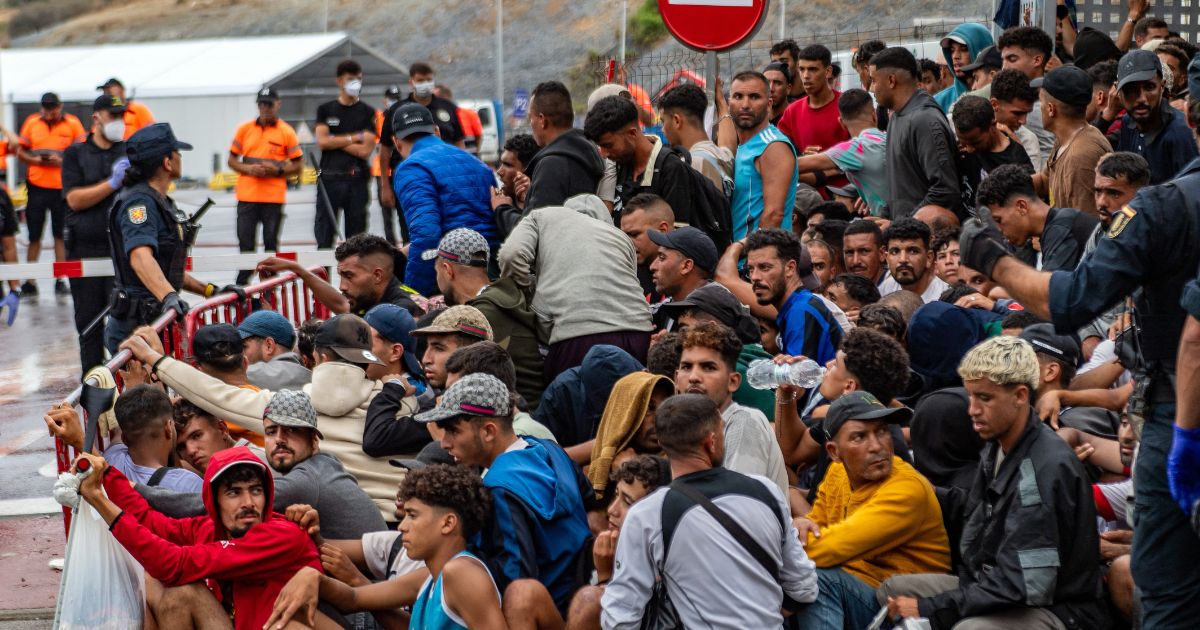
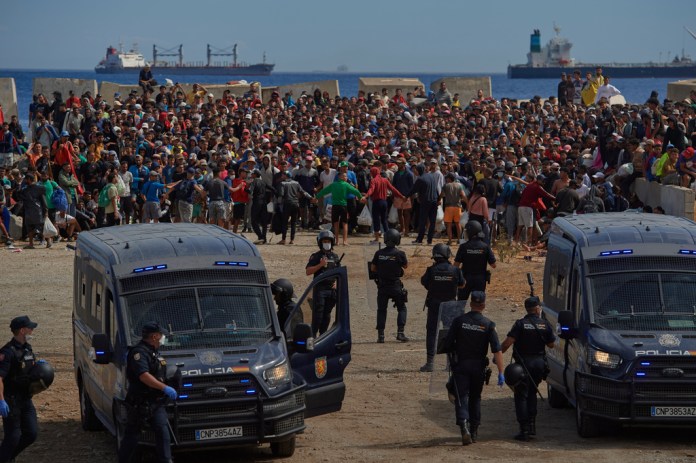
Bordering Morocco, the architecture and culture of this city of 83,595 inhabitants stand apart from the rest of North Africa; it is distinctly Spanish. Now, this part of Spain is facing a wave of migrants — predominantly Moroccan and sub-Saharan men — crossing illegally via the Tarajal breakwater to reach European soil.
Some images look as though they were lifted from a post-apocalyptic script: hundreds of people trying to scale fences, breaking through Civil Guard security lines with the force of a human stampede, and wandering through the middle of city avenues. These images raise a lingering question: do nations and their citizens have the right to defend their borders?
This is not the first time such a blow to Spain’s sovereignty has shattered the peace in Ceuta. In May 2021, 6,000 people did the same thing after Moroccan police deliberately allowed the intruders to pass.
The mass influx that began this week has already resulted in at least 18 deaths. The only ones to profit from this bloodshed are the human traffickers who make a fortune transporting Africans to the doorstep of the West.
Juan Jesús Vivas, the president of Ceuta, has described the daily arrivals as escalating. He has asked Madrid to deploy the army to contain the surge — which had intensified over the past two weeks before turning into an incessant flow this Thursday.
Meanwhile, in Madrid, the government of Socialist leader Pedro Sánchez refuses to acknowledge the situation as a crisis and, as usual, attempts to shirk its responsibilities. The Ministry of the Interior took the view that human trafficking networks are exploiting a Supreme Court ruling to encourage the flow of migrants.
As reported by the state broadcaster RTVE, the Fifth Section of the Contentious-Administrative Chamber ruled on July 8 that the Aliens Act does not permit the application of border rejection — also known as “hot returns” — to those intercepted at sea; instead, the standard administrative procedure must be applied.
The Supreme Court ruling, stemming from an appeal filed by an Algerian national, was widely circulated on social media in Morocco, reportedly prompting dozens of people to attempt to reach Spain by swimming.
However, a recent development has been overlooked in many state media analyses: the “pull factor” generated by the Socialist government’s decision to launch an extraordinary process to regularize the status of approximately 500,000 undocumented individuals in the country.
This administrative measure would cover those who entered Spain before December 31, 2025 and can prove continuous residence in the country for at least five months. Yet, it is predictable that an individual who has already broken the law by entering a country illegally might also falsify the dates of their entry and stay.
Indeed, initial estimates pointing to around half a million beneficiaries have given way to a different reality: there are now over a million pending applications.
The very Spanish Socialist Workers’ Party (PSOE) currently in power — which champions the measure on the grounds that the formal integration of workers would strengthen the labor market and public services — is the same party that trivializes the importance of marriage. Yet marriage is the institution that could counteract the “demographic winter” currently threatening Spain’s economy and forcing it to rely on importing foreign labor.
For their part, opposition parties have harshly criticized the amnesty decision from the very outset, arguing that it would encourage irregular immigration and overwhelm state public services — a prediction borne out by the events in Ceuta.
Regarding this issue, Santiago Abascal, leader of the right-wing party VOX, posted on X: “They are not fleeing war or poverty. It is an invasion. They are men of military age summoned by Sánchez’s corrupt government to storm our borders, only to later wander the streets of Spain shouting ‘Long live Pedro Sánchez.’”
He added, “For every rape, every stabbing, and every blow to Spaniards’ wallets to support them, there is a direct culprit: the mafia boss desperately calling in more hitmen to hold onto power.”
Advertise with The Western Journal and reach millions of highly engaged readers, while supporting our work. Advertise Today.
" Conservative News Daily does not always share or support the views and opinions expressed here; they are just those of the writer."
*As an Amazon Associate I earn from qualifying purchases