Oil Matters In Venezuela, But Not For The Reason Dems Think
The article argues that coverage of nicolás Maduro’s capture has revived the “No Blood for Oil” refrain, which the author calls a simplistic and hypocritical critique of U.S. policy. It contends that oil is central to the Venezuela story – not as the United States is trying to seize resources, but because China has heavily invested in Venezuelan crude, importing hundreds of thousands of barrels per day and using shadow shipping networks to evade sanctions. The author says the U.S. is the world’s largest energy producer and benefits from stable, transparent markets, while the left selectively denounces American energy policy yet overlooks or enables china’s growing control over global energy supply chains and critical clean‑tech manufacturing. He characterizes oil today as a strategic asset and accuses parts of the American left of weakening U.S. energy security by opposing domestic production and tolerating China’s energy reach. The piece frames recent events as a move to restore lawful, dollar‑based energy trade that could help Venezuelans rather than enrich dictators. It is written by Larry Behrens, communications director for Power The Future.
From the moment the capture of Venezuelan dictator Nicolás Maduro hit the headlines, out came the recycled slogans that have been gathering dust for more than 20 years: “No Blood for Oil.” Right on cue, U.S. Rep. Alexandria Ocasio-Cortez predictably declared that U.S. policy toward Venezuela was “about oil and regime change.”
It’s a tired worldview recycled by eco-leftists — one where the United States is forever cast as a cartoon villain scheming to seize foreign oil fields. Yes, oil is part of the Venezuela story, but not in the simplistic bumper-sticker way the left keeps chanting.
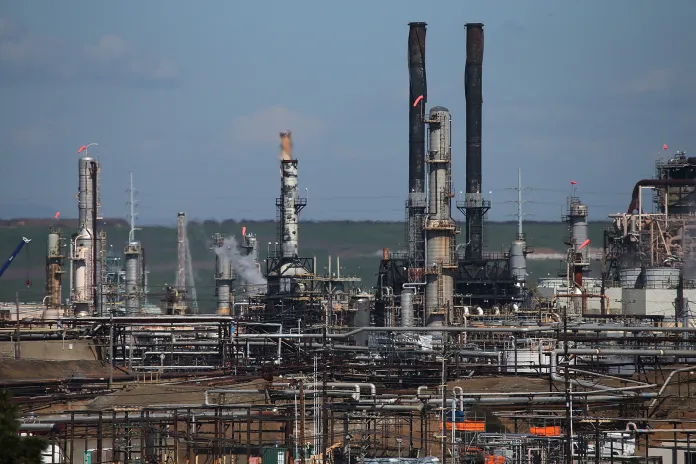
Today, the United States is the world’s largest energy producer. American oil and gas don’t just power our economy — they stabilize global markets. Meanwhile, China is the world’s largest oil importer. Beijing’s economy survives only because tankers sail halfway around the world to feed its refineries. And one of the places China leans on most heavily is Venezuela. In 2025 alone, Beijing took in 470,000 barrels of oil per day from Maduro; that’s about 4.5 percent of China’s sea imported oil.
That’s the part the protest signs conveniently overlook.
Beijing poured billions into Venezuela. Chinese state banks extended loans. Tankers full of Venezuelan crude quietly fed China’s refineries — often routed through the “shadow fleet,” an underground shipping network designed to move illegal oil to dodge sanctions. Oil wasn’t some side note for China. It was strategic leverage, energy security, and geopolitical real estate in America’s own hemisphere.
When critics like AOC accuse the U.S. of “oil greed,” they’re not exposing American motives; they’re exposing their own blind spot. Because the country most worried about losing Venezuelan crude isn’t the United States; it’s Communist China, Venezuela’s biggest customer.
One Venezuelan voice summed it up perfectly: “Those who say the U.S. is only interested in our oil, I ask you: What do you think the Russians and Chinese wanted here?” The left never seems troubled when Beijing buys up oil assets around the world. They don’t chant “No Blood for Oil” when China bankrolls dictators. They don’t protest when Chinese companies lock up energy reserves from Africa to Latin America.
Their outrage only turns on when America is involved.
Here’s where the hypocrisy deepens. The same politicians and activists who scream “No Blood for Oil” at American energy policy are also the loudest voices demanding that the United States become dependent on Chinese-made solar panels, Chinese batteries, and Chinese critical minerals. They want American coal, oil, and gas shut down and replaced with supply chains that run straight through Beijing. At the same time, they oppose any effort that might constrain China’s oil imports or strategic reach.
To recap: The American left opposes American energy independence. The American left opposes confronting China’s solar and wind power leverage. The American left opposes disrupting China’s access to Venezuelan crude.
Whose interests are really being served by that agenda?
This is not to suggest that every left-wing activist is knowingly carrying water for Beijing. But the real-world effect of the left’s policies is unmistakable: weaken American energy, strengthen Chinese energy. Whether that’s ideology, naivety, or simple reflexive anti-Americanism almost doesn’t matter anymore. The consequences are the same, regardless of intent.
Additionally, Democrats’ narrative still misses the real story.
Oil isn’t just a commodity anymore. It’s a strategic weapon. For a nation like China, which imports roughly three-quarters of its oil, disruptions aren’t an inconvenience. They’re an existential threat.
When regimes like Venezuela wobble, China’s energy security wobbles too. That’s why Beijing is howling. Not because of morality or sovereignty, but because its energy lifeline just became a lot less certain.
Meanwhile, the United States isn’t scrambling for oil. We produce more energy than any nation on Earth. Our Gulf Coast refiners, workers, and communities stand to benefit from a stable, lawful, above-board energy market, not the shadowy tanker games China has relied on. As Venezuela’s future and fortunes hopefully shift for the better, its oil moves back into the real marketplace priced in dollars, traded openly, and benefiting the Venezuelan people, not dictators.
That’s not “imperialism,” that’s stability.
Yes, oil is part of what’s happening in Venezuela. But it’s about disrupting a shadow supply chain that propped up Beijing and funded a dictatorship rather than America looting another nation’s resources. And it’s about strengthening the rule of law in global energy, something the left claims to support (unless America has anything to do with it).
Those whose worldview can only process events through the lens of “America bad, oil evil” will no doubt shake their heads. But oil matters here not because America needs to raid it, but because China does. For a rising authoritarian power with global ambitions, that’s a weakness worth paying attention to — whether the protestors understand it or not.
Larry Behrens is an energy expert and the communications director for Power The Future. He has appeared on Fox News, ZeroHedge, and Newsmax speaking in defense of American energy workers. You can follow him on X @larrybehrens.
" Conservative News Daily does not always share or support the views and opinions expressed here; they are just those of the writer."
*As an Amazon Associate I earn from qualifying purchases