Non-campaign, local road events bring politicians in front of rural, small town, and a-political America
Political candidates often visit local community events centered around food and cultural celebrations to connect with voters outside conventional campaign settings. These events, such as Kentucky’s Fancy Farm picnic, Iowa’s State Fair, and minnesota’s King Turkey Day, serve as platforms for candidates to showcase their accessibility, test campaign messages, and boost their profiles. Historically, prominent politicians, including presidents and vice presidents, attend these gatherings, which also attract significant media attention. missing such events can carry political risks, especially for candidates seeking to maintain or grow support in rural or traditional districts.Similar events are held across several states, providing opportunities for politicians to engage with local populations and reinforce their image as relatable, man-of-the-people figures.
Political smack talk with a side of Kentucky mutton and pork. Minnesota turkey dinners for hopeful political winners. Talking policy stances to Iowa fairgoers eating pork chops on sticks.
In between scheduled campaign rallies and town halls, U.S. political candidates have for decades sought to bring their political ideas to established local events that draw crowds and constituents they may not typically reach.
By targeting more apolitical events that are already engrained in local communities, candidates look to spread the word of their campaigns to new voters who may not venture out to a typical political rally. Likewise, these local, popular events can boost the political profiles of candidates trying to raise their profiles and make a name for themselves in the community.
Many of these community events center around local food, cultures, and celebrations, making them some of the most fun and unique campaign stops of the year for candidates and voters.
Political science professor Stephen Voss of the University of Kentucky compared these local community stump opportunities to “the local dive bar restaurant that tourists don’t know about that allows a state or a city to maintain its identity.”
The state of Kentucky is home to one of the most famous of these events, being the Fancy Farm Picnic in the state’s rural southwest region. An annual fundraiser for St. Jerome Catholic Church, the event prides itself as the “world’s largest one day barbeque,” featuring truck giveaways, live music, a 5K race, lots of pork and mutton, and a famed political stump session.
The state’s biggest names in politics head to the church fundraiser, bringing their teams and one-liners that they hope will gain traction on social media or make for standout political ads. Adam Hope, communications director for the Kentucky GOP, said the event can serve as a place to “push the limits of some of your messaging tactics to see what sticks.”
“If the crowd reacts really well to something, then you know maybe that’s something you can run with throughout the rest of the general election,” Hope said.
The political speaking part of the event – which has taken place for nearly a century – mainly includes candidates roasting their opponents and poking fun at current state politics in front of the partisan crowd. It has also drawn national figures, like two-time presidential nominee and former Vice President Al Gore.
“The purpose of Fancy Farm is that the candidates show they’re willing to go face the people, even if it’s in an inelegant and rambunctious setting,” Voss said. “It’s how they project a man of the people – the kind of person you wouldn’t mind having a beer with or getting your hands covered in barbecue sauce with. So candidates still feel some pressure to campaign in person rather than merely you know hide in the basement and make advertisements.”
In Iowa, the iconic state fair has become a hot spot for political grandstanding and attempts to connect with rural American voters in that same “man of the people” way.
“[Politicians] may do things like throw some feed into a pig pen just to show, ‘Hey look, I’m just a regular person like you,’” former political science professor at Iowa’s Drake University Dennis Goldford told History.com.
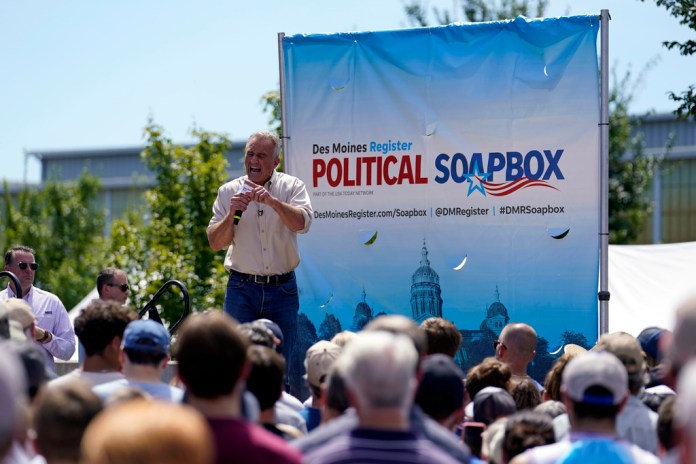
The Iowa State Fair has for decades drawn politicians campaigning for every sector of government – from presidential hopefuls to local officials. The Des Moines Register, the daily newspaper local to the fair, has hosted the fair’s “political soapbox” since 2002, giving a stage to candidates to give their pitches to fairgoers.
This year, starting on Friday, Aug. 14, the soapbox is hosting over 20 statewide and federal candidates to share their stories and answer questions from fairgoers, if they so chose, for 20 allotted minutes.
Candidates speaking at the soapbox this year include the Democratic, Republican, and Libertarian nominees for U.S. Senate – State Rep. Josh Turek, Rep. Ashley Hinson (R-IA), and Thomas Laehn – and the Republican and Democratic nominees for governor, businessman Zach Lahn and State Auditor Rob Sand.
The speeches will run through Saturday, Aug. 22, according to the Des Moines Register.
Besides the political speeches themselves producing headlines, the buzz around the politics of who attends these events also often draws national media attention.
This year, Sen. Mitch McConnell (R-KY), an about thirty-time Fancy Farm attendee, and Gov. Andy Beshear (D-KY) made news for not going to the picnic, as McConnell skipped for health reasons and Beshear said he missed it for his son’s baseball game. Voss spoke to the political risk of missing the event, saying Democrats, especially, have to be careful about inadvertently sending the message that they’ve given up on trying to court the votes of rural, western Kentuckians.
“Democrats in Kentucky, especially, need to be careful about potentially sending the message they’ve given up on the bulk of the state, that they’ve retreated to a few urban islands and they’re happy there,” Voss said.
Several incumbent Iowa politicians in safe districts also caught flack in 2022 for skipping out on the soapbox.
But it’s not just Iowa and Kentucky. Several states across the country have these types of local culture-oriented events that bring state and federal politicians out of the woodwork and in front of local, often apolitical audiences.
In Minnesota, the southwestern town of Worthington has been holding “King Turkey Day” for over 80 years as a community event rooted in celebrating the local turkey industry.
National politicians have historically flocked to the event, bringing in big names like former Presidents Richard Nixon and Lyndon B. Johnson, when they were vice president and a sitting senator, respectively.
Sen. Amy Klobuchar (D-MN) spoke ahead of the event’s race between turkey mascots in 2023 and ahead of her 2024 senate reelection campaign.
GOP SHARPENS MINNESOTA FRAUD ATTACKS AFTER TIM WALZ DEPUTY WINS SENATE NOMINATION
This year’s King Turkey Day is scheduled for mid-September, coming just weeks ahead of Minnesota’s highly anticipated gubernatorial and senate races in November.
Key presidential election states, such as South Carolina and New Hampshire, also famously host these more local-oriented events, with Rep. Jim Clyburn’s (D-SC) Fish Fry and New Hampshire’s Politics and Eggs breakfast.
" Conservative News Daily does not always share or support the views and opinions expressed here; they are just those of the writer."
*As an Amazon Associate I earn from qualifying purchases