Navy Sends Robots to Take Out Iranian Mines in Strait of Hormuz: Several Successful Detonations Already Reported
The passage describes how the U.S.is using autonomous drones to detect and help clear mines in the Strait of Hormuz amid an Iranian crisis.It says the Navy is transitioning from older minesweepers (four recently retired) to newer unmanned systems.
It explains that drones operate both on the surface and underwater: underwater vehicles use high-resolution sonar to locate likely mines, while surface drones tow sonar equipment and are supported by helicopters for surface scanning. After mines are found, a longer process begins-neutralizing them remotely by detonating them or breaching them so they sink-and then retrieving or handling the remnants with explosive ordnance disposal teams. The article notes that identifying mines may take weeks, but making the waterway safe could require weeks or months, partly because confirming whether mines were actually laid takes extra time.
It also cites reporting that specific uncrewed vessels scan wide swaths of sea, using systems such as a floating sonar called the AQS-20, and references sea drones launched from ships for additional scanning.
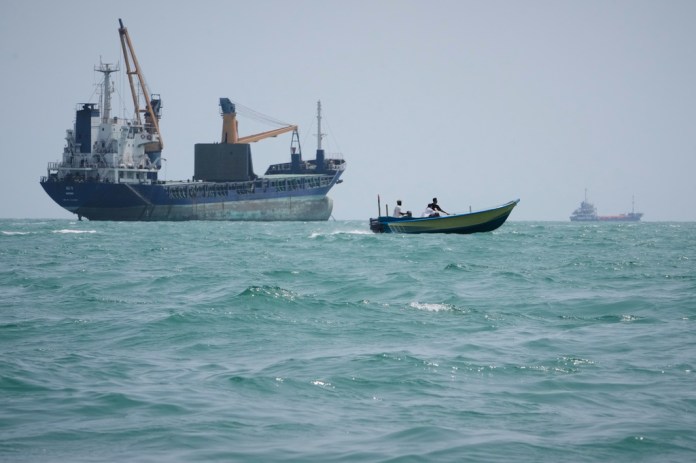
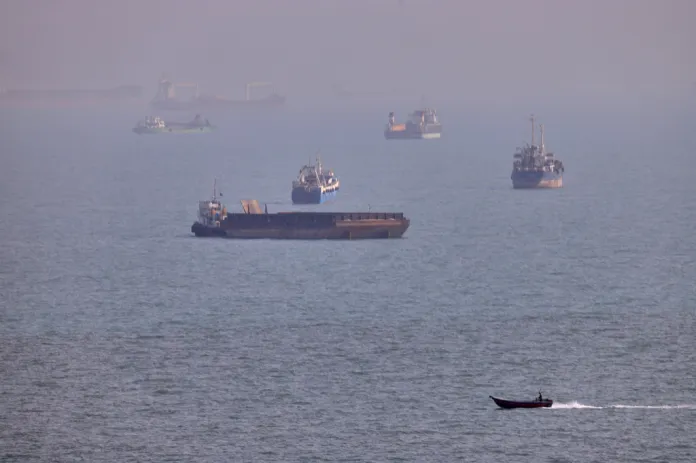
Drones are probing the Strait of Hormuz for Iranian mines as the U.S. military works toward reopening the key waterway.
The need to get rid of the mines comes as the U.S. Navy is in transition from its fleet of minesweepers, four of which were recently retired, to sea drones, according to Fox News.
“To be honest, that the minesweepers retired was never a concern to me, because we had brought in newer technology,” retired Vice Adm. Kevin Donegan, who previously commanded the Navy’s 5th Fleet, said.
Drones are working both above and below water.
Underwater drones map the ocean floor and use high-resolution sonar to discern which objects might be mines.
“They kind of look like torpedoes and they map the bottom,” Donegan said.
Surface drones tow sonar systems through narrow lanes, accompanied by helicopters that scan for mines near the surface.
Bryan Clark, a defense analyst at the Hudson Institute, said finding mines is just the beginning.
“The mine neutralization part is really the long leg of the process,” Clark said.
Remotely controlled systems are used to disable a mine by either blowing it up or punching a hole in it so that it sinks.
Trump’s got Iran’s number—warning ’em off while we surge drones & ships to clear their mines from the Strait of Hormuz. Navy’s smart pivot from old sweepers to unmanned tech keeps oil flowing. Weakness? Nah, strength! Who’s with me?https://t.co/P4Rq2Ch2F0#MAGA #AmericaFirst…
— HoboJoe (@Happy_HoBo_Joe) April 25, 2026
“You’ve got to then retrieve this thing with EOD personnel,” Clark said, referring to explosive ordnance disposal teams.
Ensuring that a waterway is mine-free could take weeks or months.
“The finding part, you could do within a couple of weeks,” Clark said.
Donegan said it remains uncertain what Iran actually did.
🇺🇸 The U.S. is sending autonomous sea drones to sweep mines in the Strait of Hormuz, and the timing says everything.
The Strait carries roughly 20% of global oil traffic. One successful mining campaign and energy prices spike worldwide within hours.
The U.S. deploying this… https://t.co/JUx5oaLWgx pic.twitter.com/C5o1PlnmX6
— Mario Nawfal (@MarioNawfal) April 19, 2026
“When somebody says they mined it, you have to go validate if that’s even true, and that takes time,” he said.
A report from The Wall Street Journal said that a Common Uncrewed Surface Vessel, a drone that tows a new floating sonar system called the AQS-20, is part of the effort to detect mines.
The drone goes back and forth scanning 100-foot-wide swathes of the sea.
Battery-powered sea drones dropped from ships are also used to scan for mines, The Wall Street Journal reported.
Advertise with The Western Journal and reach millions of highly engaged readers, while supporting our work. Advertise Today.
" Conservative News Daily does not always share or support the views and opinions expressed here; they are just those of the writer."
*As an Amazon Associate I earn from qualifying purchases