National Park Service offers plan to mitigate ‘adverse effects’ of Trump arch
The National Park Service (NPS) sent a memorandum of agreement to preservation groups concerning President Donald Trump’s proposed 250-foot triumphal arch at Memorial Circle in Washington, D.C. The NPS acknowledged that placing the arch at this location would impact historic properties by altering their visual and spatial characteristics, and these effects cannot be fully avoided. To mitigate these effects, measures include restrictions on construction noise, lighting, vibrations, coordinating with Arlington National Cemetery to avoid disruptions, and documenting existing views before construction begins. The project faces opposition from preservationists and veterans who argue that the arch’s size and placement would disrupt historic sightlines connecting key landmarks like the Lincoln Memorial and Arlington Cemetery. Additionally, the project is encountering legal challenges, including a federal lawsuit from veterans claiming it requires congressional approval and may dishonor fallen service members.The arch project is expected to take up to three years and may involve extensive daily construction. The Interior Department previously stated the structure would enhance the visitor experience and serve as a monument to American sacrifices. The NPS is seeking approval from various historic preservation offices to proceed with the project.
The National Park Service sent a memorandum of agreement to historic preservation groups that included a series of measures to lessen the impact of President Donald Trump’s planned 250-foot triumphal arch after concluding the massive structure would have unavoidable “adverse effects” on historic sites around the nation’s capital.
The proposed MOA, obtained by the Washington Post, lays out steps federal officials say could mitigate the project’s effects as the Trump administration seeks to complete a required historic preservation review and move the arch toward final approval.
Stay informed.Stay ahead.
Join Washington Examiner for unlimited access to the news, analysis, and commentary that matter most.
Already a member? Log in
NPS is asking the National Capital Planning Commission, District of Columbia State Historic Preservation Office, Virginia Historic Preservation Office, and the Advisory Council on Historic Preservation to sign the agreement by Monday, according to the outlet.
The park service acknowledged in the agreement that placing the arch at Memorial Circle, between Arlington Memorial Bridge and Arlington National Cemetery, would affect historic properties by changing their setting, design, spatial organization, and views. The agency said those effects “cannot be fully avoided” while keeping the arch at its proposed location, which is “central” to the project.
” data-image-caption=”
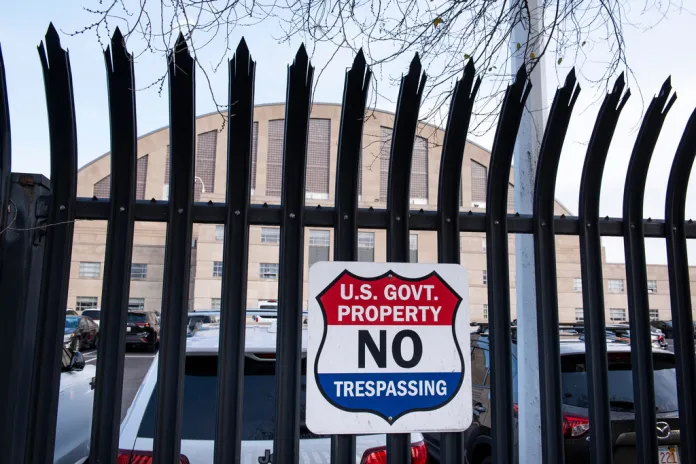
The Memorial Circle, where President Donald Trump has proposed building an arch to commemorate the United States’ 250th anniversary is seen, Tuesday, May 19, 2026, in Washington. (AP Photo/Alex Brandon)
” data-large-file=”https://cndimages.nyc3.cdn.digitaloceanspaces.com/breaking-news/wp-content/uploads//2026/09/localimages/AP26139614917734.jpg?w=696″ src=”https://cndimages.nyc3.cdn.digitaloceanspaces.com/breaking-news/wp-content/uploads//2026/09/localimages/AP26139614917734.jpg?w=696″ alt=”Memorial Circle.” class=”wp-image-4578452″ >
To reduce the impact, NPS proposed restrictions on construction noise, lighting, vibration, and work hours, including coordination with Arlington National Cemetery to avoid disruptions during funerals and major commemorative events. The plan would also maintain pedestrian access during construction.
Other measures include rehabilitating the Memorial Avenue landscape, mitigating dust from transporting materials, and documenting existing views before construction. The park service also proposed creating exhibits, signs, and webpages explaining the history of the corridor and triumphal arches.
Under the National Historic Preservation Act of 1966, federal agencies are charged with reviewing adverse effects on historic sites. An adverse effect occurs when a federal project alters any characteristic of a historic property. The most obvious example would be physical damage or destruction, but more subtle ways include introducing incompatible visual, atmospheric, or audible elements that intrude on the property’s historical integrity.
The arch has faced opposition from preservationists, veterans, and others who argue its size and placement would disrupt the historic sightline connecting the Lincoln Memorial, Arlington Bridge, and Arlington National Cemetery.
TRUMP ARCH COULD TAKE UP TO THREE YEARS AND 20 HOURS OF CONSTRUCTION PER DAY
The project is also facing a federal lawsuit from three military veterans who argue that the project requires congressional approval and an extensive review process and would dishonor service members buried at Arlington National Cemetery. A federal judge has required the administration to provide notice before beginning the construction process while the case proceeds.
Trump has said the arch should stand 250 feet tall to commemorate the nation’s 250th anniversary. The Interior Department previously said the arch will “enhance the visitor experience at Arlington National Cemetery for veterans, the families of the fallen, and all Americans alike, serving as a visual reminder of the noble sacrifices borne by so many American heroes throughout our 250-year history so we can enjoy our freedoms today.”
" Conservative News Daily does not always share or support the views and opinions expressed here; they are just those of the writer."
*As an Amazon Associate I earn from qualifying purchases