How Justice Alito Constructed The Opinion Overturning Roe
The article reviews Mollie Hemingway’s book, Alito: The Justice Who Reshaped the Supreme Court and Restored the Constitution, which examines how Justice Samuel Alito built the five‑justice majority to overturn Roe v. Wade and Planned Parenthood v. Casey in Dobbs v. Jackson Women’s Health Organization. It argues that while all majority members call themselves originalists, each justice brings a different approach, and Alito had to synthesize these varying views into a single, workable opinion. The 5‑4 majority consisted of Thomas,Alito,Gorsuch,Kavanaugh,and Barrett,with Thomas assigning the Dobbs opinion to Alito after Chief Justice Roberts did not support overturning roe and Casey. Hemingway explains that Alito balanced substantive due process concerns and the perspectives of justices like Thomas and Kavanaugh to produce an opinion strong enough to overturn the precedents,while incorporating other viewpoints without weakening the core argument. After weeks of drafting and edits,Alito’s draft reportedly surprised the other justices with its forceful and cohesive reasoning. The piece also notes an explosive report about death threats faced by liberal justices during Dobbs’ release and includes a brief bio of The Federalist writer Shawn Fleetwood.
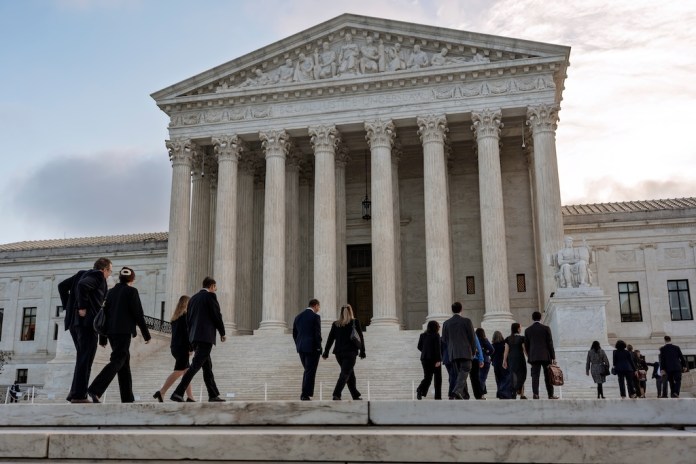
By now, most Supreme Court observers are aware that Associate Justice Samuel Alito authored the infamous decision overturning Roe v. Wade and its made-up “constitutional right” to abortion. How he was able to hold his majority together despite their differing approaches to legal interpretation, however, has always remained a bit of a mystery.
That is, until now.
In her newly released book, Alito: The Justice Who Reshaped the Supreme Court and Restored the Constitution, Federalist Editor-in-Chief Mollie Hemingway peels back the curtain on how the Bush appointee constructed the court’s majority opinion in Dobbs v. Jackson Women’s Health Organization (2022).
While each justice in the majority are self-described originalists, Hemingway details how each has their own secret sauce when it comes to their respective approaches to the law. This means that it was up to Alito to find a way to incorporate their varying views into the final decision overturning Roe and its successor, Planned Parenthood of Southeastern Pennsylvania v. Casey (1992).
Hemingway notes that in the days after oral arguments, the justices met for a conference to express their views on Dobbs and indicate how they would vote on the case. The final vote margin came down to 5-4 to overturn Roe and Casey, with the majority being comprised of Associate Justices Clarence Thomas, Alito, Neil Gorsuch, Brett Kavanaugh, and Amy Coney Barrett.
At the Supreme Court, the most senior justice in the majority assigns the opinion. While the chief justice is always considered to be the most senior, the majority assignment ultimately fell upon Thomas since Chief Justice John Roberts did not support overturning Roe and Casey.
Hemingway writes that, despite his decades-long criticisms of Roe and Casey, it was “an easy call for Thomas” to assign Alito the seemingly insurmountable task of authoring the Dobbs decision. Unlike Thomas, who holds differing views on stare decisis and “will not trim his views to attract other justices to join his opinions,” Alito was seen as the “best person for the job” because “one of his greatest strengths is keeping a majority opinion together and incorporating arguments from everyone.”
“That is all the more important when the vote is 5-4,” Hemingway writes. “Alito is known for being generous, humble, and ecumenical in his opinion writing. Over his decades on the Court, he has learned to be bold as prudence allows. Alito is not upset when another justice wants to include something that he believes is unnecessary or that tinkers with his prose.”
One of the chief areas in which Alito was all but required to perform a judicial balancing act was on the issue of substantive due process.
Hemingway notes that when writing the Dobbs opinion, the Bush appointee had to account for Thomas’ position that the Supreme Court “was in error when it kept finding rights” in the 14th Amendment’s due process clause. At the same time, she writes, Alito also had to consider the beliefs of justices like Kavanaugh, “whose concurrence emphasized how singular Dobbs was among substantive due process cases and how important precedent was.”
After taking these points into consideration, Hemingway details how Alito spent weeks crafting a majority opinion that incorporated these varying views but that didn’t sacrifice the core legal argumentation necessary to overturning Roe and Casey. After going through several rounds of edits, he produced an opinion that his fellow justices in the majority quickly signed onto.
“It was obvious to the other justices that the draft had been circulated before the formal distribution,” Hemingway writes. “They were not prepared for how powerful it was and were shocked by how devasting the opinion was to the Roe and Casey regimes.”
[ExplosiveReport:[ExplosiveReport:As Dobbs Majority Faced Death Threats, Liberal Justices Slow-Walked Release]
Shawn Fleetwood is a staff writer for The Federalist and a graduate of the University of Mary Washington. He is a co-recipient of the 2025 Dao Prize for Excellence in Investigative Journalism. His work has been featured in numerous outlets, including RealClearPolitics and RealClearHealth. Follow him on Twitter @ShawnFleetwood
" Conservative News Daily does not always share or support the views and opinions expressed here; they are just those of the writer."
*As an Amazon Associate I earn from qualifying purchases