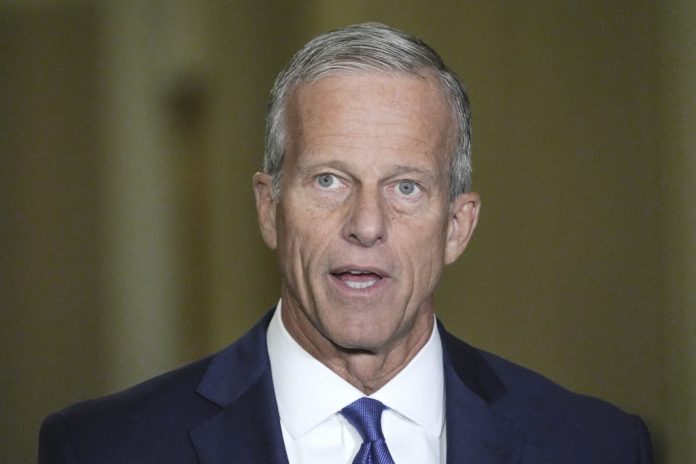
House Republicans pass party-line spending bill framework
Republican leadership achieved a notable victory by passing a $95 billion budget framework for a party-line spending bill,which includes funding for the Pentagon amid tensions with Iran,support for farmers,and election integrity reforms. The resolution narrowly passed 216-214 after some GOP members initially remained undecided. Opposing the bill were two Republican representatives, Warren Davidson (OH), Thomas Massie (KY), and Independent Kevin Kiley (CA), who caucuses with Republicans, citing concerns such as lack of funding offsets and unaddressed issues like Planned Parenthood funding and waste reduction.
House Budget Chairman Jodey arrington highlighted improvements in legislative efficiency, but some GOP hard-liners hesitated over unamended concerns related to affordability and spending offsets. The house moved swiftly to approve the framework, but the Senate has yet to introduce its version, partly due to the recent death of Senator Lindsey Graham, who was the Senate’s budget committee chair. Senate Majority Leader John Thune indicated the Senate would delay considering the bill until after a government funding deal is reached, disrupting the House’s reconciliation process.
The House’s budget resolution allocates specific funds to four committees without offsets: $10 billion for House Administration, $60 billion for Armed Services, $12 billion for Agriculture, and $13 billion for Intelligence. GOP leaders are also considering including major elements of the SAVE America Act into the bill, though this faces procedural challenges under Senate rules. To bypass potential legislative hurdles,leadership is working to attach a mandatory version of the SAVE America Act to the budget bill,aiming to ensure its passage despite the byrd Rule restrictions.
Republican leadership secured a major win Wednesday after passing a $95 billion budget framework for a party-line spending bill.
The framework includes money for the Pentagon amid the Iran war, farmers, and election integrity reforms. The resolution passed 216-214, exactly a week after the framework was unveiled, but not without a fight, after several Republican members headed into the vote undecided.
Recommended Stories
Two Republicans, Reps. Warren Davidson (R-OH) and Thomas Massie (R-KY), and Rep. Kevin Kiley (I-CA), an independent who caucuses with the GOP, opposed the resolution.
We’re getting better at it [reconciliation] every time we do it,” House Budget Chairman Jodey Arrington (R-TX) told the Washington Examiner. “We’re getting we’re getting more efficient.”
“It was a busy week and lots of meetings to address all kinds of questions and concerns to get people feeling good about the product, and I think we’re there,” he continued. “I think it speaks for itself. Election integrity and and support for our troops in conflict.”
GOP hard-liners held out their vote on the legislation after a slew of concerns that were not addressed in the third bill, such as cuts to Planned Parenthood funding, rooting out waste, fraud, and abuse, as well as affordability issues that have become a focal point for the 2026 election.
Along with the lack of provisions in the bill, these members took issue with the bill containing no offsets for the $95 billion in spending.
But while the House has moved quickly to usher through the budget framework, the Senate has yet to unveil its own version, in part because of the unexpected death of the late Sen. Lindsey Graham (R-SC), who was the Senate’s budget committee chairman.
Senate Majority Leader John Thune (R-SD) also told reporters Tuesday that his chamber would not take up the third budget bill until after a government funding deal is hammered out, taking the wind out of the House’s flurry to kick off the reconciliation process.
The House’s resolution includes spending instructions for four committees: the House Administration Committee at $10 billion, the House Armed Services Committee at $60 billion, the House Agriculture Committee at $12 billion, and the House Intelligence Committee at $13 billion, with no spending offsets in the resolution.
In the budget bill, House Republicans are considering including the main components of the SAVE America Act, something GOP hard-liners have demanded be included in exchange for their support of the legislation.
House Speaker Mike Johnson (R-LA) has previously said Republicans will work to pass as much of the SAVE America Act into law “as possible.”
In its current form, the SAVE America Act would not pass the Senate’s Byrd Rule, which governs policies allowed in reconciliation bills, meaning Republicans would need to overrule the parliamentarian’s ruling, something Thune has previously refused to do.
In an effort to circumvent that, a source familiar with the matter told the Washington Examiner that Republicans and leadership are “actively” working through attaching a “real mandatory SAVE policy” to the budget bill with the goal of it overcoming the Senate’s “Byrd bath.”
" Conservative News Daily does not always share or support the views and opinions expressed here; they are just those of the writer."
*As an Amazon Associate I earn from qualifying purchases