Harris becomes a campaign dilemma for Democrats in 2026
Democratic candidates in competitive midterm races are managing their relationships with Vice President Kamala Harris, with some welcoming her support and others distancing themselves due to her close ties to the Biden governance and the recent 2024 election loss. Harris remains a leading contender for the 2028 Democratic presidential nomination, but her association with the administration complicates her support among candidates in key races, especially in conservative-leaning states like Alaska and Iowa, were some Democrats prefer to avoid her endorsement to prevent political backlash.
In Alaska, Democrat Mary Peltola rejected Harris’s fundraising email and is focused solely on local issues, highlighting a reluctance to associate with Harris. similarly, in Iowa, candidates like Rob Sand and Josh Turek prefer to distance themselves from Harris, partly due to Iowa’s growing Republican registration advantage and the state’s recent political dynamics. Despite this, Harris is still considered influential for the Democratic base, especially among Black voters, women, and younger progressives, and continues to endorse various Senate candidates nationally.
In georgia, Senator Jon Ossoff expressed appreciation for Harris’s support, reflecting the state’s more competitive political landscape. Conversely, Harris has not widely campaigned publicly with Democratic candidates in red-leaning states as her 2024 defeat, illustrating a strategy of cautious engagement in such regions.
the political landscape shows a nuanced picture: some democrats avoid Harris’s involvement to improve electability, while others still leverage her support for base energization and fundraising.Her potential role in future campaigns remains meaningful, especially as she maintains high visibility and poll support, but her public associations are carefully managed amid evolving electoral considerations.
Democrats running in competitive races this midterm cycle are grappling with how to handle former Vice President Kamala Harris on the campaign trail, with some candidates welcoming her help while others are keeping their distance.
Harris remains a front-runner for the 2028 Democratic presidential nomination, but her ties to the Biden administration and 2024 loss are making some candidates wary of embracing her in must-win contests.
Recommended Stories
The latest dustup came as Alaska Democrat Mary Peltola rejected a Harris fundraising email sent on her behalf. “Mary isn’t seeking endorsements from anyone from the Lower 48 — her focus is and always will be Alaska,” a Peltola spokesperson told a local news outlet.
Harris lost Alaska to President Donald Trump by 13 points in 2024, underscoring the political challenge for Democrats running in the state.
Other Democrats running in red-leaning states did not seem receptive to support from Harris.
ROB SAND AND JOSH TUREK DON’T WANT KAMALA HARRIS TO CAMPAIGN FOR THEM IN IOWA
A campaign spokesperson for Rob Sand, the Democratic gubernatorial nominee in Iowa, told the Washington Examiner that the campaign does not want an endorsement from Harris, nor do they want her to appear at any campaign rallies or have any involvement with Sand’s campaign. The position marks a stark contrast with 2018, when Harris supported Sand’s successful campaign for Iowa state auditor. Trump carried Iowa by 13.2 points over Harris in 2024.
This week, the Cook Political Report moved the Iowa gubernatorial race from “toss-up” to “leans Democratic.” It also changed Iowa’s Senate race from “leans Republican” to “toss-up” — a boost to Democratic Senate candidate Josh Turek.
Iowa Democrats appear to be on the cusp of reviving their base after the Cook Political Report recently changed its rating of the Iowa gubernatorial race from “toss-up” to “leans Democratic.” It also changed Iowa’s Senate race from “leans Republican” to “toss-up” — a boost to Democrat Josh Turek.
Turek’s campaign told the Washington Examiner he has no plans to campaign with Harris and isn’t seeking her support. In 2024, Turek, an Iowa state representative, outperformed Harris by roughly 13 points in his district, illustrating the dramatically different political coalitions the two Democrats assembled in Iowa.
University of Iowa political scientist Timothy Hagle noted in an interview that Republicans hold a roughly 190,000-voter registration advantage in the state, a gap that has grown over the last several election cycles.
“We have an open Senate seat, an open governor’s race, and I think that the nominees in those races and sort of a lot of Iowa Democrats more generally sort of understand they don’t want to spoil that by appearing to be too far to the left on issues,” Hagle said. “And so if they were to associate with Kamala Harris, it could be a problem for them.”
The distancing from Harris in red states isn’t new for Democrats.
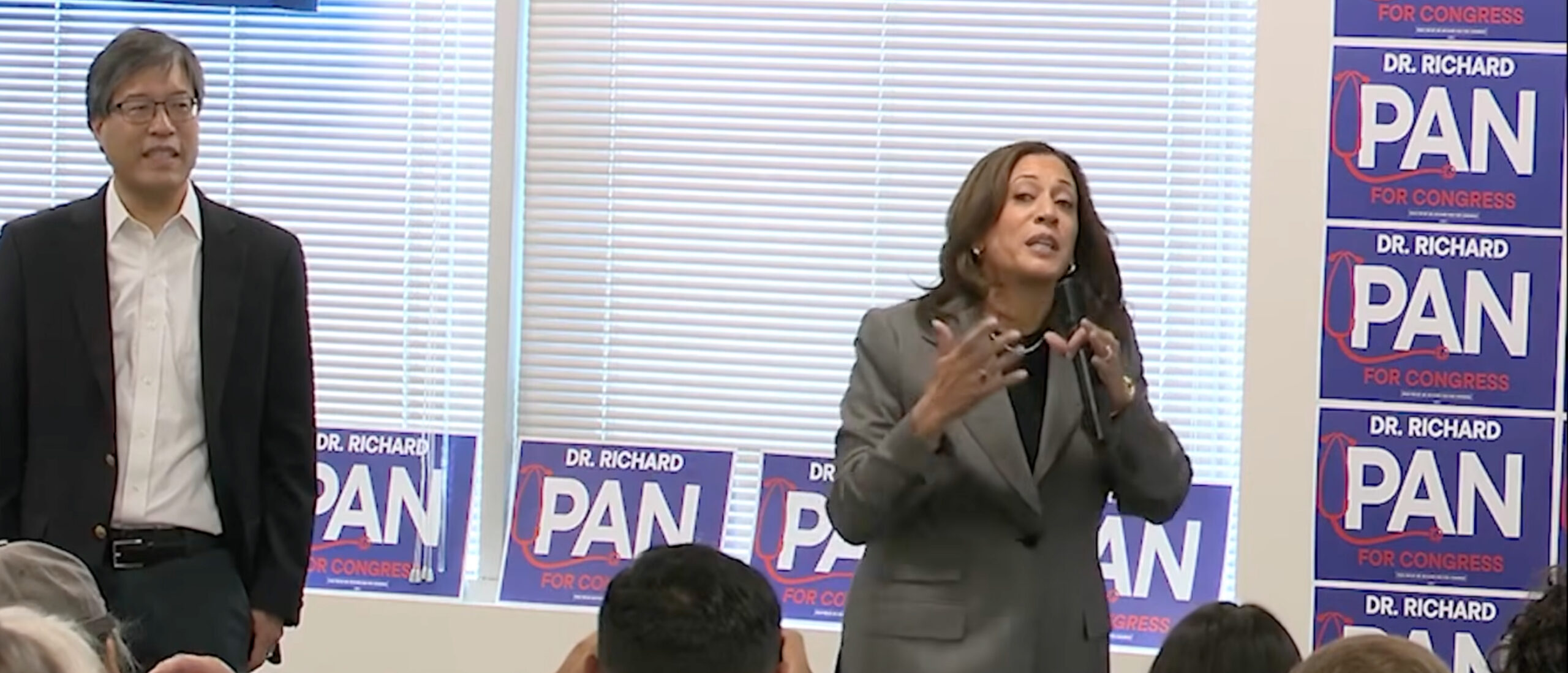
In one of her forays back into the political scene after the 2024 loss, Harris visited Tennessee in November 2025 for her 107 Days book tour but did not explicitly endorse or even mention state Rep. Aftyn Behn, who was then running for the state’s 7th Congressional District, by name. At an event where Harris and Behn both appeared, the lawmaker left before Harris arrived, citing a fundraiser she needed to attend.
But not all Democrats are running away from Harris.
Sen. Jon Ossoff (D-GA) held a private “Women for Ossoff” call with Harris, where he said it was a “delight” to see her. Ossoff is running in one of the most closely watched Senate battles. But unlike Democrats running in red-leaning states, Georgia has become a perennial purple state that Democrats must keep if they hope to regain control of the upper chamber.
The Peach State is also home to a sizable black electorate, a constituency Democratic strategist Dallas Jones identified as one of Harris’s remaining strengths within the Democratic coalition.
A spokesperson for the Ossoff campaign told the Washington Examiner that “Senator Ossoff is grateful for Vice President Harris’ help and support in his re-election campaign.”
In addition to Ossoff, the former vice president endorsed Senate Democratic candidates including Troy Jackson in Maine, Abdul el Sayed in Michigan, Roy Cooper in North Carolina, and James Talarico in Texas. It is not clear whether Harris has endorsed former Ohio Sen. Sherrod Brown’s comeback bid against Sen. Jon Husted (R-OH). The Brown campaign did not respond to a request for comment from the Washington Examiner.
Jones said that while Harris’s endorsement still carries real weight, it’s mainly only on two fronts.
“It’s base energy and money, and so fundraising, her list, and donor networks are still strong in the party,” said Jones. “And so sometimes that comes in with a bump in small-dollar money. Base turnout, especially with black voters, women, younger progressives, she still remains a trusted messenger.”
Among the potential 2028 Democratic candidates, Harris continues to poll in first place. A recent Focaldata-Financial Times poll showed that Harris received 30% support, more than double her closest competitor, Gov. Gavin Newsom (D-CA), at 14%. Simply ignoring Harris may not be prudent for Democrats. Harris still has loyal followers in the party who claim her truncated 107-day race against Trump, after Biden dropped out, did not give her sufficient time to run a serious campaign.
Harris’s standing creates a complicated dynamic for Democrats. She remains one of the party’s most recognizable figures and retains a national fundraising network and loyal base of supporters, even as candidates in Republican-leaning states appear wary of associating themselves too closely with the former vice president.
“Now, in the case of Mary Peltola, in some of the places that are more conservative, where they are polling well, they still need Republicans to swing the pendulum and to get them over the hump,” Jones added. “So a rejection of a Kamala Harris endorsement makes sense in those states as a campaign strategy.”
Harris has not held a public campaign rally with a Democratic candidate since appearing in Tennessee during Behn’s unsuccessful congressional campaign, although that could change before November.
SOUTH CAROLINA’S MOVE TO FRONT OF 2028 DEMOCRATIC PRIMARY CALENDAR COULD BENEFIT KAMALA HARRIS
Hagle said Harris’s struggles as the Democratic nominee in 2024 could help explain why some candidates are reluctant to put her on the campaign trail.
“She was not a great candidate in terms of a lot of her public appearances and things and statements that she made, being criticized for having word salad and things of that nature, and so it was just too easy for the Republicans to poke fun at that,” Hagle said. “But she can speak to her supporters in a way that would maybe get them energized, and that’s kind of the key: is if you can get your base energized, that can be important.”
" Conservative News Daily does not always share or support the views and opinions expressed here; they are just those of the writer."
*As an Amazon Associate I earn from qualifying purchases