Democrats brace for more anti-establishment primaries after upsets
The recent Democratic primary in Colorado highlights a surge of anti-establishment candidates challenging customary party insiders, signaling a broader ideological shift within the party ahead of the 2026 midterm elections. Melat Kiros, a young attorney and Ph.D. student, defeated longstanding Rep. Diana DeGette, indicating voters’ growing preference for authentic, populist-progressive candidates over established figures. similar trends are evident across other states like New York,Michigan,Florida,California,arizona,and Missouri,where insurgent candidates with progressive or socialist platforms are gaining momentum,fueled by economic dissatisfaction,frustration with party leadership,and a desire for generational change. Analysts compare this movement to the Tea Party insurgency within the Republican Party, warning it could lead to party rifts and complicate governance. Democratic strategists emphasize that voters are seeking candidates who present genuine visions rather than traditional political lines, tho some party leaders express concern over the vetting of these new challengers. The surge reflects deep dissatisfaction with the party establishment and may reshape Democratic dynamics, especially if progressive candidates succeed in key battleground races, with potential implications for leadership if Democrats regain control of Congress.
Colorado’s Democratic primary shake-up is intensifying fears among party insiders that an anti-establishment revolt once seen as concentrated in New York City is rapidly spreading across the country ahead of the 2026 midterm elections.
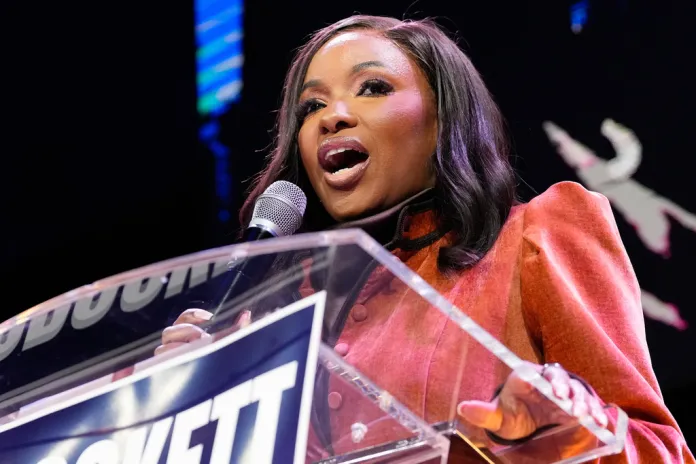
The defeat of longtime Rep. Diana DeGette (D-CO) in Colorado at the hands of 29-year-old attorney and Ph.D. student Melat Kiros marked the latest warning sign for Democratic insiders already rattled by a string of progressive-backed primary upsets in recent weeks.
Recommended Stories
Kiros led the longtime incumbent by nearly 10 percentage points as of Wednesday morning, underscoring the scale of the upset and fueling broader questions about whether Democratic voters are increasingly turning against institutional party figures.
The result came just days after challengers backed by New York City Mayor Zohran Mamdani unseated Reps. Dan Goldman (D-NY) and Adriano Espaillat (D-NY) in New York primaries, accelerating anxiety among establishment Democrats who fear a growing anti-incumbent mood inside the party.
Now, Democratic operatives are bracing for another round of insurgent primaries across the country. In Michigan, progressive state Rep. Donavan McKinney is mounting a high-profile challenge against Rep. Shri Thanedar (D-MI), while Abdul el Sayed has emerged as a formidable contender in the state’s closely watched Democratic Senate primary.
In Florida, socialist candidate Oliver Larkin is challenging Rep. Jared Moskowitz (D-FL), while activist Elijah Manley is also running on an anti-establishment platform. California has become another hot spot, with Mai Vang and Angela Gonzalez-Torres both launching insurgent campaigns against establishment-aligned Democrats. In Arizona, organizer Kai Newkirk is running as a progressive challenger, while in Missouri, former Rep. Cori Bush is attempting a political comeback with support from local Democratic Socialists of America activists.
Wisconsin is also emerging as a test case for the Left, with state Rep. Francesca Hong competing in a crowded Democratic gubernatorial primary in one of the country’s most important battleground states. For many Democrats, the issue is no longer whether anti-establishment energy exists inside the party, but how far it could spread before November.
“I think they’re absolutely part of a wave that we’re seeing inside Democratic politics,” Democratic strategist Randy Jones told the Washington Examiner, arguing the party establishment has struggled to reconnect with its base since President Donald Trump’s reelection.
Jones said many voters no longer trust longtime Democratic figures after repeated national losses and are instead gravitating toward candidates they view as authentic and economically populist.
“I think they certainly are progressive candidates, but I think they are candidates with populist economic visions that don’t involve racism or xenophobia,” Jones said.
“I think the average voter thinks that everybody’s lying to them,” he said. “These people don’t sound like they’re selling them a line, they sound like they’re selling them a vision.”
Democratic strategist Jon Reinish said the backlash is also being fueled by growing frustration among Democratic voters demanding generational change after years of party losses and leadership stagnation.
“A lot of members, especially long-serving ones who are very used to their jobs, are so in their own bubble that even though the party and the party faithful have been very vocal about generational change being among their No. 1 desires as voters, folks sort of thought it didn’t apply to them,” Reinish said.
Reinish argued some longtime incumbents are misreading the mood of Democratic voters and failing to recognize how quickly the party’s electorate is changing.
“If you’re 70, you’ve had an incredible 30-year legislative career in the House, you’ve had a great run,” he said. “Shouldn’t the idea be to leave with your head held high, knowing that the alternative could be a thumping embarrassment?”
The growing unrest has exposed an increasingly public divide inside the Democratic Party, with prominent establishment figures openly questioning whether socialists still belong under the Democratic Party’s tent.
Veteran Democratic strategist James Carville warned Democrats may be headed toward a “schism,” arguing on his podcast that some DSA-aligned candidates “have no place in the Democratic Party.”
Former Democratic National Committee Chairman Jaime Harrison also issued a pointed message to candidates running under the Democratic banner while attacking the party itself.
“If you hate the Democratic Party, then please don’t run for our nomination,” Harrison posted on social media. “Don’t use our resources. Don’t rely on our volunteers. Don’t use our infrastructure.”
Meanwhile, the DSA celebrated Kiros’s victory as proof the movement is gaining traction nationally, declaring on social media that “another Democratic Socialist is going to Congress.”
Some Democrats now see parallels to the tea party movement that reshaped the Republican Party more than a decade ago, as progressive challengers increasingly topple longtime incumbents and deepen tensions between the party’s base and establishment wing.
“This is exactly what the Republicans went through with the tea party insurgency of 2010 and then capping it off with the MAGA insurgency of the Trump era,” Reinish said. “Republicans have already lived through this kind of anti-establishment revolt. It created enormous headaches for leadership, made governing much harder, and completely reshaped the direction of the party.”
Reinish also warned Democratic leadership is struggling to balance pressure from the party’s activist base with broader electability concerns as insurgent candidates gain momentum.
“Leadership has to walk a line,” he said. “Trying to play God doesn’t work. But at the same time, there’s a pretty serious vetting problem with a bunch of candidates.”
Doug Wilson, a Democratic strategist in North Carolina, said the movement is being fueled by economic frustration, generational dissatisfaction, and anger at Democratic leadership after Trump’s return to power.
“I think it’s deeper than just anti-establishment,” Wilson said of the Colorado results. “This is the result of a generation of families living paycheck to paycheck colliding with an affordability crisis and the hegemony of an imperial presidency.”
Wilson said the movement bears similarities to the tea party revolt, but argued Democratic voters are being driven more by frustration with party leaders they believe have failed to aggressively confront Trump and address economic anxiety.
“The difference on the Democratic side is the insurgency is the result of what is seen as a lack of grit and pushback against Trump,” he said. “Progressives see Trump as a threat to democracy as a whole.”
Republicans, meanwhile, are increasingly trying to frame the Democratic shift as politically dangerous in battleground states.
“The socialist takeover of the Democrat Party is no longer confined to deep-blue strongholds,” National Republican Congressional Committee spokesman Mike Marinella said in a statement. “The radicals are taking over battleground districts, putting must-win seats out of reach for Democrats and sinking their chances of flipping the House.”
Jones dismissed Republican attempts to label the insurgent wing as communist or extreme.
“If Richard Hudson, the chair of the NRCC, thinks that his path to keeping his majority is calling us all communists, then I think he’s either in denial or he’s suffering a severe lack of creativity,” Jones said. “I don’t think that’s going to work.”
Still, Democrats are increasingly watching whether the insurgent momentum seen in New York and Colorado can spread into battleground-state races with broader national implications.
“It’s clearly what Democratic voters are asking for and voting for right now,” Jones said. “The majority of folks in my party who want to present a better vision for the public, a winning vision, I think they’re either on board or they’re going to have to get on board.”
DSA EYES NATIONAL EXPANSION AFTER NEW YORK WINS AS DEMOCRATS BRACE FOR NEW PRIMARY FIGHTS
Wilson said the real test for Democratic leadership may come after the midterm elections if Democrats regain the House majority.
“I think if Leader Jeffries becomes speaker in January 2027, it is going to be very interesting to see how he balances an emboldened progressive wing and the remaining moderate wing of the caucus,” Wilson said.
" Conservative News Daily does not always share or support the views and opinions expressed here; they are just those of the writer."
*As an Amazon Associate I earn from qualifying purchases