Court grills DOJ over decision to end refugee status for Rwandan immigrants
A federal appeals court questioned teh Justice Department’s claim that two Rwandan refugees cannot challenge the revocation of their refugee status in court. The hearing took place in the U.S. Court of appeals for the 10th circuit, which requested new arguments after the Supreme Court’s June decision in Mullin v. Doe. That ruling limited courts’ ability to review certain immigration decisions,and the DOJ argued it should guide the current case as well. However, the refugees’ lawyers argued that the Mullin decision applies only to removal proceedings, not to the termination of refugee status, which they say is a final agency action not subject to judicial review in the same way. The panel questioned both sides, with some judges skeptical of the DOJ’s reliance on Mullin, and the court did not indicate when a decision might be made. the case centers on whether the refugees can legally challenge the termination of their refugee status in federal court.
A federal appeals court grilled the Justice Department on Monday over its assertion that two Rwandan nationals may not challenge the revocation of their refugee status in court.
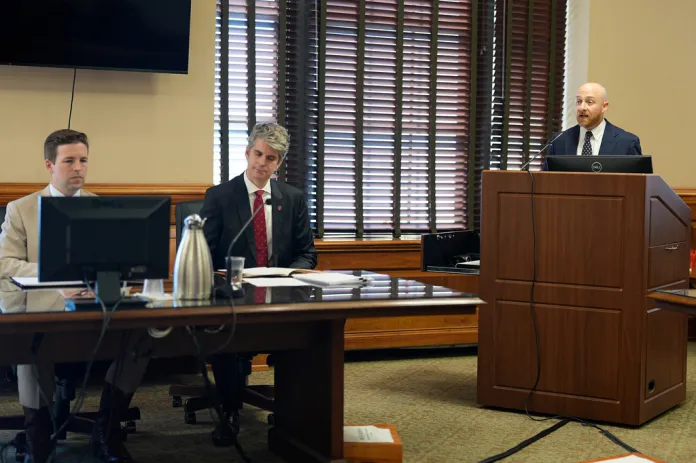
A three-judge panel on the U.S. Court of Appeals for the 10th Circuit heard arguments brought by both the DOJ and the lawyers for the two Rwandan refugees. The panel requested a new oral argument session after the Supreme Court’s June ruling in Mullin v. Doe. In the Mullin case, the high court ruled that federal immigration law barred courts from reviewing the decision by the Trump administration to end temporary protected status for various countries. After that decision, the DOJ asked the appeals court to reconsider its ruling in the case of the Rwandans, asserting that the Mullin decision provides a blueprint for how the 10th Circuit should act in this case.
Recommended Stories
“We are looking at an act where Congress has throughout insulated certain discretionary decisions by the executive in the immigration context, and specifically in clause 1, Congress insulated judicial review over certain judgments and any other decision or action,” DOJ lawyer Aneesa Ahmed told the panel, relating the Mullin ruling to the case at hand.
Multiple judges pushed back on Ahmed’s assertion that the Mullin ruling proves their case, sparring over the specific language of federal immigration law and whether it offers an avenue for review in federal courts. Ahmed emphasized that, at the conclusion of removal proceedings in immigration court, the two refugees could ultimately raise any legal challenges in a petition for review to a federal circuit court.
The DOJ requested that the appeals court affirm the district court’s ruling tossing out the challenge by the refugees, after the panel had previously sided with the refugees earlier this year prior to the Supreme Court’s Mullin ruling.
Daniel Black, a lawyer for the two refugees, urged the appeals court to allow the legal challenge to proceed, claiming that Mullin dealt with a different part of immigration law and that the judicial review bar does not apply in this case to the two Rwandan refugees.
“The termination of refugee status is discrete, final agency action that strips a vested status, and this Court has already held that it does not arise from removal proceedings,” lawyers for the refugees said in a filing ahead of Monday’s hearing. “No petition for review can reach it: the immigration courts do not review USCIS refugee-status terminations, and 8 U.S.C. § 1252(b)(4)(A) confines any petition for review to ‘the administrative record on which the order of removal is based’ — a record which the refugee termination never enters.”
“Because no other adequate remedy exists in a court, the [Administrative Procedure Act] supplies review in the only forum the statute leaves open: the District Court,” the refugees’ filing continued.
FEMALE-ONLY SPA ASKS SUPREME COURT TO LET THEM BAN ‘SWINGING D***S’
The appeals court panel also appeared skeptical of Black’s arguments, peppering him with sharp questions over the scope of the Mullin ruling and how it relates to this part of immigration law.
The 10th Circuit panel included U.S. Circuit Judges Timothy Tymkovich, an appointee of former President George W. Bush; Gregory Phillips, an appointee of former President Barack Obama; and Carolyn McHugh, an Obama appointee. The appeals court, which oversees federal courts in Colorado, Kansas, New Mexico, Oklahoma, Utah, and Wyoming, did not indicate how it would rule or offer a timeline for when a ruling would come.
" Conservative News Daily does not always share or support the views and opinions expressed here; they are just those of the writer."
*As an Amazon Associate I earn from qualifying purchases