Clarence Thomas and Two Fellow Conservatives Form Unexpected Majority with Two Liberals in SCOTUS Decision
The provided content discusses a 5-4 Supreme Court decision concerning the jurisdiction of state courts when plaintiffs seek review from federal courts. Justices Clarence Thomas, samuel Alito, Brett Kavanaugh, Sonia Sotomayor, and Ketanji Brown Jackson formed the majority, while Chief Justice John Roberts, Amy Coney Barrett, neil Gorsuch, and Elena Kagan dissented.
The case involved a woman, T.M., who alleged her due process rights were violated after she was involuntarily detained and medicated at a hospital following a gluten allergy incident. Her subsequent legal actions targeted the state court’s consent order dismissing her suits,leading to a dispute over whether federal courts could hear her challenge under the Rooker-Feldman doctrine. Justice Sotomayor clarified that this doctrine barred federal review when a case is under appellate review in state courts, aligning with established precedents. Justice Thomas emphasized that federal district courts lack appellate jurisdiction over state judgments, and his dissent argued that federal courts should have broader authority to hear collateral attacks on state decisions.
The case underscores ongoing debates regarding jurisdictional limits between federal and state courts, with the majority affirming the narrow scope of the Rooker-Feldman doctrine and the dissent advocating for more expansive federal oversight of certain state court rulings.The University of Maryland Medical System expressed satisfaction with the ruling, viewing it as clarifying existing legal principles.
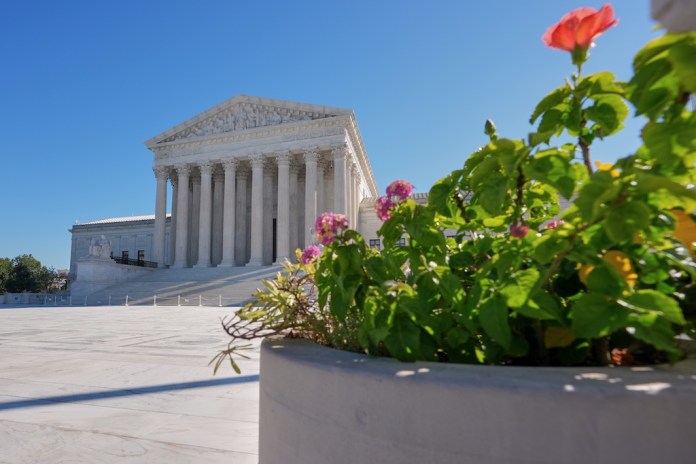
Supreme Court justices Clarence Thomas, Samuel Alito, and Brett Kavanaugh joined with liberal justices Sonia Sotomayor and Ketanji Brown Jackson in a 5-4 decision upholding the jurisdiction of state courts when plaintiffs also seek review by the federal court system.
Chief Justice John Roberts, Amy Coney Barrett, Neil Gorsuch, and Elena Kagan dissented in the ruling in T.M. v. University of Maryland Medical System Corp.
“The case was brought by a person identified only as T.M., who said she has a medical condition that can cause psychosis when she ingests gluten. In March 2023, she accidentally did so and was taken to the emergency room at Baltimore Washington Medical Center, according to court filings,” Newsweek reported.
She was then allegedly held at the hospital involuntarily for three months and forcibly injected with antipsychotic medication. Her parents filed lawsuits in state and federal courts against the hospital, seeking her release and to end the medication.
The parties reached a settlement agreement allowing T.M.’s release, but the state judge presiding over the habeas corpus case (wrongful detainment) set several conditions, including that the plaintiff agree to dismiss with prejudice all the pending cases against the University of Maryland Medical System Corp.
“However, 10 days later, she and her parents obtained new counsel and sued them in federal district court, seeking a declaration that the [state judge’s] order violated her due process rights [under the U.S. Constitution]. At the same time, she appealed the consent order to the Appellate Court of Maryland,” Newsweek said.
The federal district court dismissed her complaint, saying it lacked jurisdiction under what’s known as the Rooker-Feldman doctrine, which provides that federal district courts are not allowed to act on a matter while it is under appeal in the state court system. Only the U.S. Supreme Court has jurisdiction to take up such cases.
In her majority opinion, Sotomayor wrote, “This case asks whether this rule bars suit when the state court judgment at issue is subject to further review in state appellate proceedings. A straightforward application of the logic and reasoning underlying Rooker-Feldman leads to one conclusion: It does.”
She added the plaintiff’s theory “cannot be squared with this Court’s precedents, which plainly adopted a different, more functional view of original and appellate jurisdiction than what T. M. advances here.”
Interesting 5-4 case with more-common-than-you-might-think crossing of ideological lines
The Majority:
Sotomayor (wrote the opinion)
Thomas
Alito
Kavanaugh
JacksonMinority:
Barrett
Roberts
Kagan
Gorsuch https://t.co/C2txF0j9mP— The Deseret Stone (@DeseretStone) June 18, 2026
In his concurring opinion, Thomas wrote, “The power to revise or modify another court’s judgment or decree has been recognized as an exercise of appellate jurisdiction from before the ratification of the Constitution,” explaining that federal district courts are not authorized to exercise appellate jurisdiction over state court decisions.
“Congress has long given only this Court [U.S. Supreme Court], and not inferior courts, appellate jurisdiction to revise state-court judgments,” he further contended. “Congress has never purported to give inferior federal courts general revising power over state-court judgments for errors of federal law.”
In her dissenting opinion, joined by Roberts, Kagan, and Gorsuch, Barrett wrote, “Because Rooker-Feldman stands on shaky ground, we have consciously kept its footprint small. Its rationale has gotten no firmer, so we should make the doctrine no larger.”
Barrett argued that federal district courts do have jurisdiction over “collateral attacks on state-court judgments,” arguing that a “collateral attack is not the functional
equivalent of an appeal.”
Cornell Law School defines a collateral attack as “a challenge on the validity of a prior judgment through a new case rather than by a direct appeal,” adding, “Common grounds for a collateral attack include a lack of personal jurisdiction, a lack of subject matter jurisdiction, and a failure of due process in the first case.”
T.M. had made the argument in federal court that her due process rights were violated by the consent order the Maryland state judge issued.
Barrett concluded her dissent, writing, “Still, the news is not all bad. Although the Court expands Rooker-Feldman beyond Exxon’s line, it repeatedly emphasizes that the doctrine is ‘narrow’ … Courts should not lose sight of that message. In the end, Rooker-Feldman has been given an inch — it should not be allowed to take a mile.”
The University of Maryland Medical System wrote in a statement to Newsweek that the ruling “provides important clarity regarding the legal framework governing state court proceedings. “We appreciate the Supreme Court’s careful consideration of this matter and its decision today and are pleased that the Supreme Court justices agreed with our position, which affirms the legal principles and longstanding precedent in this case.”
Advertise with The Western Journal and reach millions of highly engaged readers, while supporting our work. Advertise Today.
" Conservative News Daily does not always share or support the views and opinions expressed here; they are just those of the writer."
*As an Amazon Associate I earn from qualifying purchases