Breaking: Trump Admin Victorious in Two Crucial Supreme Court Cases Regarding Immigration
The provided content includes a news report highlighting two meaningful supreme Court decisions under president Donald Trump’s governance related to immigration. in Mullin v. Doe, the Court upheld the administration’s authority to terminate Temporary Protected Status (TPS) for Haitian and Syrian nationals, emphasizing that the law governing TPS restricts judicial review of such decisions. The ruling was supported by a majority of justices, with opposition from three justices. The decision noted that the original reasons for TPS, such as civil war in Syria and an earthquake in Haiti, are no longer applicable, thus allowing the termination. Additionally, in Mullin v. Al Otro Lado, the Court approved the administration’s policy to turn back illegal immigrants at the U.S.-Mexico border, including those claiming asylum, reinforcing that arriving at the border does not automatically grant asylum rights under current laws.These rulings reflect a stance favoring executive authority over immigration enforcement and strict interpretations of immigration statutes.
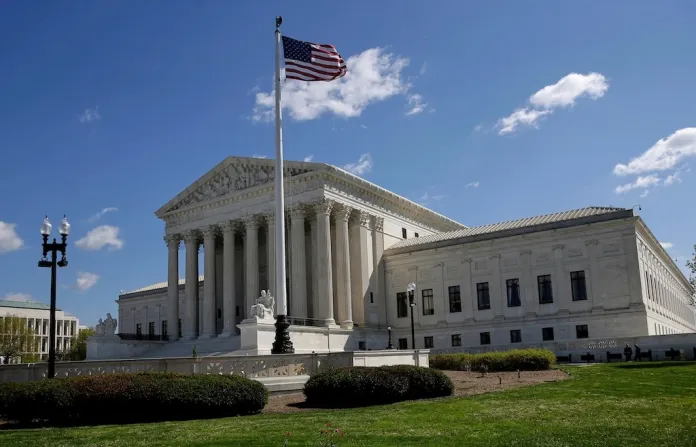
The Supreme Court handed President Donald Trump two major victories Thursday in his administration’s efforts to clamp down on immigration.
In the case of Mullin v. Doe, the Supreme Court kicked aside lower court rulings that tried to prevent the administration from ending Temporary Protected Status for Haitian and Syrian nationals who had been allowed to live in the United States indefinitely.
Chief Justice John Roberts, Clarence Thomas, Samuel Alito, Neil M. Gorsuch, Brett M. Kavanaugh, and Amy Coney Barrett supported the ruling. Justices Ketanji Brown Jackson, Sonia Sotomayor, and Elena Kagan opposed it.
The court ruled that the law that created TPS did not allow for judicial review.
The court noted that Syrian immigrants had been covered by TPS since 2010 and Haitians since 2012. As noted by Scotusblog, former Homeland Security Secretary Kristi Noem, in striking down TPS for both nations, noted that the civil war in Syria that created the conditions for TPS has ended. She also noted that the earthquake that was the impetus for granting TPS to Haitians is now firmly in the past.
…We have our next opinion. It is another big one: Mullin v. Doe. The court rules in favor of the Administration in ending the Temporary Protected Status for Syrian and Haitian nationals. Big day for the Trump Administration on immigration in combination with the Mullin v. Al…
— Jonathan Turley (@JonathanTurley) June 25, 2026
Alito noted in the majority opinion that TPS “allows ‘no judicial review of any determination … with respect to the … termination’ of a TPS designation. The term ‘determination’ can be used to describe either an individual decision or the whole process leading to a final decision, and under either understanding of the term,” he wrote.
Thus, he ruled the law “squarely bars” judicial review of Noem’s ruling.
Alito said the claim from Haitians that they were targeted because of their race “will likely fail.”
He noted that the Trump administration “has terminated every TPS designation that has come up for renewal” and “simply opposes the TPS program, at least as it has been implemented in the past.”
In Mullin v. Al Otro Lado, the court ruled that the Trump administration can continue turning back illegal immigrants at the Mexican border even when those immigrants claim they are seeking asylum.
The case was decided on a 6-3 vote with the justices arrayed as they were in the other immigration-related ruling.
The central question in the case was whether illegal immigrants claiming to be asylum seekers had to have their cases heard. The lawsuit sought to claim that Haitians who had reached the border but were turned back had, in fact, arrived in the U.S. under terms of immigration law, according to Scotusblog.
Alito, writing for the majority, said “no one would say that a person ‘arrives in’ a place—for example, a house, a city, or a country — before the person enters that place. The context in which the phrase ‘arrives in the United States’ is used in the immigration statutes at issue here supports an ordinary meaning.”
Alito said that an illegal immigrant “who unsuccessfully attempts to arrive in the United States does not arrive in the United States.”
If Congress wanted “aliens who arrive at or near the border to be able to apply for asylum,” Alito wrote, it could have crafted federal law to reflect that position.
“Congress did not use those terms,” he wrote.
Advertise with The Western Journal and reach millions of highly engaged readers, while supporting our work. Advertise Today.
" Conservative News Daily does not always share or support the views and opinions expressed here; they are just those of the writer."
*As an Amazon Associate I earn from qualifying purchases