A Rare Kremlin Concession: Former Marine Freed After Years of Captivity
The provided content appears to be a webpage excerpt containing an article about the release of Robert Gilman, a former U.S. Marine, from detention in Russia. Gilman was held for over four years after being arrested on charges that his family and defense team dispute as false and politically motivated. His health deteriorated significantly during imprisonment due to mistreatment, leading to concerns from human rights groups and government officials.
The article highlights that Gilman’s release was achieved without a prisoner swap, a notable departure from previous diplomatic exchanges, and involved high-level negotiations led by U.S. advisers. President Donald Trump announced Gilman’s return via social media, celebrating the effort and indicating that the U.S. never offered concessions. The event is viewed as a gesture of goodwill from Russia amid ongoing geopolitical tensions, particularly relating to the war in Ukraine.
Gilman was transported to a medical facility in Texas for recovery, and ongoing efforts continue to secure the release of other Americans detained in Russia. The article conveys the complex diplomatic efforts involved and the significance of Gilman’s case within broader U.S.-Russia relations.
In an unexpected breakthrough that illustrates the complex dynamics of back-channel foreign policy, Russian authorities officially released former U.S. Marine Robert Gilam today, after spending over four years in a Voronezh detention facility.
Announced on social media, President Donald J. Trump championed the development, “American citizen Robert Gilman, a former United States Marine, is coming HOME!” after extended discussions with Russian President Vladimir Putin.
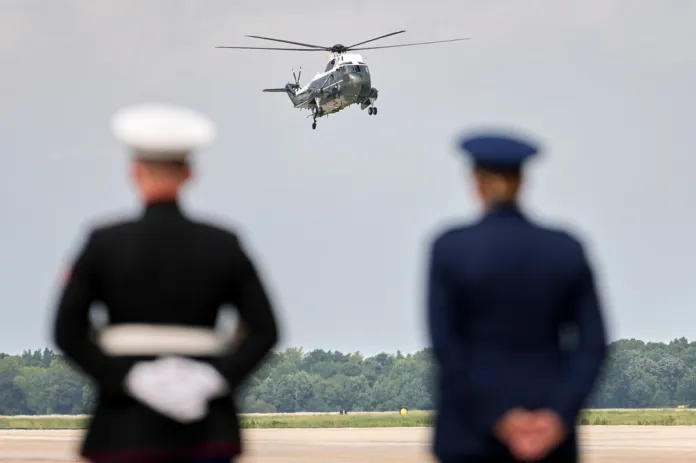
Officials in the administration confirmed that Gilman had been loaded onto a State Department aircraft along with his mother, Nina, and were bound for Joint Base Andrews in Maryland before relocating to a medical facility in Texas.
Trump d that during a short phone call with Gilman the recently freed American had one primary request: “A GREAT cheeseburger when he lands.”
The 32-year-old native of Lowell, Massachusetts, who had been working as an English teacher in Europe, was originally arrested in January 2022 while aboard a train in the southern part of Russia. State media accused him of assaulting a police officer while intoxicated, a charge both his family and defense team dispute as categorically false and politically motivated.
His original three-and-a-half-year sentence was extended several times by Russian courts to the point where it had tripled in length. His father, Vladimir Gilman, d in an op-ed that at the time of the incident on the train his son was suffering from a medical episode and had unintentionally kicked the officer.
As the sentence prolonged, national security advocates and human rights organizations publicized warnings that Gilman’s health would soon reach a point of critical collapse.
Eric Lebson, chief strategy officer at Global Reach, reported that the American had been moved inconspicuously from a prison ward to a psychiatric facility in a “dissociative stupor” caused by prolonged mistreatment, including 16-hour exercise sessions and psychotropic medications.
Eventually placed on a feeding tube and permanently handcuffed to a hospital bed, medical assessments described his condition as life-threatening.
An ocean away, the crisis sparked alarm across Capitol Hill and in the State Department, which formally designated Gilman as being wrongfully detained.
Senator Edward Markey (D-Mass.), who has been extremely vocal in advocating Gilman’s release over the last four years, celebrated his return while curtly condemning Moscow’s treatment of the veteran.
Markey asserted, “It is a tragedy that it took Robert’s near-death condition for his case to receive the attention that is required for his release to be negotiated,” accusing Russian officials of subjecting Gilman to systemic abuse and deliberate provocations throughout his tribulation.
Following the release, Gilman’s family began expressing relief on social media, praising the executive branch’s handling of the situation.
His sister, Lexie Hudson, d, “There is no other reason that Robert is alive today other than that President Trump heard about the case and took action,” further expressing gratitude to lawmakers for making sure the case remained in the public limelight.
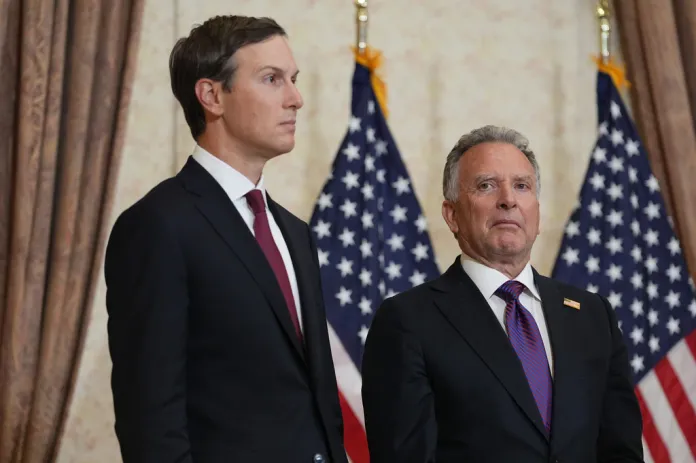
Behind the scenes, the high-stakes extraction effort was led by a team of presidential advisers, including negotiator envoy Adam Boehler, Special Envoy Steve Witkoff, Deputy National Security Advisor Sebastian Gorka, and Senior Advisor Jared Kushner.
The Kremlin’s decision to grant a humanitarian pardon without requesting a reciprocal prisoner swap illustrates a conspicuous departure from prior Cold War-style exchanges.
State Department spokespersons underscored the fact that the administration never offered a prisoner swap or policy concessions to secure Gilman’s return. Foreign policy analysts in the Beltway interpret Moscow’s choice as a calculated gesture of goodwill during the current war in Ukraine.
As Gilman undergoes comprehensive medical and psychological rehabilitation in San Antonio, U.S. officials affirm that the comprehensive hostage agenda remains an urgent diplomatic dilemma. Several Americans remain captive in Russian penal colonies, including Stephen Hubbard, a retired teacher indicted on the count of serving in a Ukrainian territorial defense unit.
Diplomatic channels will stay open to secure the release of all remaining detained citizens, as State Department officials continue navigating complex geopolitical friction to bring every last American home.
Advertise with The Western Journal and reach millions of highly engaged readers, while supporting our work. Advertise Today.
" Conservative News Daily does not always share or support the views and opinions expressed here; they are just those of the writer."
*As an Amazon Associate I earn from qualifying purchases