A brewing conflict within anti-Houthi coalition risks another Yemen war
The article discusses ongoing conflicts in Yemen involving the Houthis, the anti-Houthi alliance, and regional actors. It highlights the internal tensions among Yemen’s anti-Houthi groups,particularly between the Southern Transitional Council (STC) and the Presidential Leadership Council (PLC),which threaten to destabilize the region and complicate U.S.efforts. The STC, advocating for South Yemen’s independence, remains active despite its official dissolution, with many leaders operating in exile and rallying support. Clashes between these factions, along with crackdowns and protests, indicate rising hostility. The U.S. opinion favors supporting the STC’s hard-line stance against the Houthis, whom they accuse of being paid off by Iran and engaging in regional aggression. The article emphasizes that a complete approach involving regional partners is necessary to effectively counter the Houthis, with recent Houthi attacks on shipping underscoring the evolving threat.
As the Houthis continue on the path to war against Saudi Arabia and the United States, an entirely different conflict brewing among the anti-Houthi alliance in Yemen threatens to derail the U.S. position in the region.
While the Houthis joined the post-Oct. 7, 2023, wars against Israel in defense of Hamas, the Yemeni civil war that brought the Houthis to power has remained frozen around the 2022 ceasefire. In a development that surprised many, a brief war broke out within Yemen late last year, but between the Houthis’ two chief rivals, the separatist Southern Transitional Council, backed by the United Arab Emirates, and the Presidential Leadership Council, backed by Saudi Arabia. The brief flare-up ended when Saudi Arabia pressured the UAE to withdraw from Yemen, then backed a lightning offensive that brought the STC under PLC control. A large STC delegation was sent to Riyadh, where it has been held since January. The delegation announced the dissolution of the STC.
Recommended Stories
SAUDI ARABIA ANNOUNCES 14-NATION NAVAL COALITION TO KEEP BAB EL MANDEB STRAIT OPEN
” data-large-file=”https://www.conservativenewsdaily.net/breaking-news/wp-content/uploads//2026/08/localimages/AP26124723206092.jpg?w=696″ “https:>
With a clear defeat for the STC, international attention has shifted back toward the Houthis and the primary divide of the civil war. The situation is far from resolved in the southeast, however, and though dissolved on paper, in practice the STC is still very much active. Many officials were able to flee the capital of Aden before it fell to PLC forces, and have been trying to rally support for their cause. With coordination from this exiled group, STC supporters have increasingly clashed with the PLC, and the situation has grown increasingly tense in recent months.
The Washington Examiner spoke with Amr al Bidh, whom the STC identifies as a member of its leadership council and its chief of foreign affairs, who warned the possibility of a new conflict within the anti-Houthi alliance is growing by the day.
“Would it move towards military escalation? For now, our position is no. We don’t want that,” Bidh said of the current situation. “But is it probable? Definitely, it might.”
Mohammed al Basha, a Washington-based Yemen analyst and former Yemeni official, told the Washington Examiner that a new civil war between the STC and PLC was unlikely at this exact moment, while the conflict with the Houthis ramps up.
However, he warned that “in the future, yes, that is a scenario.”
Regrouping the Southern Cause
Bidh was brought on to the STC in 2023, lending it increased legitimacy due to his prestigious family. His father served as the final leader of South Yemen and was a key figure in unification to create the Republic of Yemen in the 1990s. He served as the new country’s vice president until his defeat in the 1994 civil war, sending the family into exile.
Now, 32 years later, Bidh finds himself in exile once again. A leading voice for the Southern Cause, as the South Yemen independence movement is called, can’t return home to Aden, barred by Saudi Arabia until he takes his “pledge” in Riyadh. He now advocates the Southern Cause from London and Abu Dhabi, where he splits his time.
His situation is shared by many of the STC’s leadership, some of whom were able to flee Yemen before the PLC takeover.
After the former South Yemeni leader’s death earlier this year, Bidh has inherited the prestige of the family name as his only politically-active offspring.
“I was part of that movement from the beginning, since I was a kid … and I grew up within these ranks,” he said, adding that the Southern Cause has become part of his family’s DNA.
Bidh was in his leadership position in the STC when it launched its lightning offensive across eastern Yemen, seizing vast swathes of PLC territory almost without a fight. Bidh claimed the move was undertaken because the PLC wasn’t able to keep proper control over the eastern territory and that al Qaeda and the Houthis were using it to smuggle weapons.
He maintains the offensive wasn’t intended to be “hostile against the Saudis.”
“We were not really targeting Saudi Arabia. Like we haven’t fired any missiles against Saudi Arabia,” he said, adding that the move was meant to act as a springboard for a more forceful move against the Houthis.
The Washington Examiner reached out to the Saudi Embassy and PLC for comment.
Whatever the case, the sudden offensive was viewed by Saudi Arabia, the PLC, and most of their Western allies as an unprovoked attack at the behest of the UAE, meant to expand its influence in the country. A Saudi ultimatum forced all UAE forces and influence out, leaving the STC at the mercy of a much larger, internationally-backed force.
Bidh and the rest of the STC has rejected the dissolution declaration made in January as illegitimate.
“Under duress, they had to dissolve the STC, but they don’t have the right. They don’t have the mandate to do that. So our organization is still working, still relevant. We’re working from Aden and from all the provinces in the south, and also I’m still engaging internationally between the capitals in Europe and also in D.C. So we are still relevant,” Bidh said.
The south Yemen pressure cooker
Since unification, south Yemen has long complained of being neglected by the government in Sanaa. Fighters for the Southern Cause came to play an outsize role in the Yemeni civil war, emerging as arguably the anti-Houthi alliance’s most capable fighters. As the Saudi-backed government struggled to make any headway against the Houthi offensives, the UAE-backed STC was noted as an unusually effective military force, not just checking Houthi advances but pushing them back from several major strategic areas.
STC fighters’ salaries were paid by the UAE, but after the country was fully kicked out of Yemen, the responsibility was supposed to fall on the Saudis. According to Bidh, the fighters are “getting paid somehow,” but “not fully,” and under the control of the PLC. Saudi Arabia began its overhaul of payments with a $90 million grant to pay both public sector and security salaries, Saudi Arabia’s ambassador to Yemen announced in mid-January.
But their “loyalty is still with the Southern Cause,” Bidh said of the soldiers.
Part of the bitterness is from the fighting in December and January, which, although far less bloody than elsewhere in the Yemeni civil war, still resulted in dozens of STC fighters and commanders being killed. Persecution against Southern Cause leaders has also ramped up since the takeover.
“They still … are going after our leadership on the ground, and they try to ban us. They try to close our offices. So the trust between us and the Saudis is not there, I would say, and that’s why we don’t have any relationship with them. We are still a bit far from there,” he said.
” data-large-file=”https://www.conservativenewsdaily.net/breaking-news/wp-content/uploads//2026/08/localimages/AP26050831198083.jpg?w=696″ “https:>
Independent sources confirm the growing prosecution and crackdown on former STC figures. On April 1, Aden’s security director submitted a memo to PLC Attorney General Qaher Mustafa, requesting arrest warrants against STC leaders for carrying out “grave” offenses and destabilizing security, accusations the STC has rejected.
The military has been used to suppress some protests, and Human Rights Watch reported six protester deaths in February alone.
One of the main areas of tension between the STC and PLC is the role of Islamism. The STC is more secular and against Islamist groups like the Muslim Brotherhood, while the PLC has many within its ranks.
To fill the vacuum left by the STC rout, the PLC and Saudi Arabia have used “groups who are more aligned with the Muslim Brotherhood, with more Salafist groups who are really concerning to our security,” Bidh said, later adding that most of the leaders put in place are Salafis and aligned with the Muslim Brotherhood.
Protests and escalation
Bidh’s characterization of the protests is largely backed up by a report from the Sanaa Center, which detailed the kingdom’s approach of a top-down restructuring, empowering officials in the PLC to govern with little connection to the south. Commanders from the PLC have been installed to run STC units, which have also been split up.
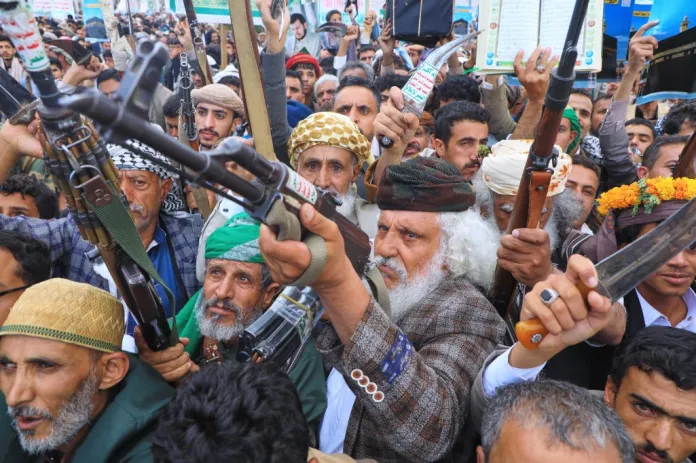
Protests in Aden and elsewhere in the south have also been consistently covered, with thousands of demonstrators waving Southern Cause flags and chanting Southern Cause slogans.
Bidh gave another unique metric of measuring dissent — south Yemeni popular culture and poetry.
“The Saudis can’t just reconcile with the leadership of the south, they need to reconcile with the people, because now the whole situation in the south is becoming hostile to the Saudis. You can see it now in the songs and the poetry. It became a culture to be against Saudi Arabia, and that’s unfortunate,” he said.
” data-large-file=”https://www.conservativenewsdaily.net/breaking-news/wp-content/uploads//2026/08/localimages/AP26058794969354.jpg?w=696″ “https:>
The STC, wary of their January defeat and inferior position — Bidh estimated the PLC forces as numbering 200,000 and the STC at 80,000 — has acted strategically. Bidh laid out the STC’s “nonviolent escalation program,” covering the next couple of months, which has so far taken the form of daily street protests.
“What we are a bit scared of is how they are retaliating by using aggressive force and using force against our people,” Bidh said. “If this continues for a long time, then probably the military will move on, and that’s what would create an insurgency.”
He claimed some of the leaders in the revamped military with southern roots have grown “frustrated by the troops that the Saudis are giving them, the order to kill our people or to detain and refuse … the freedom of expression to our people,” he added.
The Houthi problem
The other main ideological fissure is around how to deal with the Houthis. The STC always took a hard-line approach, advocating a maximum pressure campaign. The Saudis and PLC are viewed as too accommodating to the Houthis, crossing into appeasement. Bidh claimed the reason the Houthis hadn’t entered the wider war raging in the region was that the Saudis were paying them off, to the tune of around $300 million, “to calm the Houthis down.”
Bidh’s trips to Western capitals frame the STC’s hard-line approach to the Houthis as more beneficial to the U.S. than Saudi appeasement.
“It’s totally contradicting the U.S. policies in the Middle East, where they undermine the main political and military actor, the STC, who are against the Houthis, and empower the Houthis … and at the same time they’re empowering the Muslim Brotherhood and the Salafist groups within the government of Yemen,” Bidh said.
Bidh appealed to President Donald Trump specifically, noting that “all the positions of Trump are aligned with our position,” especially the opposition to both the Houthis and Muslim Brotherhood.
Bidh said he understood the U.S. was “still busy” with the Strait of Hormuz, but that the Bab el Mandeb Strait was of equal importance. To effectively deal with the Houthis, he advocated bringing the UAE back into the fight, along with other regional actors like Egypt, and keeping Yemen out of the exclusionary influence of Saudi Arabia.
The Houthis are in a much better position now, he argued, due to Saudi “appeasement.”
JOINT OPERATION WITH US OPENS SAUDI ARABIA TO BARRAGE FROM IRAN AND ITS PROXIES
“We can’t do this alone, and no one can do this alone. Like airstrikes by itself is not a solution. Ground force by itself is not a solution. We need to have a comprehensive approach where we can really interdict and and strangle the Houthis up in the north, and to cut all the sources, cut all the smuggling routes for them, strangle them economically and do the military campaign properly, with the right elements to it,” Bidh said.
Shortly after the interview with Bidh was conducted, the Houthis began attacking shipping in the Red Sea. U.S. focus has likewise shifted toward Yemen, but solely against the Houthis.
" Conservative News Daily does not always share or support the views and opinions expressed here; they are just those of the writer."
*As an Amazon Associate I earn from qualifying purchases