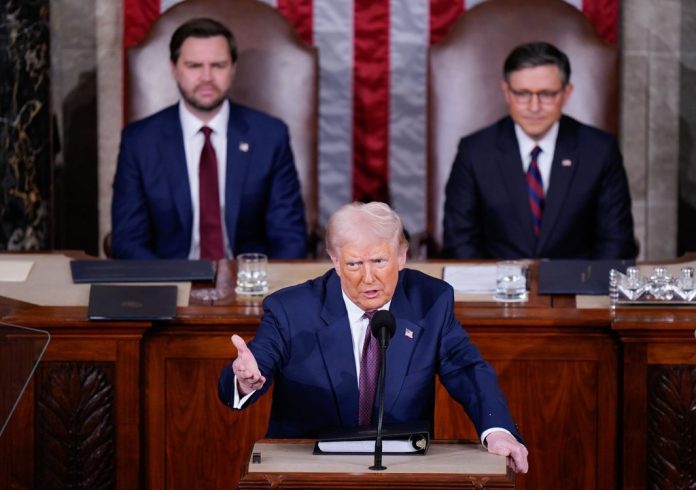
Trump prepares to deliver State of the Union at low point of second presidency
Trump is set too deliver the State of the Union late in his second term, facing a set of mixed signals: a strong political push earlier in his presidency but growing headwinds now.
Key points:
– The supreme Court recently ruled that several tariffs Trump imposed using emergency powers were unconstitutional, undermining his economic policy just before the address.
– Analysts say Trump should frame the speech around economic gains and a brighter future while portraying Democrats as obstructive, and they suggest he add some humor to connect with voters.
– Domestically,the address is expected to emphasize the economy,tax reform,deregulation,energy,and priorities like illegal immigration and crime. Democrats,including Abigail Spanberger,will respond with an official critique of the economy and related issues.
– Spanberger will deliver Democrats’ response from Williamsburg, and Senate Democrats invited small business owners harmed by tariffs to attend the State of the Union as guests.
– The speech will likely touch on foreign policy topics such as Iran, Israel-Hamas, and Ukraine, but some commentators advise keeping foreign policy lower-profile to focus on domestic concerns.
– Public opinion shows mixed signals: independents’ approval of Trump is around 26% in a CNN poll,while his overall approval average sits near 43%. No post-address campaign trip is planned, though the White House hopes a strong speech will reset momentum ahead of the 2026 midterms.
– Observers view the State of the Union as a chance to re-center his message and set the tone for Republican candidates in the upcoming elections, even if it may not change many minds in the 90-minute speech.
Trump set to deliver State of the Union at a low point in second presidency
President Donald Trump could not be in a more different political position to deliver the first State of the Union address of his second term compared to his address to a joint session of Congress last March.
A year ago, Trump provided his first presidential report to Congress of his second term from a position of strength, months after not only winning the Electoral College vote against former Vice President Kamala Harris, but also the popular vote — the first Republican presidential nominee to do so since former President George W. Bush in 2020.
Now, despite Trump’s projection of strength, this year’s State of the Union comes days after the Supreme Court dealt him the biggest political blow of his second term.
The Supreme Court undermined Trump’s signature economic policy last Friday when it decided that the tariffs the president had imposed using his emergency economic powers, including his Liberation Day duties and fentanyl-related levies, were unconstitutional.
“Trump had the cards when he won in November of 2024,” Suffolk University Political Research Center director David Paleologos told the Washington Examiner. “Now he’s doubled down, and he’s overplayed his hand.”
Aaron Kall, co-author of Mr. Speaker, The President of the United States: Addresses to a Joint Session of Congress, added. “This is one of the most difficult moments the president has had to encounter, and some of it is circumstances out of his control, but some of it also has been caused directly by things that he’s done.”
With the Supreme Court and the economy top of mind, Trump previewed on Monday that his State of the Union, which he will deliver with the justices in the audience, would be “long” because “we have so much to talk about.”
Trump broke former President Bill Clinton’s 2020 record for the longest State of the Union with his address to a joint session of Congress last year, lasting 1 hour and 39 minutes.
“We have a country that’s now doing well, greatest economy we’ve ever had, most activity we’ve ever had,” Trump told so-called Angel Families, or families who have had members killed by an illegal immigrant, on Monday. “I’m making a speech tomorrow night, and you’ll be hearing me say that.”
Trump’s admission that he will underscore his economic accomplishments during his State of the Union was welcomed by Republican strategists, some of whom have been imploring the president to do so for months.
“Voters want to hear first and foremost that the resident understands the economic uncertainty they face and that he has concrete plans to fix them,” former Republican National Committee communications director Doug Heye told the Washington Examiner. “That’s it.”
Fellow Republican strategist John Feehery agreed that Trump should “speak directly to the American people about how the economy is coming back and how the future is very bright.”
But Feehery, who used to be former House Speaker Dennis Hastert’s (R-IL) press secretary, told the Washington Examiner Trump ought to, “at the same time,” portray “the Democrats as a bunch of partisans who don’t want to work [with] him to make America great again,” particularly amid the partial federal government shutdown over Department of Homeland Security funding.
“He needs to also show some humor because the American people could use a few laughs,” the strategist said.
The clamor for Trump to promote his economic accomplishments — including tax reform through the One Big Beautiful Bill Act, deregulation, private and foreign investment, and stock market performance, in addition to energy, healthcare, and housing initiatives, even the tax-advantaged Trump Accounts for American children — have been crescendoing since last November’s off-year elections, in which Democrats, such as Gov. Abigail Spanberger (D-VA), won partly by campaigning on the president’s perceived inaction regarding affordability.
Spanberger will deliver Democrats’ official response to Trump’s State of the Union from Colonial Williamsburg’s Historic Area in Virginia shortly after the president’s prime-time address, which starts at 9 p.m. EST.
Another indication that Democrats are preparing to criticize Trump on the economy: Senate Minority Leader Chuck Schumer (D-NY) and other Democrats have invited small business owners hindered by the president’s tariffs to accompany them to the State of the Union as their special guests.
Trump has dismissed economic agenda concerns, instead contending during a press conference last month to mark his first anniversary of being back in office that he has a messaging problem because of “bad public relations people.”
After the White House last week added two aides to its communications team, Trump declared on Thursday that he had “won” the affordability issue, citing January’s positive inflation and employment data, regardless of last quarter’s less-than-expected gross domestic product.
A day later, the Supreme Court issued its opinions on the Learning Resources, Inc. v. Trump tariff case, with the president spending the weekend expressing his rage on Truth Social and increasing the temporary global tariff rate from 10% to 15% as his trade deals risk falling apart.
For Paleologos, the Suffolk University pollster, Trump should “liken himself to regular people” during his State of the Union.
“And say, ‘Look, we’re all Americans. We’ve all been knocked down in our lives, myself included,’” he said. “‘But we’re all Americans, and we all get back up and fight.”
Although the economy will loom large over Trump’s State of the Union, so too will other domestic priorities, including a decrease in illegal immigration and crime, namely violent offenses, such as murder.
While illegal immigration and crime have declined during Trump’s second term, thanks in part to the Laken Riley Act, which Congress passed before last year’s address to a joint session of Congress, Trump will return to the House of Representatives chamber on Tuesday, under fire on immigration after federal agents killed two anti-immigration Customs and Enforcement protesters in Minnesota in January.
The deaths of Renee Good and Alex Pretti are what precipitated the ongoing partial government shutdown.
Similarly, though Trump, in his pursuit of a Nobel Peace Prize, did negotiate an end to the war between Israel and Hamas, a ceasefire eludes him and Ukraine on the fourth anniversary of Russia’s invasion of its borders.
Trump’s State of the Union will also likely touch on Iran after last June’s military strikes against Iran Supreme Leader Ayatollah Ali Khamenei’s nuclear enrichment facilities as the president contemplates another operation to pressure the regime into a new nonproliferation agreement, emboldened by January’s capture of former Venezuelan dictator Nicolas Maduro in Caracas.
Kall, the University of Michigan’s debate director, recommended that Trump downplay foreign policy during his State of the Union.
“Republicans have just a slim lead in Congress, and the president’s approval ratings have been underwater, especially on issues like the economy and immigration, which he’s had such an advantage on for so long,” he said. “He spent so much of this last year of his presidency on foreign policy, and travel — the[[United Kingdom], Russia, [the] Middle East — but in a speech like this, just about eight, nine months until the midterms, domestic focus and economic focuses are important.”
One topic that Trump is unlikely to broach during his State of the Union? His administration’s bungled release of the federal government’s files with respect to its investigation into convicted sex offender Jeffrey Epstein, even though the president campaigned on disclosing the documents.
Trump’s State of the Union will likely be the president’s last opportunity to speak to an audience of its size before the 2026 midterm elections.
Almost 3.7 million people watched Trump’s address to a joint session of Congress last year and the last State of the Union of his first term in 2020, according to Nielsen.
Like in previous years, Trump’s State of the Union coincides with multiple pre-address polls.
For example, a CNN poll on Monday found that Trump’s approval rating among independent voters is at 26%, the lowest of the president’s two terms, as is the percentage of respondents (68%) who said he is not concentrating on the country’s most pressing problems.
Trump’s average approval rating is 43%, according to RealClearPolitics.
Simultaneously, it is uncertain how Trump intends to make the most of his State of the Union to improve those numbers, as there are currently no plans for him to make a post-address campaign trip.
Trump’s tentative schedule is at odds with White House chief of staff Susie Wiles’s pledge last month that the president would campaign every week before November’s elections.
“This speech won’t have an impact on the midterms, but it will set the stage for what are you going to be talking about, you Republican candidates, who are on the ballot this November,” Paleologos, the pollster, said. “What are the kinds of things you run on, and how are you going to be framing those issues?”
Kall, the debate expert, concurred: “He’s not going to be able to change a lot of minds in 90 minutes, but he could view it as the start of reset… The speech is all kind of a process to just start trying to rebuild, rekindle some of that political momentum in the run-up to the midterms.”
Nevertheless, the White House remains adamant that Trump’s State of the Union will be a “very good and powerful speech.”
TRUMP’S SECOND TERM RECORD SHOWS SPARSE BLACK VOTER POLICY WINS IN ANTI-DEI AGE
“You’ll be hearing more about what is to come from the president’s speech very soon, at the appropriate time,” White House press secretary Karoline Leavitt told reporters last week. “Everyone should tune in.”
" Conservative News Daily does not always share or support the views and opinions expressed here; they are just those of the writer."
*As an Amazon Associate I earn from qualifying purchases