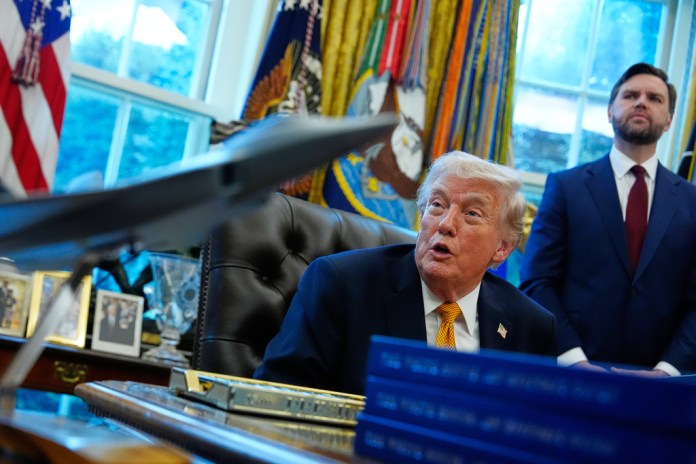
Trump awaits court decisions on National Guard deployments as protests fade
Deprecated: str_getcsv(): the $escape parameter must be provided as its default value will change in /var/www/html/breaking-news/wp-content/plugins/wp-auto-affiliate-links/aal_engine.php on line 361
The article discusses the ongoing legal disputes surrounding former President Donald Trump’s deployment of the National Guard to several U.S. cities, including los Angeles, Chicago, and Washington, D.C., to protect federal assets amid civil unrest. Although the protests have mostly subsided, court battles continue over the legality and scope of these deployments.
In Los Angeles, a federal judge ruled that extending the National Guard’s federalization was unlawful, criticizing the creation of what he described as a “national police force” using state troops. The Justice Department has appealed this decision, arguing that the deployment remains necessary.
In Chicago, the National Guard deployment was blocked by lower courts before it began, and the Trump management has taken the case to the Supreme Court, which is still considering whether to allow the deployment. Central to the dispute is the interpretation of the law governing the President’s authority to federalize the National Guard, specifically whether “regular forces” includes the military.
In Washington, D.C.,the deployment differs because the president has broader authority over the local National Guard.A federal judge ruled the deployment unlawful for using troops to deter crime, but an appeals court temporarily allowed the deployment to continue as it reviews the case. The issue gained additional attention after two National Guard members were shot while on patrol in the city.
the legal challenges highlight a complex balance between presidential power and state authority over the National Guard, with courts examining the limits of federal intervention in local matters.The disputes are expected to persist into 2026 amid continuing debates over executive authority and law enforcement.
Trump awaits court decisions on National Guard deployments even as protests fade
Legal battles over President Donald Trump‘s use of the National Guard in cities to protect federal assets have dragged on even as unrest has subsided, with the president awaiting key court decisions over the deployments in Los Angeles and Chicago.
Trump first deployed the National Guard to Los Angeles in June, after unrest over immigration operations in the city devolved into violence. The federalization and deployment of troops, against the wishes of Gov. Gavin Newsom (D-CA), sparked a lawsuit from the governor and other state officials, a tactic that has been repeated to challenge deployments in Chicago; Portland, Oregon; and Washington. Each of the lawsuits has resulted in different rulings, which have placed the deployments in various states of limbo, even as the peak of the unrest has passed.
Chicago National Guard case remains pending on Supreme Court emergency docket
Trump’s deployment of the National Guard to Chicago was halted before it could even begin in earnest, with a district court halting the deployment of troops to the city. A federal appeals court upheld the district court’s pause of the federalization and deployment of troops, leading the Trump administration to the Supreme Court’s emergency docket as it seeks to lift the court-imposed block on the deployment.
The Trump administration made the request to the Supreme Court in October, arguing that the lower courts’ block of the deployment “improperly impinges on the president’s authority and needlessly endangers federal personnel and property.”
“This case presents what has become a disturbing and recurring pattern: Federal officers are attempting to enforce federal immigration law in an urban area containing significant numbers of illegal aliens,” Solicitor General D. John Sauer wrote in his petition to the Supreme Court. “The federal agents’ efforts are met with prolonged, coordinated, violent resistance that threatens their lives and safety and systematically interferes with their ability to enforce federal law.”
The high court later asked for additional briefs on whether “regular forces,” in the language of 10 U.S. Code §12406, includes the military. The law Trump cited allows the president to federalize and deploy National Guard troops when the “president is unable with the regular forces to execute the laws of the United States,” among other provisions.
The Trump administration argued that “regular forces” do not include the military, while Illinois officials argue that it does include the military but also claim that other laws limit Trump’s ability to call the military to Chicago.
The high court could either grant the requested stay and thus allow troops to be deployed to Chicago, allow the stay to remain, or take up the case for full arguments. There is no set timeline for the Supreme Court to respond to emergency docket requests, but recently, the justices have responded within two months of the initial petition being filed.
Los Angeles deployment faces roadblock unless appeals court intervenes
Trump’s deployment of the National Guard to Los Angeles had been his most successful so far, but earlier this week, U.S. District Judge Charles Breyer ruled that extending the deployment and federalization of troops is unlawful.
“Six months after they first federalized the California National Guard, Defendants still retain control of approximately 300 Guardsmen, despite no evidence that execution of federal law is impeded in any way — let alone significantly,” Breyer wrote in his Wednesday ruling. “What’s more, Defendants have sent California Guardsmen into other states, effectively creating a national police force made up of state troops.”
“In response to Plaintiffs’ motion to enjoin this conduct, Defendants take the position that, after a valid initial federalization, all subsequent re-federalizations are completely, and forever, unreviewable by the courts,” he wrote. “Defendants’ position is contrary to law.”
Breyer paused the effect of his order until Monday, allowing for the Justice Department to appeal the ruling to a federal appeals court in the meantime, something it quickly did on Wednesday. The administration now awaits a ruling, which could come before Breyer’s ruling goes into effect on Monday.
John Shu, a constitutional law expert who served in both Bush administrations, said he believes the Justice Department should have shown Breyer evidence why the continued deployment is necessary, rather than relying on the argument that the president’s actions are unreviewable by a court.
“It’s not enough to say ‘the president has the power to declare an emergency,’” Shu told the Washington Examiner. “While that’s true … ideally, the administration goes in with as much legal ammunition as possible and shows why the emergency still exists and why they need the Guardsmen.”
Shu also argued that while unrest has subsided since the peak of the unruly protests in June, the Justice Department still could make an argument for why some troops need to remain deployed. He said a reduction in violence does not necessarily undermine the Trump administration’s argument in favor of the deployment.
“Maybe a little, but the administration could make the argument the reason it’s calmed is because of the National Guard deployment and because there is a stay-behind force of 100 National Guardsmen maintaining the peace,” Shu said.
He also said that with this case, the court is seeking to balance the interests of the governor, who acts as commander in chief of the state National Guard, and the president, who controls federalized troops, rather than intervening in decisions about military operations.
“The president does have a broad discretion, but broad does not mean unlimited. There is an argument to be made that courts should not involve themselves in determining how a president manages the military,” Shu said. “Ordinarily, that’s true, but here, the court’s not trying to manage the military. The court’s trying to determine: Where does the president’s power end, and where does the state of California’s begin?”
DC deployment allowed to continue after appeals court lifts block
The deployment of National Guard troops in the District of Columbia differs from the other deployments because the president has more powers in Washington to utilize the local forces, as he does not have to call them into federal service. Trump deployed the D.C. National Guard in August with the aim of curbing crime in the district, as opposed to simply protecting federal assets and officials.
Local officials sued the Trump administration over the deployment of troops, and U.S. District Judge Jia Cobb sided with them in November. Cobb ruled that the administration violated multiple federal laws, including the Home Rule Act.
“The Court finds that the President has no free-floating Article II power to deploy the [D.C. National Guard] for the deterrence of crime,” Cobb wrote in her Nov. 20 ruling. “Historical practice confirms this understanding of the President’s authority.”
She gave the administration until Thursday to end the deployment, but a panel on the U.S. Court of Appeals for the D.C. Circuit paused Cobb’s ruling last week, allowing the deployment to continue in the interim. Appellate judges said in the brief order that the pause was “to give the court sufficient opportunity to consider the motion for stay pending appeal and should not be construed in any way as a ruling on the merits of that motion.”
The appeals court panel is expected to issue a full ruling on the merits as soon as in the coming weeks, with no timeline set. While the panel weighs the merits of the case, the deployment is allowed to continue.
JUDGE BLOCKS TRUMP’S LA TROOPS DEPLOYMENT FOR THIRD TIME AFTER GETTING OVERRULED TWICE
The appeals court order allowing the deployment in Washington came shortly after two National Guard members from West Virginia on patrol in the district were shot. Army Spc. Sarah Beckstrom later died from her injuries, while Air Force Staff Sgt. Andrew Wolfe remains in the hospital recovering from his injuries. The two troops were allegedly shot by Afghan national Rahmanullah Lakanwal, who pleaded not guilty to multiple charges levied against him, including first-degree murder, earlier this week.
The president’s deployments of the National Guard appear poised to remain a hot-button issue at the courts heading into 2026, even as other legal battles against the president’s actions and agenda continue.
" Conservative News Daily does not always share or support the views and opinions expressed here; they are just those of the writer."
*As an Amazon Associate I earn from qualifying purchases