Top Six Takeaways From Jack Smith’s White-Hat Posturing
House Judiciary Chair Jim Jordan released the transcript of Jack Smith’s deposition, which the committee sought as part of its probe into alleged politicization of the Justice Department. Smith portrayed himself and his team as apolitical, but the article by Margot Cleveland disputes that account and highlights six specific criticisms.
First,Cleveland says Smith repeated a debunked claim that former President Trump asked local officials to “find 11,000 votes,” whereas the Georgia call transcript shows Trump’s team claimed to possess evidence of illegal votes and asked officials to investigate. Second,she argues the so‑called “fake electors” were in fact contingent electors-a historically used procedure-and that labeling them a criminal scheme is misleading. Third and fourth, Cleveland points to troubling disclosures about Ray Hulser, a top deputy on Smith’s team who previously handled the Public Integrity Section, alleging Hulser spiked or misrepresented evidence in the Clinton Foundation matter; she contends this undermines Smith’s reliance on PIN approvals and the team’s claimed integrity.
Fifth, Cleveland criticizes Smith’s justification for subpoenaing Republican members of Congress and questions why the team sought subpoenas rather than obtaining consent to records, noting concerns about the Speech or Debate Clause.she calls Smith’s offers to testify publicly hollow as Senate investigators (led by Chuck Grassley) need time and documents before holding hearings, and because Smith has not fully cooperated with requests for internal records. The piece concludes that recent document releases and unanswered questions weaken Smith’s credibility and bolster calls for further oversight.
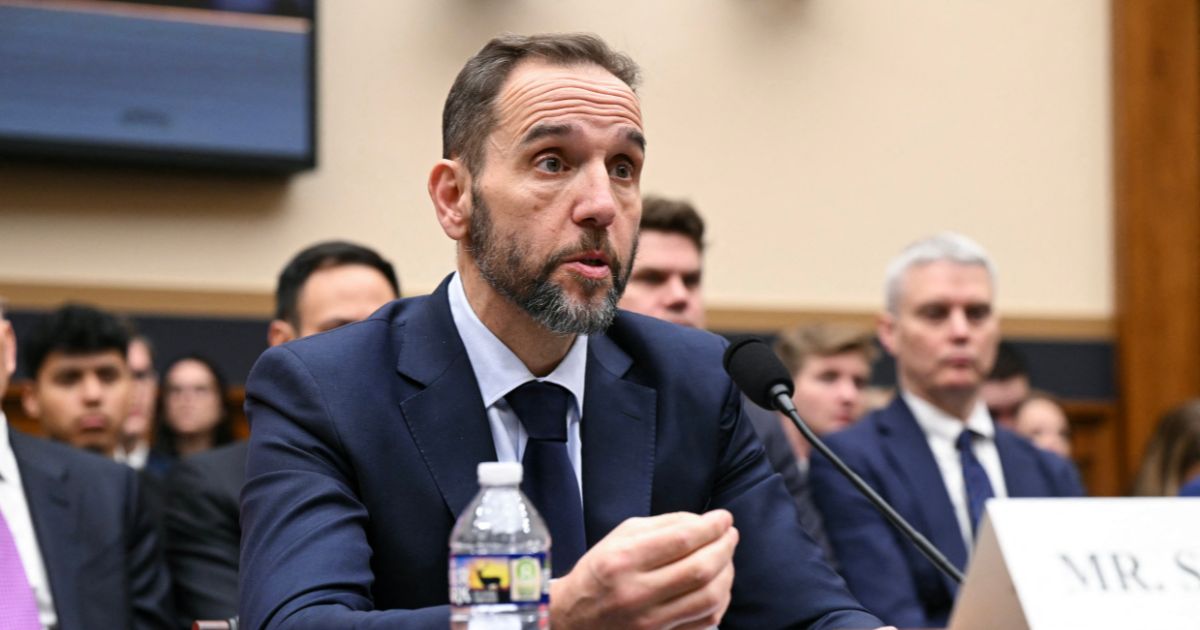
New Year’s Eve day saw House Judiciary Chair Jim Jordan, R-Ohio, release of the transcript of the Committee’s deposition of Jack Smith, the former special counsel who charged Donald Trump in two separate criminal cases in the run-up to the 2024 election. As the committee explained at the beginning of the deposition, it sought Smith’s testimony as part of its “oversight of the Biden-Harris administration’s weaponization of the Justice Department and its misuse of Federal law enforcement resources for partisan political purposes.”
While Smith spent the next several hours portraying himself and his special counsel team as apolitical, dedicated civil servants merely seeking the truth, Smith’s testimony cannot be squared with reality. Here are six times Smith proved duplicitous.
- NO!!! Trump did not ask “local officials to find 11,000 votes.”
Visual screaming intended because the false claim that Donald Trump asked election officials to “find 11,000 votes” has been debunked for more than five years, and yet Smith repeated that lie in response to Democrats’ friendly questioning.
“[Y]ou added something which I think was very interesting, which was a conspiracy to violate voting rights,” a representative of the minority members began, asking Smith to “expound on why you thought you had sufficient evidence to prove beyond a reasonable doubt that there was a conspiracy to violate the voting rights of the people.”
Smith responded: “The right to vote in a presidential election is one of the most sacred rights that America has — Americans have, and in this particular case, we had strong evidence that the defendants in this case sought to interfere with, obstruct, injure that right.”
“We had evidence, and just a couple of examples,” the former special counsel continued, “where President Trump was asking local officials to find 11,000 votes.”
However, contrary to Smith’s claim, Trump did not ask election officials “to find” him 11,000 votes — and evidence disproving the former special counsel’s testimony is there for every American to see in the form of a transcript of the January 2, 2021, telephone conversation between Trump’s legal team and the Georgia secretary of state’s office.
That transcript reveals that during that call Trump and his lawyers catalogued numerous categories of illegal votes of which they had concrete evidence, falling in some 25 categories. As Trump’s lawyer explained to Secretary of State Brad Raffensperger, they had filed a petition in court challenging the election outcome, but “the court is not acting on our petition. They haven’t even assigned a judge.” Because of the court’s delay in acting on Trump’s petition, his legal team asked the secretary of state’s office to investigate the problems.
As The Federalist previously explained,
[T]he transcript of the conversation confirmed Trump’s legal team told Raffensperger that it had solid evidence of illegal votes easily exceeding the official margin of Biden’s victory of 11,779. Under Georgia election law, if the ‘evidence establishe[s] that there are more illegal or irregular votes than the margin of victory, the remedy is a new election,’ which is why Trump focused on his need to find 11,800 votes throughout his conversation with Raffensperger.
Several times during the call, Trump repeated that refrain: “I have to find 12,000 votes and I have them times a lot. And therefore, I won the state.” Conversely, Trump never suggested, much less asked, Raffensperger “‘to find 11,780 votes” in his favor. To the contrary, Trump spoke of his need “to find 11,780 votes,” but only in the context of highlighting the tens of thousands of illegal votes for which his legal team had ample evidence, and while merely asking the secretary of state to review the evidence of illegal voting.
That Jack Smith would repeat the falsehood that Trump asked local officials to find 11,000 votes renders him the Fani Willis of federal prosecutors and exposes his both his bias and his complete lack of credibility.
- NO!!! Naming alternative electors was not a fake electors conspiracy.
Visual screaming continues unabated because Smith’s testimony concerning his special counsel investigation likewise pushed a second long-debunked narrative, namely that Trump conspired to name fake electors.
Several times throughout his testimony, Smith spoke of Trump’s supposed “fake electors scheme,” for instance, claiming “the fake elector scheme was part of what I was investigating, and it ultimately became part of the charges in the case.” There were no “fake electors,” though, but rather contingent electors, selected in states in which Trump was challenging the election tallies.
While Smith spun the selection of an alternative slate of Republican electors as a criminal conspiracy, the naming of contingent electors by Trump followed the precise approach Democrats used — successfully — in Hawaii during the 1960 election of John F. Kennedy.
In fact, the Hawaii scenario from 1960 mirrors in every material respect Trump’s selection of alternative electors. That decades-old election which pitted Kennedy, a Democrat, against Republican Richard Nixon, remained undecided for several days after voters cast their ballots, with Hawaii’s results still in doubt through mid-December. Initial returns gave Nixon a 141-vote margin of victory over Kennedy, leading to the acting governor of Hawaii, Republican James Kealoha, certifying the Republican electors on Nov. 28, 1960. But after state circuit court Judge Ronald Jamieson ordered a recount, on Dec. 19, both the Nixon and Kennedy electors met, “cast their votes for President and Vice President, and certified their own meeting and votes.”
In casting their electoral ballots for Kennedy, the three Hawaiian Democrats certified they were the “duly and legally qualified and appointed” electors for president and vice president for the state of Hawaii and that they had been “certified (as such) by the Executive.” The Hawaii electors further attested: “We hereby certify that the lists of all the votes of the state of Hawaii given for President, and of all the votes given for Vice President, are contained herein.”
Significantly, two of the three alternative Democrat electors were retired federal judges. Additionally, in later holding Kennedy had, in fact, won the election, the state court judge stressed the importance of the Democrats naming the alternative electors which allowed Congress to count Hawaii’s electoral votes in favor of Kennedy.
By framing the alternative electors as “fake electors” and by also testifying “the fake elector scheme was part of what I was investigating, and it ultimately became part of the charges in the case,” former Special Counsel Smith again cemented the partisan nature of his investigation.
- Given recently released information regarding one of Smith’s top deputies, the special counsel’s touting of his team’s integrity is laughable.
Another theme that cannot withstand scrutiny is Smith’s portrayal of his team as apolitical, dedicated public servants. First, Smith’s false claims about the 11,000 votes and the fake electors leave him with no credibility to vouch for the integrity of anyone on his staff. And second, his staff’s own silence over those misrepresentations, calls into question their apolitical bona-fides.
But beyond this, the recent releases by Sen. Chuck Grassley, R-Iowa, concerning one of Smith’s top deputies, Ray Hulser, during Hulser’s time leading the Public Integrity Section, renders Smith’s portrayal of his team as on the side of the angels, incredible.
As I detailed last week in “Top Attorney For Special Counsel Jack Smith Previously Spiked Clinton Foundation Investigation,” according to a timeline detailing the sequence of the investigation into the Clinton Foundation, Hulser, when he headed up the Public Integrity Section, or PIN Section, refused to support an investigation into the Clinton Foundation. And then when Special Counsel John Durham asked Hulser about his reasoning, Hulser told Durham that the reporting behind the launch of an investigation into the Clinton Foundation, namely reporting from a confidential human source and Suspicious Activity Reports, involved only de minimis amounts. However, contrary to Hulser’s representation to Durham, the amounts in question in the reporting ran into hundreds of thousands of dollars.
Additionally, after Trump won the 2016 election and the U.S. Attorney’s Office for the Eastern District of Arkansas sought to reopen its investigation into the Clinton Foundation, Hulser provided the new U.S. attorney a highly edited “2-page FBI Timeline on the history of the investigation.” According to documents recently released by Sen. Grassley, the 2-page timeline Hulser provided the newly appointed U.S. attorney was “a stark contrast” from the unedited version of the timeline. The Office of Inspector General would later provide the U.S. attorney a 6-page unedited timeline which revealed that the abbreviated timeline Hulser had provided prosecutors “omitted ALL references to interference from DOJ and FBI leadership” into the Clinton Foundation investigation.
Hulser’s handling of the Clinton Foundation investigation, coupled with evidence that the PIN Section chief hid or misrepresented evidence to the Trump-appointed U.S. Attorney — and potentially even Special Counsel John Durham — suggests Hulser was the farthest thing from an apolitical public servant. And that Smith would brand Hulser a “dedicated public servant” and “the best of us,” raises concerns over Smith’s vouching for other members of his team.
- Hulser’s conduct also calls into question the integrity of the PIN Section, rendering Smith’s reliance on PIN unpersuasive.
Several times during his testimony, Smith sought cover for his aggressive targeting of Republicans by stressing that the PIN Section had okayed the course of action. In addition to relying on the PIN Section’s approval of the plan to subpoena members of Congress — more on that next — Smith explained the PIN Section approved him filing on the public docket a 165-page brief detailing Trump’s alleged criminal conduct a mere 32 days before the 2024 election.
Smith first claimed it was necessary for his team to file the lengthy document a mere month before the 2024 election because the Supreme Court had recently held the indictment Smith had obtained against Trump improperly alleged as criminal acts conduct for which Trump held absolute immunity. The former special counsel then claimed that to make sure his team did not violate DOJ policy concerning taking actions close-in-time to elections, his team met with the PIN Section, and they agreed with Smith’s course of conduct.
Given that Hulser once led the PIN Section, it is meaningless that the PIN Section approved Smith’s filing of a pre-election treatise on Trump’s alleged criminal conduct.
- Smith’s justification for subpoenaing members of Congress falls flat.
Smith also relied on the PIN Section’s approval of the Special Counsel office’s decision to subpoena Republican members of Congress. However, given the recent revelations about Hulser, who once led the PIN Section, that approval should carry no weight. Further, given his past efforts to apparently spike the Clinton Foundation investigation, Hulser’s role in seeking the subpoenas proves equally troubling.
Beyond that, Smith’s justification for seeking the subpoenas was also unconvincing. Here, Smith claimed the subpoenas were necessary to confirm various communications, but he really couldn’t explain why the special counsel team could not instead ask the Republican lawmakers for permission to obtain their toll records.
Likewise, Smith’s claimed respect for the Speech or Debate Clause rang hallow given the PIN Section’s acknowledgement of the constitutional problem with the subpoenas but found them nonetheless appropriate because there was a low “litigation risk.” In other words, since Smith was unlikely to charge the senators criminally, there was little risk that the subpoenas would be challenged based on the Speech or Debate Clause.
Contrary to Smith’s feigned respect for the Speech or Debate clause, those facts suggest a disregard for our Constitution.
- Smith’s calls for a public hearing ring hollow.
Throughout his testimony, which occurred behind closed doors, Smith stressed his interest in testifying in public. Democrat members of the House Judiciary Committee amplified Smith’s talking point and called for a public hearing to supposedly further transparency.
But as Sen. Grassley made clear in late October 2025, when he responded to Smith’s offer to testify before the Senate Judiciary Committee, it would be premature to hold such a hearing. Rather, as the Chair of the Senate Judiciary Committee explained, the committee is currently in the process of gathering records and needs “time to obtain and review them prior to formally calling for a hearing on this matter.”
Sen. Grassley’s approach makes eminent sense because while the House’s questioning of Smith revealed the names of some of the players and other threads that deserve pulling, without access to the internal communications of the Special Counsel’s office and other details, the Committees won’t yet know what to ask Smith.
For instance, when Smith appeared for his deposition before the House Judiciary Committee on December 17, 2025, the members apparently had not yet had time to review the details from Sen. Grassley’s December 15, 2025, release concerning Hulser. That release proved devastating to Smith’s claim that his team consisted of apolitical civil servants, and yet no one asked Smith about his top deputy’s past questionable conduct in the Clinton Foundation investigation.
Further, if Smith were truly committed to transparency, he would respond to Sen. Grassley’s request for information concerning the special counsel’s investigation. And yet, it appears the former special counsel has yet to respond to even the most basic questions, including whether Smith or his “staff use[d] any non-government devices, such as laptops, tablets, or phones, to conduct official business.”
Whether Smith cooperates with the Senate investigation remains to be seen, but the near weekly release of documents from Sen. Grassley’s office suggests transparency will come — just not the kind those who weaponized the Department of Justice against Trump and in favor of Democrats prefer.
Margot Cleveland is an investigative journalist and legal analyst and serves as The Federalist’s senior legal correspondent. Margot’s work has been published at The Wall Street Journal, The American Spectator, the New Criterion, National Review Online, Townhall.com, the Daily Signal, USA Today, and the Detroit Free Press. She is also a regular guest on nationally syndicated radio programs and on Fox News, Fox Business, and Newsmax. Cleveland is a lawyer and a graduate of the Notre Dame Law School, where she earned the Hoynes Prize—the law school’s highest honor. She later served for nearly 25 years as a permanent law clerk for a federal appellate judge on the Seventh Circuit Court of Appeals. Cleveland is a former full-time university faculty member and now teaches as an adjunct from time to time. Cleveland is also of counsel for the New Civil Liberties Alliance. Cleveland is on Twitter at @ProfMJCleveland where you can read more about her greatest accomplishments—her dear husband and dear son. The views expressed here are those of Cleveland in her private capacity.
" Conservative News Daily does not always share or support the views and opinions expressed here; they are just those of the writer."
*As an Amazon Associate I earn from qualifying purchases