Your Doorbell Camera Is Watching You
This article centers on the disappearance of 84-year-old Nancy Guthrie and the role of home surveillance in modern privacy debates. Guthrie reportedly did not pay for a Nest cloud subscription, and her doorbell camera was disconnected the night she vanished, yet FBI officials later recovered footage and images of a masked, armed intruder on her porch from residual data in backend systems. The piece links this case to the broader reach of doorbell and indoor cameras, including Ring’s marketing of AI-powered facial recognition and a “Search Party” feature that can help locate missing pets but can also enable mass surveillance.It notes that millions of Ring cameras come with “free” facial recognition that can be activated unless users manually disable it, a move that sparked outrage and ridicule from rivals. The article argues that even without paying for cloud storage, thes devices still collect and transmit data to big Tech, raising concerns about privacy and the potential access of footage by private companies and the government. While such technology can aid in investigations and crime deterrence, it also creates an extensive surveillance network that captures daily life and stored footage, frequently enough without clear consent.
No one knows what happened to 84-year-old Nancy Guthrie when she disappeared 11 days ago. No one, that is, except for her front door camera.
Guthrie allegedly did not pay the $10 per month Google Home Premium fee required for her door-mounted Nest recording device to capture movement, detect packages, and recognize “familiar faces.” Even if Guthrie had shelled out for a subscription to access the surveillance footage, her Nest was reportedly disconnected around 2 a.m. on the night she allegedly disappeared.
Yet, 10 days into Guthrie’s absence, FBI Director Kash Patel announced the recovery of footage and images of a masked and armed person of interest on Guthrie’s front porch. The videos showing the suspect snooping around before tampering with the Nest were reportedly retrieved from “residual data located in backend systems.”
New images in the search for Nancy Guthrie:
Over the last eight days, the FBI and Pima County Sheriff’s Department have been working closely with our private sector partners to continue to recover any images or video footage from Nancy Guthrie’s home that may have been lost,… pic.twitter.com/z5WLgPtZpT— FBI Director Kash Patel (@FBIDirectorKash) February 10, 2026
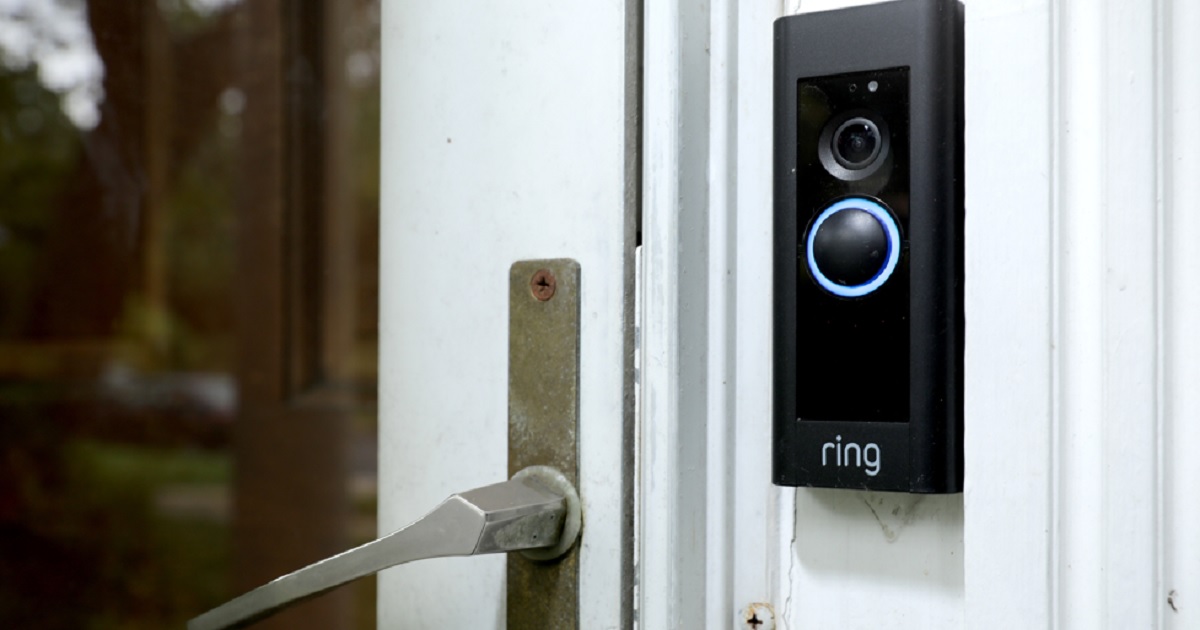
Patel’s admission that doorbell cameras like Guthrie’s are always recording comes just a couple of days after Amazon’s Ring ran a Super Bowl commercial marketing its AI-powered facial recognition technology as the tool required to “be a hero in your neighborhood.”
The 30-second spot was designed to pull at the heartstrings of pet owners and good neighbors whose Ring cameras could play a role in finding Fido when he goes missing.
“[Search Party] enables your outdoor Ring cameras to help you reunite lost dogs with their families and spot wildfires threatening your neighborhood,” the Ring app further advertises.
What the saga about a neighborhood-wide search for a lost puppy ultimately revealed, however is that the millions of Ring cameras are already equipped with “free” facial recognition software that can be harnessed for mass surveillance the moment someone requests it. The only way to opt out of the “Search Party” function is to manually disable it in the doorbell camera’s control center, which sparked outrage and even spoofs from rival camera companies.
It doesn’t take a technology expert to understand that refusing to pay for the cloud storage doesn’t mean doorbell cameras aren’t watching or collecting your data. In fact, these gadgets’ vast recording capabilities and Big Tech ownership have raised eyebrows before.
Yet, millions of Americans continue to buy into the pitch that placing a device that records video and audio to a cloud controlled by notorious censors is adequate home security. On the contrary, the rise of home surveillance — through doorbell cameras and/or the increasingly popular indoor nanny camera setup — compromises your protection by live-streaming your life to Big Tech.
It’s no secret that we live in a surveillance state. Nearly every adult has some sort of device that tracks their data usage and location and sells it to advertisers and other corporations. Which is why it’s so easy to say yes to another device that promises security that comes with a privacy tradeoff asterisk. A majority of Americans, however, are grossly ignorant to just how invasive these gadgets have become. An even bigger number don’t read through the terms and conditions, where tech companies routinely bury disclosure of their most alarming digital overreaches.
These companies don’t simply hang onto footage of you, The Truman Show-style. Their cameras capture your guests, your family members, your neighbors, and your home’s surroundings and layout. There’s no doubt that the surveillance contraptions have found lost puppies, caught criminals, deterred package thieves, and even recognized a child was choking. Yet, all of that comes at a cost.
You may not have access to watch what happens on your front porch or outside of your home because you’re too cheap to pay a monthly or yearly fee, but Google, Amazon, and other tech companies do. For the low, low price of you and your neighbor’s privacy, doorbell camera companies can have a complete and total courtside seat to the lives of millions of Americans via an AI-integrated surveillance grid you and hundreds of thousands of other consumers bought products to build for them.
All it takes is one incident like Guthrie’s disappearance, a natural disaster, or perhaps even a lost dog, as Ring suggests, for that footage to be seized and disseminated at the discretion of those companies and the government. Sometimes, as in 2023 when the Federal Trade Commission charged Ring for allowing its employees and contractors to surveil “intimate spaces” such bathrooms or children’s bedrooms, it takes nothing at all.
These recent revelations might spur you to smash your devices in Ron Swanson fashion, but not even total destruction can erase the hours, days, and months of your life those cameras captured and stored in a Big-Tech-owned digital cloud that is susceptible to even more privacy-encroaching hacks. Even if you personally refuse to buy a doorbell camera, know that Big Brother is watching you regardless.
Time will tell if the photos retrieved from Guthrie’s disconnected doorbell camera will lead to her rescue or recovery. The truth that doorbell and in-home cameras daily compromise your privacy by storing footage of you and yours in “backend systems,” however, is unfortunately timeless.
Jordan Boyd is an award-winning staff writer at The Federalist and producer of “The Federalist Radio Hour.” Her work has also been featured in The Daily Wire, Fox News, and RealClearPolitics. Jordan graduated from Baylor University where she majored in political science and minored in journalism. Follow her on X @jordanboydtx.
" Conservative News Daily does not always share or support the views and opinions expressed here; they are just those of the writer."
*As an Amazon Associate I earn from qualifying purchases