Supreme Court weighs if Rastafarian can bring claim against prison officials who cut his dreadlocks
Teh U.S. Supreme Court is set to hear arguments in a case involving Damon Landor, a Rastafarian inmate who sued the Louisiana Department of Corrections after prison officials at Raymond Laborde Correctional Center shaved his dreadlocks. Landor claims that cutting his hair violated his religious freedoms, as Rastafarian beliefs-partly inspired by the Nazirite vow in the Bible-consider dreadlocks a vital expression of devotion and identity. While prisons often require head shaving for health and security reasons, Landor had grown his hair for nearly two decades and had maintained his locks during the first months of incarceration. After being transferred, officials ignored his requests for religious accommodation and forcibly shaved him bald. The central legal question for the Court is whether individuals can sue state prison officials for damages under the Religious Land Use and Institutionalized Persons Act (RLUIPA) when their religious rights are violated. Louisiana’s Attorney General argues that the law does not allow suits against state officials in their personal capacities, a position supported by several federal courts. the Supreme court’s decision will clarify the scope of RLUIPA’s protections and the ability to seek damages for religious rights violations by government employees.
Supreme Court weighs if Rastafarian can bring claim against prison officials who cut his dreadlocks
The Supreme Court will hear arguments Monday in the case of a Rastafarian man who brought charges against a Louisiana prison for shaving his dreadlocks, accusing correction center officials of encroaching on his religious freedoms.
Damon Landor sued the Louisiana Department of Corrections after prison officials at the Raymond Laborde Correctional Center cut his dreadlocks, which are partly inspired by the Nazirite vow described in Numbers 6:5, which instructs those who take the vow to “let the locks of the hair of his head grow.” When the vow was completed, it was traditional to shave the head at the entrance of the Tabernacle.
Rastafarians interpret this passage as a spiritual basis for wearing dreadlocks as a symbol of devotion and natural living.
Louisiana Attorney General Liz Murrill has argued that Landor cannot sue state officials for damages under the Religious Land Use and Institutionalized Persons Act of 2000. Several federal courts have ruled in favor of the state.
The Supreme Court is set to determine on Monday whether an individual can sue a government employee for damages due to violations under RLUIPA. The question is not directly about whether the officials were justified in cutting Landor’s dreadlocks.
Prisons have historically shaved the heads of inmates to prevent the spread of disease, to prevent contraband from being hidden in one’s hair, and to prevent hair-pulling in case of violence.
Landor’s attorney has described the incident in court filings, detailing that the inmate had spent nearly two decades growing his hair “nearly to his knees,” in accordance with Rastafarian tradition.
For the first four months of Landor’s five-month prison sentence, he had been able to keep his locks. However, when he was transferred to the Raymond Laborde Correctional Center, prison officials reportedly disregarded Landor’s presentation of “various legal materials regarding his religious accommodations,” and proceeded to cut his hair.
“Prison officials threw the decision into the trash, strapped Landor down, and shaved him bald,”the court filing reads. “In an instant, they stripped him of decades of religious practice at the heart of his identity.”
Landor, through his counsel, argues that the Supreme Court should interpret RLUIPA to cover his right to vindicate his religious freedom protections through damages claims made against state officials.
Murrill, in contrast, argues that state officials cannot be sued in their individual capacities under RLUIPA.
PRESIDENTIAL EMERGENCY POWERS A LOOMING ISSUE AT THE SUPREME COURT
“Congress did not unambiguously permit suits against officials in their personal capacities, much less suits for damages,” the state attorney general’s office wrote in a court filing.
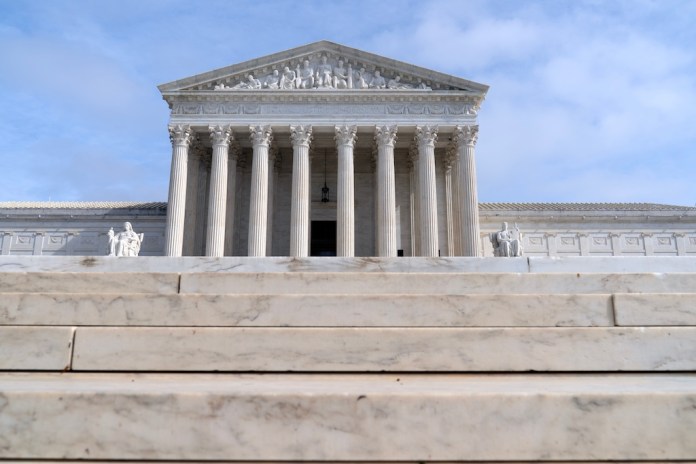
The Supreme Court convenes Monday at 10:00 a.m.
" Conservative News Daily does not always share or support the views and opinions expressed here; they are just those of the writer."
*As an Amazon Associate I earn from qualifying purchases