SCOTUS Appears Willing To Side With Trump In Asylum Dispute
The U.S. Supreme Court heard arguments in the asylum case *Urias-Orellana v. Bondi*, involving Salvadoran national Humberto Urias-Orellana, who entered the U.S. illegally after fleeing violence in El Salvador. He sought asylum and protection under the UN Convention Against Torture, but his claims were denied by an immigration judge and the Board of Immigration Appeals (BIA) on grounds that his experiences did not legally constitute persecution. Urias-Orellana appealed to the Supreme Court, challenging whether federal appellate courts must defer to the BIA’s judgment on what qualifies as persecution under the Immigration and Nationality Act (INA).
Plaintiff’s attorney argued that determining persecution is a legal question subject to de novo review by courts, not just factual findings reserved for immigration judges or the BIA. Justices expressed skepticism, noting that credibility and fact assessments typically fall under the agency’s purview.Several justices questioned whether the case involves mainly factual or legal determinations and whether courts shoudl defer to the agency’s expertise. The case touches on the legal standards for asylum eligibility and how much judicial review is appropriate regarding agency decisions on persecution claims.
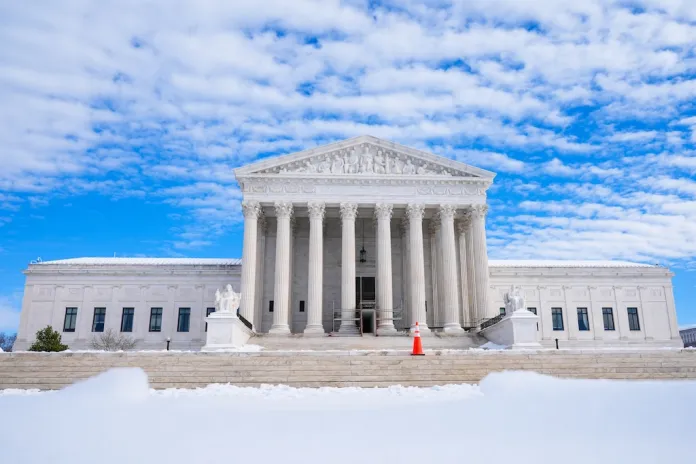
The U.S. Supreme Court appeared favorable to the Trump administration’s position in a high-profile asylum-related case before the bench on Monday.
During the roughly hour-long hearing, the justices heard arguments in Urias-Orellana v. Bondi. The case centers around Salvadoran national Humberto Urias-Orellana, who fled his home country and illegally entered the United States with his family in 2021 after reportedly enduring targeted violence in El Salvador.
As summarized by Oyez, upon entering America, the illegal alien and his family were charged by the Department of Homeland Security “with removability for illegal entry,” which prompted them to apply for asylum “based on persecution of their family group.” Urias-Orellana also sought “protection” under the United Nations’ “Convention Against Torture” (CAT) doctrine.
His applications were rejected by an immigration judge, who concluded that his claims did not meet the standard of what constitutes as persecution, and his “CAT claim failed because he did not report his harassment to the police and did not demonstrate that doing so would be futile,” Justia summarized.
The ruling was later upheld by the Board of Immigration Appeals (BIA), which prompted plaintiffs to appeal to the First Circuit Court of Appeals for review.
The appellate court’s rejection of the petition led Urias-Orellana to appeal to SCOTUS, in which he asked the high court to address the question of “whether a federal court of appeals must defer to the BIA’s judgment that a given set of undisputed facts does not demonstrate mistreatment severe enough to constitute ‘persecution’” under the Immigration and Nationality Act (INA).
In his opening remarks, plaintiffs’ attorney Nicholas Rosellini contended that “deciding whether undisputed facts qualify as persecution under the law involves legal interpretation, not fact finding,” — “Even the BIA agrees,” he added — and therefore, cases such as Urias-Orellana’s are eligible for review by federal appellate courts.
The BIA “treats the issue as a question of law subject to de novo review. That should not change when a case reaches federal court,” Rosellini said. “Under both the INA’s text and [existing precedent], courts should decide for themselves whether undisputed facts establish persecution under the law.[[Federal law]explicitly provides for legal deference on closely related issues but not this one. And decades of experience confirms that courts perform crucial legal work in applying the INA’s persecution standard. Deference to the BIA is unwarranted.”
While discussing a past Supreme Court case (INS v. Elias-Zacarias) dealing with asylum and the standard of “persecution” with Rosellini, Associate Justice Sonia Sotomayor noted that “the question is, did [Urias-Orellana] have a fear for his life?” She further asked how the Salvadoran national and his family’s circumstances are “any different from what happened in Elias-Zacarias,” in which the court held that a guerilla organization’s efforts to coerce an asylum seeker “into performing military service does not necessarily constitute ‘persecution on account of … political opinion’ under … the Immigration and Nationality Act.”
Rosellini argued that Sotomayor’s question is not what’s at issue in this matter and contended that “this is a past persecution case.”
“Under the INA, a noncitizen is presumptively eligible for asylum if they have suffered persecution in the past. It’s not this forward-looking inquiry about whether they have a well-founded fear of persecution going forward. That’s a different kind of inquiry … It involves the calculation of a future probability. And so, the case for substantial evidence review would be much stronger there,” Rosellini said. “But here … the facts of what happened to my client are undisputed. The immigration judge took his testimony as credible and true, and found that the death threats he experienced were indeed credible and menacing but nevertheless held that, under the law, they did not rise to the level of persecution.”
That response prompted pushback from Chief Justice John Roberts, who noted that, in his answer, Rosellini acknowledged that the case “involved credibility findings … the sort of findings that we typically leave to a district court or another fact finder involving credibility, weighing of facts, and all that sort of thing, to reach a particular determination.”
“It seems to me a prototypical case for the BIA,” Roberts added.
Associate Justices Ketanji Brown Jackson and Elena Kagan also appeared skeptical of Rosellini’s arguments.
In her line of questioning, Jackson probed Urias-Orellana’s attorney about “why the [INA] doesn’t prescribe the standard of review in this [particular] situation.” She further noted that, from her understanding, “the agency … determined that your client was not eligible for admission because he had not satisfied the requirements for asylum,” and that, the INA “tells us what the standard of review is supposed to be.”
Meanwhile, Kagan questioned Rosellini about why this should be considered a “primarily legal” matter for the federal appellate courts rather than a factual one reserved for immigration judges and the BIA. In discussing the standard of persecution, she noted how “what’s going to happen in this case is we’re going to have to look at all this evidence, all these facts, and decide whether these threats were indeed that level of menacing, and that sounds like really weighing evidence to me. That sounds really factual.”
Citing Kagan’s questioning, Associate Justice Samuel Alito similarly probed Rosellini about the factual v. legal argument. He specifically asked, “You may have a set of historical facts that are undisputed, but determining whether they add up, whether the totality of those facts satisfies that standard sure looks to me like primarily a factual question. Why is it not?”
“Because, when courts make that decision, they are building out a decision — a body of decisional law that guides future cases. If you look at the First Circuit’s decision in this case, the [immigration judge’s] decision in this case, they are analogizing to cases that came before,” Rosellini said.
“But that would be true in a vast majority of situations. Do you think the determination of whether — of negligence — is a legal standard?” Alito asked, to which Rosellini replied, “No, Your Honor. We would agree that negligence would be something that’s reviewed deferentially.”
Associate Justices Neil Gorsuch and Brett Kavanaugh similarly appeared skeptical of Rosellini’s arguments. Associate Justice Clarence Thomas asked Rosellini one question about SCOTUS’ deferential handling of Elias-Zacarias and how Urias-Orellana’s persecution case differs from that.
Associate Justice Amy Coney Barrett did not ask any questions of either party during the hearing.
Shawn Fleetwood is a staff writer for The Federalist and a graduate of the University of Mary Washington. He previously served as a state content writer for Convention of States Action and his work has been featured in numerous outlets, including RealClearPolitics, RealClearHealth, and Conservative Review. Follow him on Twitter @ShawnFleetwood
" Conservative News Daily does not always share or support the views and opinions expressed here; they are just those of the writer."
*As an Amazon Associate I earn from qualifying purchases