Roberts More Upset About Trump Criticism Than Judges Earning It
Deprecated: str_getcsv(): the $escape parameter must be provided as its default value will change in /var/www/html/breaking-news/wp-content/plugins/wp-auto-affiliate-links/aal_engine.php on line 361
The piece centers on Chief Justice John Roberts’ remarks about hostility toward federal judges and the broader debate over threats to the judiciary. It notes Roberts acknowledged that criticism of judges can be healthy, but he warned that personally directed hostility is dangerous and must stop.The author suggests Roberts’ comments indirectly rebuke Donald Trump, given the president’s recent criticisms of lower-court judges.
The article argues that the real issue is not ordinary critique but judges acting with partisan aims, describing this as a “judicial coup” by some lower courts that issue broad injunctions to block the president’s agenda. it contends that such actions undermine the separation of powers and the rule of law.
The piece also asserts that actual threats against the judiciary have largely come from the political left,citing examples like Senate Leader Chuck Schumer’s 2020 remarks toward Supreme Court justices,protests at the homes of conservative justices,and threats against Justices Kavanaugh and Barrett,among others. It contrasts this with claims of conservative critics who argue left-leaning judges are acting as activists.
Ultimately, the author argues that while Roberts’ instinct to defend judges is understandable, the greater danger to judicial legitimacy is the judiciary’s own behavior when it abandons sound jurisprudence for partisan ends.It quotes Judge James Ho warning that the public won’t follow a judiciary that doesn’t stay in its lane. The piece is by Shawn Fleetwood of The Federalist.
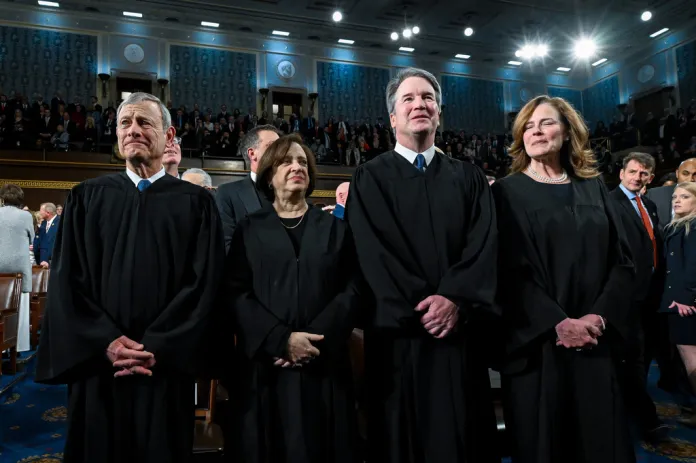
Supreme Court Chief Justice John Roberts is back in the news after publicly commenting on “hostility” toward federal judges.
The remarks came on Tuesday when the chief justice was interviewed by Senior District Judge Lee Rosenthal at a Rice University event. During her line of questioning, Rosenthal noted Roberts’ past acknowledgement that public criticism “comes with the territory” of being a judge. She then asked him how he handles such critiques of the Supreme Court or his judicial opinions.
The Bush 43 appointee began his answer by recognizing that judges aren’t “flawless” and that criticisms of their work “can very much be healthy.” What’s garnering attention is the next part in which he said that “the problem” that occasionally arises is when “the criticism … move[s] from a focus on legal analysis to personalities.”
“You see, from all over … [there’s] not just any one political perspective on it, that it’s more directed in a personal way, and that, frankly, can be actually quite dangerous,” Roberts said. “Judges around the country work very hard to get it right, and if they don’t, their opinions are subject to criticism. But personally directed hostility is dangerous, and it’s got to stop.”
Chief Justice John Roberts amid President Trump’s criticism of judges: “Personally directed hostility is dangerous and it’s got to stop.” pic.twitter.com/Etrm1fe86B
— CSPAN (@cspan) March 17, 2026
While Roberts went out of his way to “both sides” his comments, and neither he nor Rosenthal mentioned him by name, it’s hard not to see the chief justice’s remarks as a partial rebuke to Donald Trump.
Since returning to office, the 47th president has regularly condemned activist lower-court judges issuing overreaching blocks on his policies. (His previous call to impeach Obama-appointed D.C. District Judge James Boasberg for his outrageous conduct on the bench prompted pushback from Roberts last year.)
While Roberts may believe that his latest defense of judges is in the judiciary’s best interest, the chief justice is completely missing the forest for the trees.
The primary reason there’s even a discussion about criticisms of judges is that too many of them have chosen to make decisions based on partisan objectives rather than what the Constitution and law call for. Put another way, it’s a pseudo-event that these judicial activists created themselves.
More to the point, if anyone has been evoking “personally directed hostility” in these disputes, it’s the rogue judges allowing their clear animus toward Trump to steer the outcome of cases before them.
Not a week seems to go by without one of these judges issuing a far-reaching injunction on behalf of left-wing activists attempting to stop the president’s policy agenda. Unsurprisingly, many of their orders come with little sound legal reasoning, contain partisan digs at the president, and run afoul of the Supreme Court’s guidance and (most importantly) the Constitution.
Taken collectively, such actions have spawned a nationwide judicial coup, in which lower court judges have usurped separation of powers by indiscriminately policing the actions of the other branches.
Roberts’ point about “personally directed hostility” toward judges does hold some weight, however. It’s just not as cut and dry as he makes it out to be.
Many of the actual threats against the judiciary have overwhelmingly come from the American left.
It was Senate Minority Leader Chuck Schumer who took to the Supreme Court’s steps in 2020 to ominously warn Justices Neil Gorsuch and Brett Kavanaugh that they would “pay the price” and “won’t know what hit [them]” if they didn’t rule on an abortion-related case the way he wanted — a move which Roberts (to his credit) rebuked. It was left-wing activists who showed up to the homes of the Supreme Court’s conservative justices to intimidate them into upholding Roe v. Wade after its 2022 Dobbs draft decision overturning Roe was leaked. It was a left-wing nutjob who tried to assassinate Kavanaugh at his home where he lives with his wife and daughters. It was a radical pro-abortion group that encouraged its members to target Justice Amy Coney Barrett’s church and children.
These kinds of egregious threats have continued to persist years after Dobbs‘ release.
Late last year, a Michigan Democrat Senate candidate fantasized at a campaign stop about hurling beers at Kavanaugh and Barrett if given the chance. And just last month, Justice Clarence Thomas was forced to deliver remarks at an American University event virtually after a reported “security threat” jeopardized his and attendees’ safety.
The list goes on and on.
Whereas the left openly embraces threats against conservative judges for the crime of acting like judges, the right criticizes leftist judges for acting like activists.
Which brings us back to Roberts and rogue judges.
It’s understandable why Roberts instinctively wants to defend judges against what he perceives as unfair and “personal” criticisms. He’s an institutionalist, and as chief justice, views it as his responsibility to stand up for the judiciary’s credibility and its members.
But the fact remains that the greatest danger to the judicial branch’s credibility today isn’t coming from right-wing critics. It’s coming from the judiciary itself. When judges abandon proper jurisprudence to achieve partisan outcomes, people lose faith in the judiciary to operate as a trustworthy branch of government.
Fifth Circuit Judge James Ho all but predicted as much in a recent law review article. Acknowledging America’s ongoing judicial crisis, he wrote, “If the American people can’t expect the judiciary to stay in its lane, then federal judges shouldn’t expect the American people to follow them.”
Given their reliance on others to enforce their judgments, judges would be wise to heed that advice.
Shawn Fleetwood is a staff writer for The Federalist and a graduate of the University of Mary Washington. He is a co-recipient of the 2025 Dao Prize for Excellence in Investigative Journalism. His work has been featured in numerous outlets, including RealClearPolitics and RealClearHealth. Follow him on Twitter @ShawnFleetwood
" Conservative News Daily does not always share or support the views and opinions expressed here; they are just those of the writer."
*As an Amazon Associate I earn from qualifying purchases