Mexican president rejects US striking drug cartels
Deprecated: str_getcsv(): the $escape parameter must be provided as its default value will change in /var/www/html/breaking-news/wp-content/plugins/wp-auto-affiliate-links/aal_engine.php on line 361
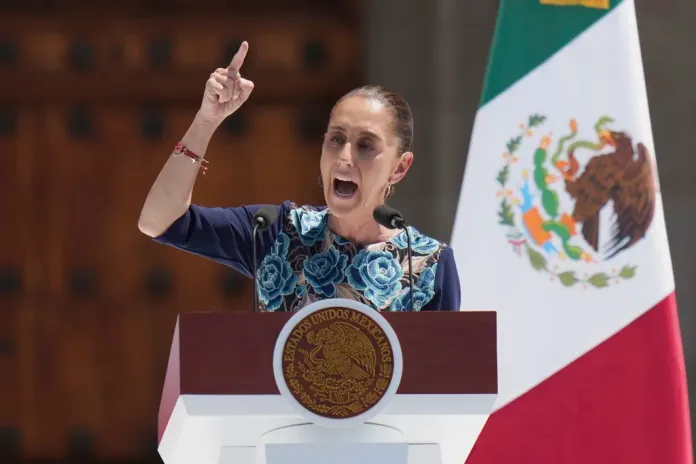
Mexican President Claudia Sheinbaum has firmly rejected calls for U.S. military intervention against drug cartels in Mexico, despite mounting civil unrest and violent protests demanding stronger goverment action on organized crime. Speaking in response to former U.S. President Donald TrumpS recent remarks that he would support “strikes in Mexico” to combat drug trafficking, Sheinbaum emphasized Mexico’s sovereignty and recalled historical conflicts, stating such foreign intervention “is not going to happen.”
amid escalating violence and widespread protests, mostly involving young demonstrators frustrated by corruption and government inaction toward powerful cartels, clashes between protesters and riot police have resulted in numerous injuries and arrests.sheinbaum accused “far-right” extremists of infiltrating the movement to exacerbate unrest and has called for investigations into possible manipulation via social media bots.
The protests in Mexico reflect a broader pattern of youth-led, social media-organized movements worldwide, often identified by shared symbols like the pirate flag from the Japanese manga “One Piece.” While similar demonstrations have led to governmental changes in countries such as Nepal and Madagascar, some movements, like a recent uprising in Morocco, have been suppressed with mass arrests.
the situation highlights Mexico’s ongoing struggle with violent crime and the limits of foreign involvement, as tensions rise between public demands for security and the government’s firm stance against external military intervention.
Mexican president rejects US striking drug cartels despite riots over violent crime
The president of Mexico is warning against U.S.-led strikes on drug cartels, despite civil unrest in her country demanding action against the gangs.
Mexican President Claudia Sheinbaum on Tuesday rebuffed President Donald Trump’s Monday remarks from the Oval Office in which he said he would be OK with “whatever we have to do to stop drugs” — including “strikes in Mexico.”
“It’s not going to happen,” Sheinbaum said at a press conference on Tuesday. Trump “has suggested on several occasions or has said, ‘We offer you a United States military intervention in Mexico or whatever you need to combat criminal groups.’”
“We are not going to ask for it because we do not want intervention from any foreign government,” she added, explaining her belief that such an arrangement would jeopardize Mexico’s sovereignty.
“The last time the United States came to intervene in Mexico, they took half of the territory,” she said, referencing the Mexican-American War in the 19th century.
However, Sheinbaum is facing intense pressure domestically to deal with the issue of organized crime after disgruntled youths launched massive protests against her government over the weekend.
Thousands of demonstrators took to the streets in Mexico to protest government corruption and mismanagement of the country, mirroring similar Gen Z protest movements in far-flung countries such as Nepal, Bangladesh, and Madagascar.
A key component of their discontent was perceived inaction to curb violent crime and drug cartels that wield immense political power behind the scenes of Mexican politics.
The largest demonstration in Mexico City saw protesters clash with squads of Mexican riot police, leaving 100 officers injured. Approximately 40 of them reportedly required admission to the hospital, and approximately 20 protesters are believed to have been similarly injured.
At least 18 demonstrators have been arrested since the violent protest this weekend, with approximately three indicted on attempted murder charges.
“The 18 people have been taken into custody for various crimes — in very specific cases for attempted homicide, resisting arrest, and robbery, and in the remaining cases for injuries of different degrees,” Mexico City Attorney General Bertha María Alcalde Luján said.
Sheinbaum blamed the violence on “far-right” extremists who she claims infiltrated the movement and used it as an avenue for political gain. She has ordered an investigation into the social media ecosystem that spawned the movement, claiming that “bots” might be involved.
Former President Vicente Fox, a conservative politician ideologically at odds with Sheinbaum, was among the most high-profile supporters of the protests. He repeatedly posted words of encouragement to demonstrators via social media over the course of the conflict.
“Peace is not when everyone is silent, but when no one is afraid to speak,” Fox wrote in a message of support on Sunday.
The civil unrest did not go unnoticed by the White House.
Among Trump’s remarks at the Oval Office on Monday was a condemnation of the disarray in Mexico City and his ongoing frustrations with the nation’s government.
“I looked at Mexico City over the weekend,” Trump said. “There’s some big problems there. Let me just put it this way: I am not happy with Mexico.”
Mexico City’s unrest is only the latest example of worldwide Gen Z protests — a growing trend of youth revolts in developing nations organized via the internet.
The individual protest movements do not have formal connections with one another regarding organization or goals, but share imagery and mobilization tactics.
Gen Z demonstrations are immediately identifiable by the use of pop culture markers such as a modified pirate flag from One Piece, the bestselling Japanese manga series.
The flag is flown by the series’ main characters, a band of pirates known as the “Straw Hats.” That symbol, a skull and crossbones donned with either its standard straw hat or alternative headwear, is becoming increasingly prominent at protests around the world.
These protests, organized online and utilizing social media to coordinate action, have already toppled governments in Nepal, Madagascar, Sri Lanka, and Bangladesh.
Not all Gen Z protests have proven successful, however — youth-led demonstrations that exploded in Morocco last month were summarily quashed by government authorities.
HOUSE REPUBLICAN DEMANDS TRUMP ADMINISTRATION DROP MEXICO NEGOTIATIONS OVER NARCO-COMMUNIST TIES
Thousands of activists were arrested on charges of assault, incitement to commit crimes, and “rebellion as part of a group.”
While many were released from police custody following their arrest, over 2,000 are believed to be facing charges.
" Conservative News Daily does not always share or support the views and opinions expressed here; they are just those of the writer."
*As an Amazon Associate I earn from qualifying purchases