America’s 250th Anniversary Must Honor Our First American
Deprecated: str_getcsv(): the $escape parameter must be provided as its default value will change in /var/www/html/breaking-news/wp-content/plugins/wp-auto-affiliate-links/aal_engine.php on line 361
The article argues that the United States’ 250th anniversary in 2026 should especially honour George Washington,whose leadership during the pivotal year of 1776 helped secure independence. It reviews key events of that year-the british evacuation of Boston, the defeat at Long Island, and the New Jersey counterattacks-and emphasizes Washington’s character, sense of duty, and resilience from his appointment as commander through the Boston siege. The piece highlights his measured conduct with troops, his respectful correspondence with poet Phillis Wheatley, and his ability to hold the army together despite setbacks and criticism. Even tho Washington made strategic mistakes and faced defeats in New York, the article credits his steady leadership, orderly retreats, and daring actions-most notably the Delaware crossing and victories at Trenton and Princeton-with turning the war’s tide. Drawing on David McCullough’s account, it contends Washington’s persistence and lessons learned from experience were decisive in winning independence. The author concludes that, among the founders, Washington remains preeminent and should be central to semiquincentennial commemorations.
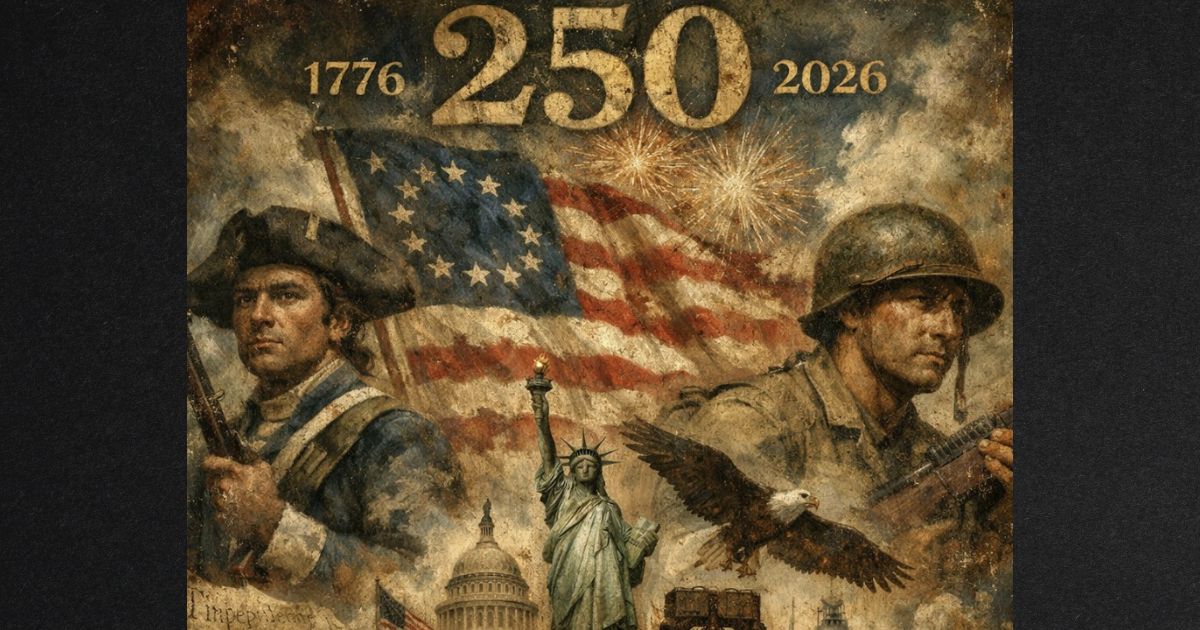
Next year marks the much anticipated semiquincentennial celebration of our nation’s founding, when 56 delegates to the Second Continental Congress unanimously adopted the Declaration of Independence, severing themselves from the British Crown to form a new body politic. Certainly the Fourth of July will, rightly, serve as the high watermark of our national festivities.
But in truth it was not simply the signing of that document that makes 250 years such a significant memorial, but everything that transpired in that fateful year: the British evacuation of Boston in March; the Americans’ disastrous defeat at the Battle of Long Island in August; the American counterattack in New Jersey in December. And as Pulitzer Prize-winning author David McCullough’s best-selling book 1776 records, no figure looms larger in all of these events than George Washington. As much as 2026 is America’s year, we would do well to remember that it is so in large part because of that one remarkable hero.
A Man of Unequaled Character and Calling
A Virginia planter and veteran of the French & Indian War, Washington in the summer of 1775 assumed leadership of the Continental Army, a position he told his wife Martha he had “used every endeavor” in his power to avoid. Yet he was a man of duty, and also someone who recognized that his previous military experience and leadership abilities made him ideally suited to command a “volunteer force of farmers and tradesmen” pitted against the “best-trained, best-equipped, most formidable force on earth,” as McCullough writes. As Washington admitted privately, he knew the eyes of the whole continent were on him, “fixed with anxious expectation.”
During the siege of Boston, the tremendous leadership qualities and virtuous character of George Washington emerged. In January of 1776 he wrote in private correspondence that he often thought how much happier he would have been if he had simply entered the ranks of common soldiers instead of accepting command, or even to retreat into the back country beyond the reach of the British. Nevertheless, he wrote: “If I shall be able to rise superior to these, and many other difficulties which might be enumerated, I shall most religiously believe that the finger of Providence is in it, to blind the eyes of our enemies; for surely if we get well through this month, it must be for want of their knowing the disadvantages we labor under.”
Contra recent woke narratives that have sought to undermine Washington’s reputation, it was also at Boston that he charitably corresponded with the black, Providence-based poet Phillis Wheatley, whose poem about the general read: “Proceed, great chief, with virtue on thy side / Thy every action let the goddess guide.” In response, Washington wrote: “I thank you most sincerely for your polite notice of me and however undeserving I may be of such encomium and panegyrick, the style and manner exhibit a striking proof of your great poetical talents.” He welcomed Wheatley to pay him a visit at his headquarters in Cambridge, Massachusetts.
To his men, Washington evinced a clarity of mind and resilience that held the fledgling army together. While at Boston, he urged fellow General Schuyler to persevere: “We must bear up against them [our troubles], and make the best of mankind as they are, since we cannot have them as we wish.” After the British abandoned the city in March, the general humbly entered Boston without fanfare, knowing this was but one moment in a likely bloody, protracted conflict.
Holding Steady Amidst Repeated Failure
Following the British evacuation of Boston, attention turned to New York City, the largest city in the colonies. Washington arrived there in time to fortify his positions before a much larger British army arrived, now supported by hundreds of ships of the greatest navy on the face of the earth. As the British closed in on Patriot forces in New York, Washington maintained a remarkable degree of stoicism before his men. He urged his troops to be “cool but determined.”
Yet the New York Campaign was in fact an unmitigated disaster. Military historians agree that during his first command on a large field of battle at the Battle of Brooklyn, later known as the Battle of Long Island, Washington was both indecisive and inept. At the subsequent British landing at Kips Bay, he expressed his disgust at his fleeing soldiers, throwing his hat on the ground and bemoaning, “Are these the men with which I am to defend America?” In a rage, he rode to within a hundred yards of the enemy, and had to be forcibly removed by two of his aides.
Yet Washington otherwise kept his head and conducted a secret orderly retreat that deceived the British and saved the American army from disaster. Indeed, one officer claimed he saw Washington on the ferry stairs at New York staying until the very end of the army’s withdrawal. As the army retreated across New Jersey, an eighteen-year-old Virginia lieutenant named James Monroe (later to be president) wrote: “I saw him… at the head of a small band, or rather in its rear, for he was always near the enemy, and his countenance and manner made an impression on me which I can never efface…. A deportment so firm, so dignified, but yet so modest and composed, I have never seen in any other person.” As Washington himself understood about Americans, “a people unused to restraint must be led, they will not be drove.”
A Courage That Turned the Tide
After the evacuation of New York, the British believed the Americans had been whipped, and that surrender was imminent — Congress shortly thereafter fled Philadelphia, and two former members of Congress joined the British. Washington even accidentally discovered that his close confidante Joseph Reed and fellow American general Charles Lee both believed he was not up to the task. (As another mark of his superior virtue, Washington never upbraided Reed about what he discovered in private correspondence, and seems to have immediately forgiven him.) “By all reasonable signs, the war was over and the Americans had lost,” writes McCullough.
Yet, amazingly, Washington appeared to draw upon untapped wells of energy and determination from such adversities. “His Excellency George Washington,” later wrote General Nathanael Greene, “never appeared to so much advantage as in the house of distress.” What followed in the final months of 1776 is now an integral part of American lore: the Christmas crossing of the Delaware, the victories at Trenton and Princeton, and Washington’s successful pleading with his tiny army to stay on past their commissions into 1777.
McCullough says that it was Washington and his army that won the war for American independence. “He was not a brilliant strategist or tactician, not a gifted orator, not an intellectual. At several crucial moments he had shown marked indecisiveness. He had made serious mistakes in judgment. But experience had been his great teacher from boyhood, and in this his greatest test, he learned steadily from experience. Above all, Washington never forgot what was at stake and he never gave up.” Without Washington, there would be no America.
There are many things to celebrate during our nation’s semiquincentennial celebrations, and many men to honor for their part in our country’s birth: Thomas Jefferson, John Adams, Alexander Hamilton, Benjamin Franklin, and John Hancock among them. But no one looms larger than George Washington, who today seems almost mythical. At Washington’s funeral, Henry “Light-Horse Harry” Lee famously eulogized Washington as, “first in war, first in peace, and first in the hearts of his countrymen.” In 2026, it is our duty to ensure that honorific remains as true as when it was first spoken.
Casey Chalk is a senior contributor at The Federalist and an editor and columnist at The New Oxford Review. He is a regular contributor at many publications and the author of three books, including the upcoming “Wisdom From the Cross: How Jesus’ Seven Last Words Teach Us How to Live (and Die)” (Sophia Institute Press, 2026).
" Conservative News Daily does not always share or support the views and opinions expressed here; they are just those of the writer."
*As an Amazon Associate I earn from qualifying purchases